Table of Contents
- Why Commercial Christmas Lighting Matters for Retail
- Commercial Grade LED Christmas Lights vs. Retail-Grade Options
- Holiday Lighting Safety Regulations for Businesses
- Retail Storefront Holiday Lighting Ideas That Drive Results
- Technical Specifications: What Retail Managers Need to Know
- Maintenance and Storage Protocols for Year-Round Performance
- ROI and Energy Cost Analysis for Commercial Displays
- Professional Installation vs. DIY: Making the Right Choice
- Frequently Asked Questions
Why Commercial Christmas Lighting Matters for Retail
A well-executed commercial christmas lighting display creates immediate curb appeal, draws foot traffic, and signals that your business is thriving. This is a strategic investment in how customers perceive your brand during the year’s most profitable season.
Retail managers face a specific challenge: lighting must be professional enough to reflect your brand, durable enough to survive weather and frequent operation, and efficient enough not to spike energy costs. Generic retail-grade lights fail quickly under commercial use, they flicker, burn out unevenly, and leave gaps in displays midway through December. Commercial-grade systems solve this by design.
At Houston Light, we’ve installed Commercial Holiday Lighting for retail stores across the region for over a decade. This guide covers the technical and practical decisions every retail manager should make before the holiday season arrives.
Start your lighting planning in September, not November. Sourcing commercial-grade components, scheduling installation, and testing systems takes time. Last-minute orders often mean compromised availability and rushed installations.
Commercial Grade LED Christmas Lights vs. Retail-Grade Options
The difference between commercial-grade and retail-grade lighting comes down to component durability, electrical engineering, and long-term reliability. Retail-grade lights are designed for occasional home use. Commercial-grade systems are engineered for continuous operation, full weather exposure, and multiple seasons of use.
LED Technology and Energy Efficiency
LED lights consume 75-80% less energy than incandescent alternatives (energy.gov). A commercial display running 240 hours per month on incandescent costs significantly more in electricity than the same display on LED. Over a season, that difference compounds substantially.
Commercial-grade LEDs use full-wave rectification instead of the half-wave rectified circuits found in cheaper retail lights. Full-wave rectification produces steadier light output with minimal flicker. Retail-grade LEDs often create visible flicker that becomes more noticeable as bulbs age or when multiple strands are connected in series.
Color consistency matters for storefront displays. Commercial LED strings maintain color temperature across their entire lifespan. Retail-grade LEDs shift color as they age, warm white gradually becomes yellow-white, and multi-color displays lose saturation.
Durability and Weather Resistance Standards
Commercial-grade lighting meets IP65 or higher weatherproofing standards, dust-tight and protected against water jets from any direction (iec.ch). Retail-grade lights typically meet IP44 standards at best, which protects against splashing water but not sustained exposure. The difference shows up in December: retail-grade connections corrode, sockets fill with moisture, and bulbs fail in clusters.
UL-certified commercial lighting has been tested for electrical safety under real-world conditions. The certification verifies that the product won’t create fire hazards, that connections are secure under temperature cycling, and that power distribution can handle actual current draw without overheating.
Commercial-grade systems use thicker gauge wire, better insulation, and solder connections instead of crimp connections. Solder joints remain stable across hundreds of thermal cycles, while crimp connections fail under repeated expansion and contraction.
Never mix retail-grade and commercial-grade strands on the same circuit. The lower voltage tolerance of retail-grade lights creates voltage drop issues when connected to commercial systems, leading to uneven brightness and premature failure.
Holiday Lighting Safety Regulations for Businesses
Retail properties are subject to electrical and fire safety codes that don’t apply to residential installations. Your liability exposure is higher, and your installation must meet specific standards.
UL Certification and Electrical Compliance
UL certification is not optional for commercial installations, it’s the baseline that insurers, building inspectors, and code officials expect. UL 588 is the standard for seasonal and holiday lighting (ulprospector.com). It covers electrical safety, fire resistance, and durability under actual conditions.
Verify that every component carries UL certification, including light strings, extension cords, connectors, and distribution boxes. A single uncertified component can void your insurance coverage if an incident occurs.
Amperage capacity is critical. Each circuit has a maximum amperage rating. Commercial LED strings draw less current than incandescent, but total load across all connected strands can quickly exceed capacity. Exceeding capacity creates heat, which degrades insulation and increases fire risk. Professional installation includes load calculations that ensure no circuit is overloaded.
Installation Safety and Liability Coverage
Professional installation with insured labor protects you in two ways: the work is done correctly, and you have documentation of proper installation if a problem occurs later. Insured labor means the contractor carries general liability coverage that protects you if someone is injured during installation or if the installation causes property damage.
Working at height is inherent in retail storefront lighting. Professional installers have equipment, training, and insurance to work safely. A fall or injury during DIY installation could create liability extending far beyond the cost of the lights themselves.
Retail Storefront Holiday Lighting Ideas That Drive Results
Professional displays combine color, layering, and focal points to create visual hierarchy. Facade and accent lighting uses warm white (2700K) or cool white (5000K) to highlight architectural features. Warm white creates a welcoming, traditional feel and works well for brick or wood storefronts. Cool white emphasizes modern architecture and works better for glass or metal facades.
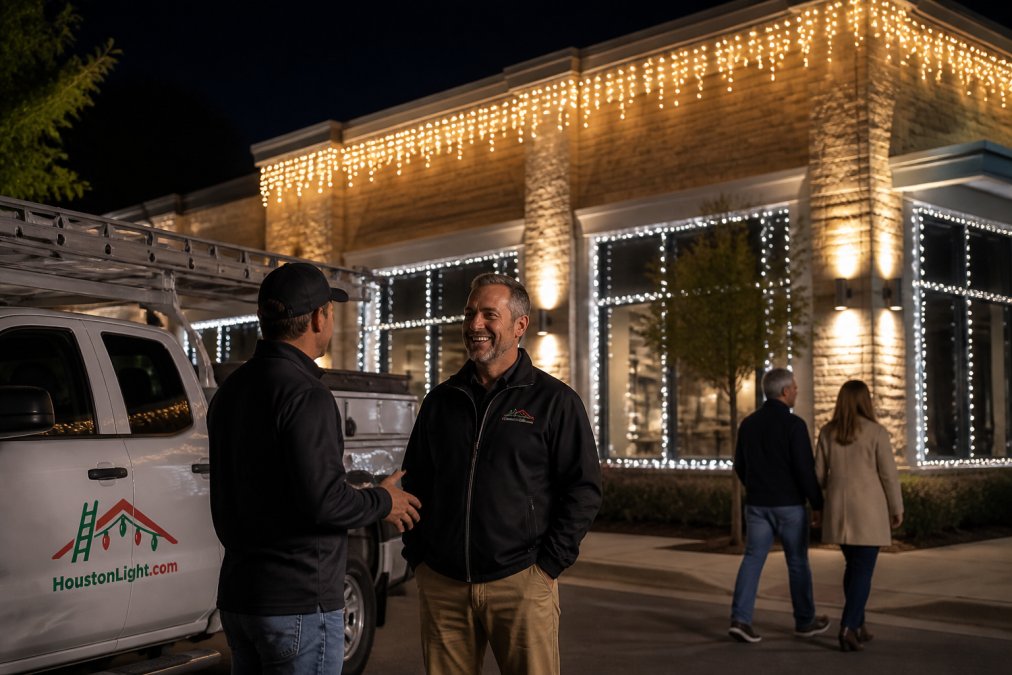
Layering means combining multiple types of light sources. A storefront might use warm white icicle lights along the roofline, cool white mini lights in windows, and accent uplighting on architectural details. This creates depth and prevents the display from looking flat.
3D Displays and Window Installations
3D displays, oversized ornaments, sculptural light-filled shapes, or animated sequences, create memorable focal points that draw attention from the street. Window installations combine lighting with merchandise displays. Backlit window displays with warm white or color-changing LED strings create visual interest while showcasing products.
Connectable strands allow you to expand displays without running additional circuits. Commercial-grade connectable systems maintain consistent voltage across multiple connections, preventing the brightness drop that occurs when retail-grade strands are daisy-chained. retail store security.
Technical Specifications: What Retail Managers Need to Know
Understanding the technical side prevents costly mistakes and ensures your display performs as expected throughout the season.
Light Bulb Types: C6, C7, and C9 Options
C6 lights are small, about the size of a fingertip, and produce approximately 0.5 watts per bulb. They’re ideal for dense, detailed displays. C7 lights are medium-sized and draw about 0.8 watts per bulb. They’re the most versatile option for general storefront use and available in nearly every color combination. C9 lights are large, roughly the size of a golf ball, and draw about 1.2 watts per bulb. They’re visible from a distance and create bold visual statements.
The choice depends on your display goals and available circuit capacity. A display using C9 lights might require more circuits than the same installation using C7 lights, increasing installation complexity and cost.
Voltage Drop, Amperage, and Power Distribution
Voltage drop occurs when current travels long distances through wire. As distance increases, resistance increases, and voltage at the far end of the strand drops below the voltage at the source. This causes lights at the end of a long run to be noticeably dimmer.
Commercial-grade systems address voltage drop by using thicker gauge wire and limiting the number of strands that can be connected in series. A typical commercial C7 string allows 15-20 additional strands to be connected before voltage drop becomes visible. Retail-grade strings often limit connections to 3-4 strands.
Amperage capacity determines how many lights you can run on a single circuit. A 15-amp circuit can safely handle about 1,440 watts of continuous load. That’s roughly 1,800 C7 LED bulbs. Professional installers calculate total amperage draw across all connected strands and distribute the load across multiple circuits to stay within safe limits.
Power distribution boxes allow you to manage multiple circuits from a single control point. A commercial-grade distribution box includes circuit breakers, surge protection, and timer connections. This prevents overloads, protects equipment from electrical surges, and allows you to schedule when lights turn on and off without manual intervention.
Installation Hardware and Connectable Strands
Light clips secure strands to roof edges, gutters, or building features without damaging the structure. Commercial-grade clips distribute pressure across a wider area than retail-grade alternatives, preventing stress fractures. They’re designed to be reusable across multiple seasons.
Mounting stakes hold ground-level displays in place. Commercial-grade stakes are heavier, use thicker metal, and penetrate deeper into soil, resisting wind displacement.
Connectable strands use standardized connectors that maintain consistent voltage and current across multiple connections. Commercial-grade connectors are sealed against moisture and designed for repeated connection and disconnection. Twist-lock connectors create a mechanical seal and are generally more reliable over multiple seasons.
The difference between a display that looks flawless in December and one that has dead sections or flickering lights comes down to connector design and voltage management. Invest in commercial-grade connectable strands to avoid mid-season failures.
Maintenance and Storage Protocols for Year-Round Performance
Inspect all components before installation each year. Look for damaged wire insulation, corroded connectors, or bulbs that don’t light. Replace any damaged components before installation.
Clean connectors and contact points with a dry cloth before connecting strands. Moisture or dust on connectors creates resistance, which generates heat and causes voltage drop.
Test each strand individually before connecting multiple strands in series. If a strand fails during testing, it’s easy to replace.
Store lights in a cool, dry location during off-season. Moisture damages connectors and insulation. A climate-controlled storage space is ideal, but a dry garage or storage room is acceptable.
Organize stored lights by type and location. Label each strand with its color, bulb type, and installation location. Coil strands loosely to avoid stressing the wire.
Document your installation each year with photos. Record which circuits power which displays, where strands are connected, and any issues that occurred during the season.
ROI and Energy Cost Analysis for Commercial Displays
The upfront cost of commercial christmas lighting for retail stores is higher than retail-grade alternatives, but the return on investment justifies the expense when you account for energy savings, longevity, and the value of a professional display.
A typical commercial storefront display using 5,000 LED C7 bulbs consumes about 6 kilowatts when fully lit. Running 8 hours daily for 45 days uses 2,160 kilowatt-hours. The same display using incandescent lights would consume roughly 30 kilowatts and cost significantly more for the season.
Replacement costs matter because commercial-grade systems last longer. A retail-grade display might require 30-40% bulb replacement annually. A commercial-grade display typically requires less than 10% replacement. Over a five-year lifespan, you’ll replace significantly fewer components.
A professional display attracts customers. Retail locations with professional holiday lighting report increased foot traffic during the season. A storefront that looks professional and well-maintained attracts customers, while one with flickering lights or dead sections signals neglect.
Commercial systems fail less frequently, reducing downtime and disruption to your operations.
Professional Installation vs. DIY: Making the Right Choice
Professional installation is the better choice for retail storefronts because the stakes are higher. Your storefront is visible to customers 24/7, and installation mistakes reflect on your brand. Professional installers have the expertise to design displays that work, the equipment to install safely at height, and the insurance to protect you if something goes wrong.
Professional installers bring design expertise. They understand how to layer lighting, balance color, and create visual hierarchy. They can recommend display strategies based on your building’s architecture and your brand’s aesthetic.
DIY installation makes sense only for small, ground-level displays on residential properties. For commercial storefronts, the complexity, safety considerations, and liability exposure make professional installation the prudent choice. If you’re interested in professional Holiday Decorating services for your retail location, professional teams can handle both the technical installation and the creative design elements that make displays memorable.
The difference in cost between professional and DIY is often smaller than it appears. DIY requires purchasing equipment you might not have and spending time troubleshooting problems that a professional would solve immediately. If something fails or causes damage, your insurance may deny coverage because the installation wasn’t performed by a licensed professional.
Houston Light handles commercial christmas lighting for retail stores with a systematic approach: we assess your property, design a display that matches your brand, source commercial-grade components, install everything safely, and provide documentation for your insurance. We offer free on-site consultations so you can understand your options before committing. A lifetime warranty on all installations means we stand behind our work.
The difference between a holiday display that attracts customers and one that looks neglected comes down to planning, quality components, and professional installation. Commercial-grade systems cost more upfront, but they deliver better results, last longer, and protect your brand reputation. Start your planning early, invest in quality components, and partner with professionals who understand the technical and aesthetic requirements of commercial retail displays.
Frequently Asked Questions
Q: What is the difference between commercial-grade and retail-grade Christmas lights?
A: Commercial-grade lights are engineered for durability, weather resistance, and extended operation hours. They feature UL certification, full-wave rectification for flicker-free performance, and connectable strands rated for high amperage loads. Retail-grade lights are designed for shorter seasonal use and residential applications. Commercial-grade components cost more upfront but deliver superior reliability, longer lifespan, and lower replacement costs over multiple seasons.
Q: What safety standards should commercial holiday lighting meet?
A: All commercial Christmas lighting must carry UL certification, indicating compliance with electrical safety standards. Outdoor installations require IP65 or higher weatherproofing ratings to protect against moisture and temperature fluctuations. Installations should meet local electrical codes and OSHA requirements for working at height. Professional installers carry liability insurance covering injury and property damage. Before installation, verify permits with your local building department, especially for large facade or rooftop displays.
Q: How can retail stores maintain energy efficiency with holiday displays?
A: LED lights consume 75-80% less energy than incandescent alternatives and generate minimal heat. Use timers to control operating hours, typically 6-10 hours daily during peak shopping periods. Ensure proper voltage distribution across long strands to prevent voltage drop, which wastes energy and reduces light output. Professional installers optimize power distribution by calculating amperage capacity and using appropriately sized spools and connectors.
Q: What are the latest trends in commercial Christmas lighting design?
A: Warm white and multi-color LED combinations dominate current retail displays. 3D installations, including oversized ornaments and dimensional facade lighting, create memorable curb appeal and drive foot traffic. Programmable color-changing systems allow stores to adapt displays for different promotions or holidays. Sustainable, energy-efficient designs appeal to environmentally conscious customers. Custom installations tailored to storefront architecture and brand identity outperform generic off-the-shelf displays in customer engagement and sales impact.
Q: How much does commercial Christmas lighting typically cost?
A: Pricing depends on storefront size, display complexity, bulb type selection, installation height, and seasonal timing. Factors include material costs, labor hours, equipment rental, and geographic location. Many providers offer tiered packages based on square footage and design scope. To get an accurate quote tailored to your specific retail property, schedule a free on-site consultation where designers can assess your storefront, discuss your vision, and provide transparent pricing based on your exact needs.
Q: Should I hire a professional installer or install commercial lighting myself?
A: Professional installation ensures compliance with electrical codes, proper voltage distribution, and safe working-at-height practices. Installers carry liability insurance protecting your business if accidents occur. DIY installation risks electrical hazards, incomplete coverage, and performance issues like voltage drop or flickering. Professional teams complete large displays efficiently before peak shopping season, minimizing business disruption. Professionals also provide maintenance support and warranty coverage. For retail storefronts, professional installation protects both your investment and your customers’ safety.
Q: What happens if lights fail during the holiday season?
A: Commercial-grade LED systems have high reliability rates due to full-wave rectification and durable components, but failures can occur. Professional installers typically provide maintenance support and rapid response for repairs. A lifetime warranty on materials and installation ensures replacements at no cost. Before the season starts, installers perform full system testing to identify weak points. Regular maintenance protocols, including post-installation inspections and pre-season checks, prevent most failures. Discuss maintenance response times and warranty coverage details during your initial consultation.