
Outdoor decorative lighting is one of the most effective tools for transforming a space after dark. Most people use only a fraction of its potential. Done right, it works in layers, each serving a distinct purpose. Get the layers wrong and you end up with either a flat, washed-out look or a chaotic mix of light sources that fight each other.
Ambient, Accent, and Task Lighting: The Three-Layer Framework
Outdoor decorative lighting works best when it follows a three-layer framework: ambient, accent, and task.
Ambient lighting is the foundational layer, the overall glow that defines the mood of a space. String lights overhead, wall-mount sconces flanking an entryway, or a lantern-style pendant above a covered patio all set the tone without directing attention anywhere specific.
Accent lighting creates visual hierarchy and depth. Landscape spotlights aimed at a mature oak tree, uplighting on architectural details, or low-voltage fixtures tracing hardscape edges make a property look professionally designed rather than simply illuminated.
Task lighting handles function: pathway illumination guiding guests safely, deck lighting bright enough to grill by, or motion-activated fixtures near a garage. Neglecting it creates real safety gaps.
The strongest outdoor living spaces use all three layers. A common mistake is investing heavily in accent lighting while skimping on ambient, which produces dramatic highlights against darkness, striking in photos, but uncomfortable to spend time in.
Color Temperature (Kelvin) Guide for Outdoor Spaces
Color temperature is measured in Kelvin (K) and determines whether a light source reads as warm, neutral, or cool. For outdoor decorative lighting, this single specification changes everything about how a space feels.
| Color Temperature | Kelvin Range | Best For |
|---|---|---|
| Warm white | 2700K – 3000K | String lights, patio ambiance, lanterns |
| Soft white | 3000K – 3500K | Pathway illumination, sconces, entryways |
| Cool white / neutral | 4000K – 5000K | Security lighting, task areas, driveways |
| Daylight | 5000K – 6500K | Commercial security, utility zones |
Most residential outdoor decorative lighting looks best in the 2700K to 3000K range, producing the warm, inviting glow associated with evening entertaining. Security and motion-sensor applications can go cooler, around 4000K to 5000K, without looking harsh.
A common error is mixing 2700K string lights with 5000K pathway fixtures on the same property. Stick within a 500K range across all decorative layers for visual coherence.
When shopping for LED fixtures, check the Kelvin rating on the packaging, not just the wattage. Two bulbs can have identical wattage but produce completely different moods depending on their color temperature.
Curb Appeal Lighting Ideas That Actually Work
The front of your property is the first thing visitors, neighbors, and potential buyers see. Outdoor decorative lighting that enhances curb appeal communicates care, quality, and attention to detail.
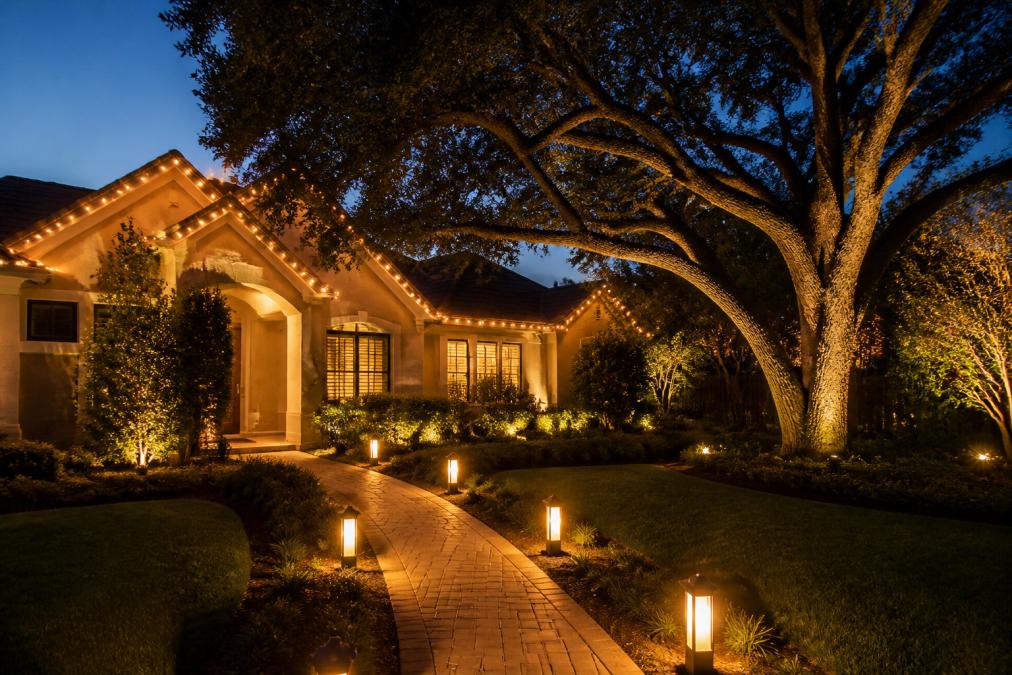
String Lights, Pathway Illumination, and Landscape Spotlights
String lights are the most versatile element in residential outdoor decorative lighting. Draped along rooflines, woven through pergola rafters, or suspended between posts above a patio, they create instant warmth and visual continuity. Use warm white (2700K to 3000K) LED string lights, they photograph well, last significantly longer than incandescent alternatives, and draw far less wattage.
Pathway illumination guides visitors safely and defines the visual edges of your landscape. Low-voltage fixtures spaced roughly 6 to 8 feet apart along a front walkway create a rhythm that draws the eye toward the entrance. Solar-powered options work well in sunny climates, though hardwired low-voltage systems offer more consistent output.
Landscape spotlights add dimension. Uplighting a specimen tree, stone column, or architectural detail creates depth that flat overhead lighting cannot produce. Accent three to five focal points rather than illuminating everything equally, that selective approach gives professionally designed outdoor lighting its signature polish.
According to the National Association of Realtors’ guide on outdoor improvements, exterior lighting consistently ranks among the improvements that most positively affect buyers’ first impressions of a property.
Wall-Mount Sconces, Lanterns, and Outdoor Chandeliers
Wall-mount sconces and lanterns define the architectural character of a home’s exterior. A lantern-style sconce flanking a front door signals traditional aesthetics; a sleek, low-profile sconce reads as contemporary. The fixture style should complement the architecture.
Outdoor chandeliers and pendants have become mainstream for covered porches and pergolas. A well-chosen pendant above an outdoor dining table anchors the space. Look for fixtures rated for damp or wet locations, the IP rating on the label indicates what conditions the fixture can handle.
For sconce placement: center the fixture at approximately 66 to 72 inches from the ground, roughly eye level for most adults. Flanking fixtures should sit at the same height on both sides of a door for visual symmetry.
Curb appeal lighting works because it creates a hierarchy of visual attention, drawing the eye from the street to the entrance along a clear, intentional path. String lights set the mood, pathway fixtures define the edges, and landscape spotlights create focal points.
Weather-Resistant Outdoor Light Fixtures: What the Ratings Mean
Not all weather-resistant outdoor light fixtures are built equally. The difference between a fixture that lasts three seasons and one that lasts fifteen often comes down to a two-character code printed on the packaging.
IP Ratings, Voltage, and Fixture Durability Explained
IP rating stands for Ingress Protection rating, a standardized classification that indicates how well a fixture resists solid particles and water. The format is IP followed by two digits: the first rates protection against solids, the second against liquids.
For outdoor decorative lighting in most residential applications, IP44 is the minimum acceptable rating. For fixtures exposed to direct rain, sprinkler systems, or ground-level moisture, IP65 or higher is appropriate.
| IP Rating | Solid Protection | Water Protection | Typical Use |
|---|---|---|---|
| IP44 | Objects > 1mm | Splashing water | Covered porch, patio |
| IP54 | Dust limited | Splashing water | Open patio, pergola |
| IP65 | Dust tight | Water jets | Exposed eaves, landscape |
| IP67 | Dust tight | Temporary submersion | Ground-level, near water features |
Most residential outdoor decorative lighting runs on either line voltage (120V) or low-voltage (12V) systems. Low-voltage landscape lighting is safer for DIY installation and produces less light pollution. Line-voltage systems power sconces, chandeliers, and security fixtures, and should always be installed by a licensed electrician.
Fixture durability depends on materials. Aluminum and marine-grade stainless steel resist corrosion in humid climates. Powder-coated finishes protect against UV degradation. Cheap plastic housings degrade quickly under sustained sun and heat exposure.
As documented in the U.S. Department of Energy’s guide to outdoor lighting, choosing the right fixture rating for the installation environment is critical for long-term performance and safety.
LED Holiday Lighting Installation: What to Expect
LED holiday lighting installation is more involved than most homeowners anticipate. A professional installation typically follows a structured sequence: site assessment, design, installation, testing, and scheduled takedown at season’s end.
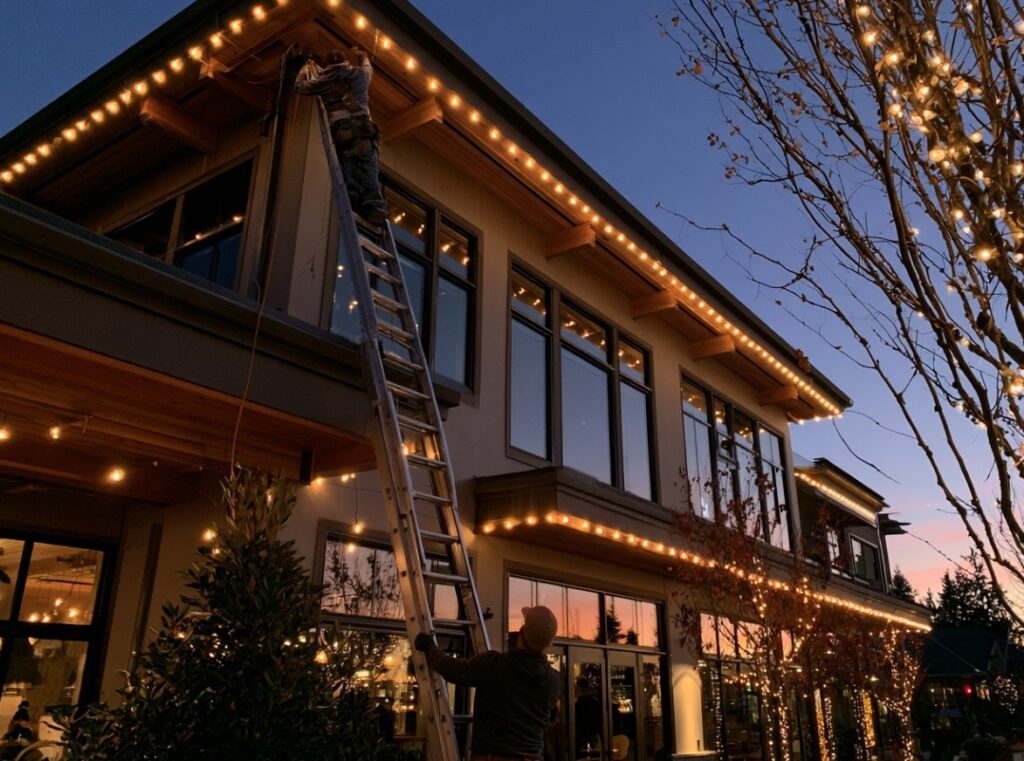
LED technology has made holiday lighting dramatically more energy-efficient than incandescent alternatives. LED fixtures produce the same output at a fraction of the wattage, run cooler (reducing fire risk), and have a significantly longer rated lifespan. For large commercial properties, that efficiency difference translates into meaningful savings across a full holiday season.
Houston Light’s installation process includes a lifetime warranty on all lighting installed, meaning if a fixture fails after installation, the replacement is covered. That guarantee matters most in LED holiday lighting installation, where large commercial jobs involve thousands of individual connection points.
Security and Motion-Sensor Lighting Integration
Security lighting and decorative lighting are not mutually exclusive. Integrating them thoughtfully produces a property that looks polished and performs a protective function.
Motion-activated fixtures are the most practical security lighting option for most residential properties. A well-placed motion sensor light near a side gate, garage, or back entrance deters opportunistic intrusion without continuous energy costs. Choose motion-sensor fixtures in a finish and style that matches your sconces and lanterns, mismatched hardware signals an uncoordinated scheme.
Dusk-to-dawn sensors automate ambient lighting so fixtures activate at sunset and shut off at sunrise. This is the standard approach for pathway illumination and entryway sconces. Smart home compatibility has expanded significantly, allowing app control, voice assistant integration, or scheduling aligned with seasonal daylight changes.
Never connect decorative string lights or low-voltage landscape fixtures to a circuit that also powers security lighting. Security fixtures draw surge current when they activate, which can cause flickering or premature failure in decorative fixtures sharing the same circuit.
Light Pollution, Dark Sky Compliance, and Responsible Outdoor Decorative Lighting
Outdoor decorative lighting carries an obligation beyond aesthetics. The light you send into the sky at night has measurable consequences for wildlife, human health, and night sky visibility.
Light pollution is the brightening of the night sky caused by artificial light sources. According to the International Dark-Sky Association’s resources on light pollution, artificial light at night disrupts nocturnal wildlife behavior, interferes with migratory bird patterns, and suppresses melatonin production in humans.
Dark sky compliance refers to lighting practices that minimize upward light scatter. Core principles include:
- Shielded fixtures: Direct light downward toward the intended surface, not upward or sideways
- Warm color temperatures: Stay at or below 3000K to reduce blue-spectrum light, which scatters more in the atmosphere
- Appropriate intensity: Use the minimum wattage needed for the application
- Timers and controls: Reduce or eliminate lighting during late-night hours when human activity is minimal
The International Dark-Sky Association’s Fixture Seal of Approval program certifies specific fixtures that meet responsible outdoor lighting criteria. Many municipalities are adopting dark sky ordinances that restrict certain fixture types and color temperatures for new construction.
Responsible outdoor decorative lighting doesn’t mean less impressive displays. Fully shielded, warm-toned LED fixtures can produce stunning results while keeping light focused where intended.
Maintenance and Seasonal Care for Long-Lasting Displays
Installation is only half the investment. Maintenance determines whether a display looks as good in year three as it did in year one.
A practical seasonal maintenance schedule covers four key moments:
- Pre-season inspection: Test all fixtures and strings before mounting. Replace any bulbs showing discoloration or flickering. Check connection points for corrosion.
- Mid-season check: Walk the property after dark and note any fixtures that have shifted, dimmed, or failed. Verify motion sensors and dusk-to-dawn controls are functioning.
- Post-season takedown: Remove all fixtures carefully without pulling string lights by the cord. Store coiled loosely in labeled containers.
- Off-season storage: Keep fixtures in a climate-controlled space if possible. Label each strand or fixture group by location to simplify next year’s installation.
LED fixtures require less frequent bulb replacement than incandescent systems, but they’re not maintenance-free. Driver components can fail over time, particularly in fixtures exposed to sustained heat. Periodic cleaning of fixture lenses removes dust and debris that gradually reduces light output.
For large commercial properties, professional maintenance contracts make more practical sense than DIY inspection. The complexity of large-scale outdoor decorative lighting installations is beyond what a property manager can reasonably audit without specialized equipment and training.
Managing outdoor decorative lighting at scale is genuinely complex. Houston Light handles every stage of that process for residential, commercial, and government properties, backed by 15 years of experience, a lifetime warranty on all installed lighting, and free on-site consultations for commercial clients. Get your FREE Estimate and see what a professionally designed, fully managed lighting installation looks like for your property.
Frequently Asked Questions
What is the best type of outdoor decorative lighting for year-round use?
LED fixtures are the strongest choice for year-round outdoor decorative lighting. They consume significantly less energy than incandescent bulbs, last far longer, and hold up well across seasonal temperature swings. Look for fixtures with an IP65 or higher rating for reliable weather resistance. Dusk-to-dawn or smart home-compatible options add convenience without sacrificing style. For permanent installations, low-voltage LED systems strike the best balance between energy efficiency, fixture durability, and design flexibility.
What is the rule of thumb for balancing brightness and ambiance in outdoor lighting?
A practical rule is to layer three types of light: ambient for general illumination, accent for focal points like trees or architectural features, and task lighting for safety on stairs and pathways. For ambiance, warm color temperatures between 2700K and 3000K create an inviting glow. Security zones benefit from brighter, cooler tones around 4000K. Dimmable fixtures give you control over both mood and wattage, so you can shift from festive to functional without changing hardware.
How do professional lighting services ensure weather-resistant installations?
Reputable professional installers select fixtures rated for outdoor exposure, typically IP65 or above, and use weatherproof connectors and UV-resistant cables. They secure all wiring away from water intrusion points and test every circuit before leaving the site. Insured labor matters here: if a connection fails or a fixture comes loose after installation, a professional service with a solid warranty handles the repair at no additional cost, rather than leaving the homeowner to troubleshoot on a ladder.
How can outdoor decorative lighting improve both home security and aesthetics?
Combining decorative and security lighting in one design is straightforward. Motion-activated fixtures placed at entry points and along the hardscape perimeter deter unwanted visitors while blending into the overall design. Pathway illumination improves visibility for guests and reduces trip hazards. Landscape spotlights on trees and architectural features create depth that looks intentional from the street, boosting curb appeal while ensuring the property is well-lit enough to discourage intrusion after dark.