Why Architecture Firms Need Curated Holiday Displays
Architecture firms communicate through space, form, and light. A poorly executed holiday display contradicts everything a firm stands for; a well-crafted one demonstrates design sensibility more effectively than any marketing brochure.
Elegant holiday displays for architecture firms serve dual purposes: they signal creative credibility to clients and reinforce brand identity during the highest-visibility season. At Houston Light, we’ve worked with commercial properties across many industries. The standard has to be higher. The details have to be right.
The most common mistake firms make is treating holiday decor as an afterthought, delegating it to an office manager with a budget and a trip to a big-box store. The result is generic, inconsistent, and often structurally inappropriate for the building. A lobby with soaring 20-foot ceilings does not benefit from a tabletop tree. A glass curtain wall façade calls for a completely different approach than a brick-clad mid-rise.
The firms that get this right treat holiday displays as a seasonal design project. They apply the same principles they use on client work: proportion, material quality, lighting hierarchy, and contextual sensitivity.
Commercial Holiday Lighting Design: Principles That Work
Good commercial holiday lighting design starts with the building, not the catalog. The most effective displays are those where the lighting feels like it was always meant to be there, requiring understanding of the building’s existing lighting hierarchy, ambient, accent, and task, and designing the festive layer to complement rather than compete.
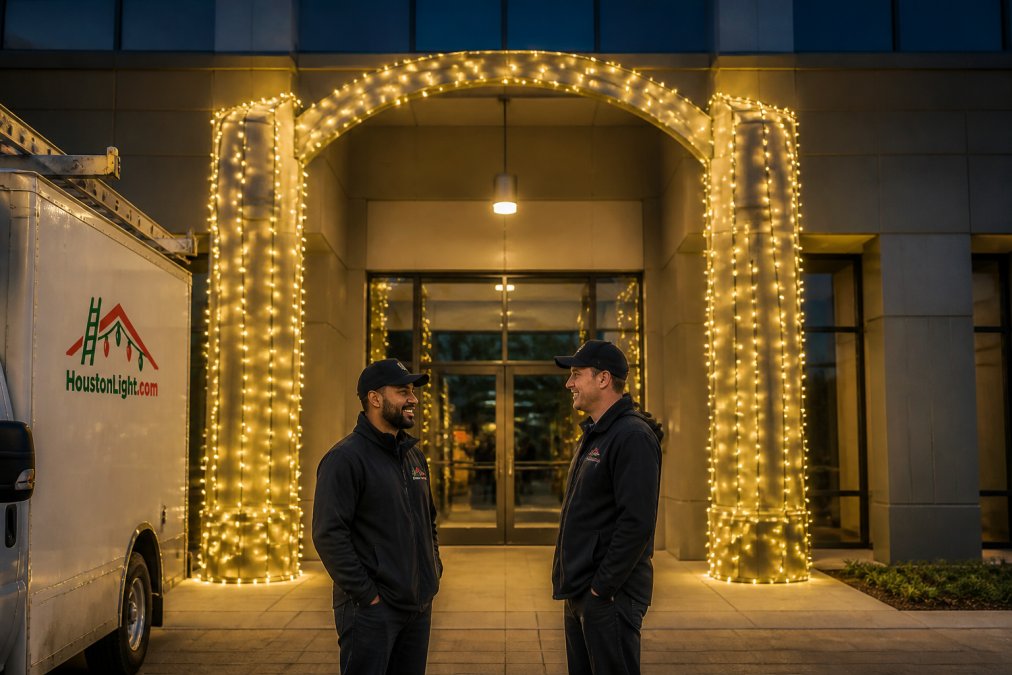
Three principles separate professional-grade commercial holiday lighting from amateur installations:
- Color temperature consistency. Warm white LEDs in the 2700K-3000K range integrate naturally with most commercial interior lighting. Mixing color temperatures creates visual noise that undermines the curated aesthetic.
- Layered illumination. The best displays use at least two lighting layers: a structural or architectural layer that traces the building’s form, and a decorative layer that adds seasonal character.
- Intentional focal points. Every display needs a visual anchor, an entrance canopy, signature tree, or lit garland run along a roofline. Without a focal point, the overall effect feels scattered.
Integrating Decor With Architectural Features
Integrating holiday decor with architectural features is the single most important skill in commercial holiday lighting design. The building’s bones tell you where the light should go.
Columns beg to be wrapped. Rooflines and cornices define natural runs for garland and LED illumination. Recessed entries create framing opportunities for oversized wreaths or lit archways. Glass facades respond beautifully to warm ambient lighting that reflects off the surface at night, creating depth without obscuring transparency.
The rule is simple: follow the geometry. A building with strong horizontal banding calls for horizontal light runs; vertical emphasis responds to vertical treatments. Fighting the architecture always shows.
Scale matters most here. A wreath that looks generous in a showroom can disappear on a three-story entrance. Commercial-grade fabrication means sizing every element to the actual architectural context.
Modern Minimalist Holiday Decor for Professional Spaces
Minimalist festive design is not about doing less, but doing exactly enough. For architecture firms, this approach resonates because it reflects the same restraint and intentionality that defines good architecture.
The hallmarks of modern minimalist holiday decor for professional spaces include:
- Monochromatic palettes: Warm white LED illumination with natural greenery
- Structural simplicity: Clean lines, geometric forms, and deliberate negative space
- Material quality over quantity: A single large-scale custom wreath with premium materials outperforms a dozen small generic decorations
- Lighting as the primary decorative element: Let the light do the work; reduce physical ornament to what genuinely adds to the composition
This approach ages well across the season. A minimal, high-quality display looks as intentional on January 2nd as it does on December 1st.
Architectural Holiday Lighting Trends Shaping 2026
The biggest shift in commercial holiday lighting this year is the move away from static displays toward dynamic, responsive environments. Architecture firms increasingly ask for displays that change over time through programmed sequences or integration with building automation systems.
Architecture firms should brief their holiday lighting installer on the building’s existing control systems before design begins. Integrating holiday lighting with a BIM model or building management system is far easier when planned from the start.
Dynamic and Synchronized Light Shows
Dynamic light shows are no longer exclusive to large retail centers and civic spaces. Commercial-grade LED systems with DMX or DALI control protocols now make synchronized lighting achievable for mid-sized commercial buildings.
The most compelling dynamic displays for architecture firms tend to be subtle rather than theatrical. Think slow color temperature transitions from warm white to cool white across an evening, or a gentle pulse synchronized to entrance activity. The goal is visual interest, not spectacle.
According to the Illuminating Engineering Society’s guidance on exterior lighting, thoughtful dynamic lighting design considers the visual comfort of both building occupants and passersby, an important consideration for densely occupied professional spaces.
What separates a well-executed dynamic display from a gimmick is programming restraint. The technology can do far more than the design should ask of it.
Sustainable and Energy-Efficient LED Illumination
LED illumination is now the baseline for any credible commercial holiday lighting installation. Modern commercial-grade LED systems consume a fraction of the energy of older incandescent technology, with operational lifespans that mean far lower replacement costs across multiple seasons. corporate event decor.
For architecture firms with sustainability commitments, particularly those pursuing LEED certification, this matters beyond the energy bill. As documented in the U.S. Department of Energy’s resources on LED lighting efficiency, LED technology continues to improve in both efficacy and color rendering.
Energy-efficient lighting also opens design possibilities that older technology couldn’t support. Lower heat output means LED strings can be used on living plant material, in enclosed spaces, and on surfaces where incandescent heat would have been a concern.
Structural and Permitting Considerations for Exterior Displays
Structural load-bearing considerations are real for any exterior display of meaningful scale. A large roofline garland run carries significant weight, particularly when wet or in wind. Mounting points need to be assessed against the building’s structural capacity, and any penetration of the building envelope requires coordination with original structural documentation.
Permitting requirements for exterior holiday displays vary by municipality. Many jurisdictions require permits for temporary exterior lighting installations above a certain scale, for any installation involving electrical work outside existing infrastructure, or for displays visible from public rights-of-way. Firms in historic districts or under deed restrictions face additional review layers.
The practical checklist before any exterior installation should include:
- Review local zoning ordinances for temporary signage and exterior display regulations
- Confirm whether the installation requires an electrical permit under local code
- Check HOA or building association rules for commercial properties
- Assess mounting point capacity with reference to structural drawings
- Document all penetrations and mounting hardware for post-season removal
BIM and CAD integration is increasingly valuable. Mapping a proposed holiday display onto an existing BIM model allows the design team to identify structural conflicts, plan cable routing, and coordinate with mechanical and electrical systems before installation begins.
Holiday Lighting Safety Standards for Commercial Buildings
Holiday lighting safety standards for commercial buildings are governed by federal and local requirements. The National Electrical Code, administered by the National Fire Protection Association, provides baseline requirements for temporary electrical installations including holiday lighting. Most jurisdictions adopt the NEC, though local amendments apply. Any commercial installation involving new electrical connections, circuit extensions, or generators should be performed by a licensed electrician operating under a valid permit.
OSHA regulations govern the safety of installation workers, particularly when work involves ladders, scaffolding, or elevated platforms.
Practical safety considerations for commercial holiday displays include:
- Use only UL-listed or ETL-listed commercial-grade lighting products
- Ensure all outdoor-rated products carry an appropriate IP rating for exposure conditions
- Do not exceed circuit load ratings; calculate total wattage before installation
- Inspect all lighting products before installation and replace any damaged components
- Establish a clear removal and storage protocol to protect equipment and building finishes
Insured labor is not optional for commercial installations. If a contractor is not carrying general liability and workers’ compensation insurance, the building owner assumes significant exposure for any incident during installation or removal.
Custom Wreaths, Garlands, and Custom Ornaments
Off-the-shelf holiday decor has a ceiling. For architecture firms, that ceiling is usually reached immediately.
Custom fabrication allows a holiday display to feel like it belongs to the building rather than being placed in front of it. A customized wreath scaled to a 10-foot entrance door, constructed from premium mixed greenery with materials matching the firm’s interior palette, reads entirely differently than a standard retail product.

The elements worth investing in for professional spaces:
- Custom-scale wreaths: Sized to the actual architectural opening
- Garland runs: Length-specified to the actual architectural feature, with density and material selected for visual weight
- Bespoke ornaments: Oversized ornaments in finishes coordinating with the building’s material palette
- Ribbon and accent materials: Selected to complement the building’s color and material language
Commercial-grade materials are engineered for exterior exposure and multi-season use. Retail products are not. For a firm that intends to reuse its display investment, material quality at purchase is not an area to economize.
Houston Light designs and fabricates custom wreaths, garlands, and oversized ornaments as part of comprehensive holiday decorating packages, with every element sized and specified to the actual installation environment.
Elegant Holiday Displays: Installation Logistics and Maintenance
The design is only as good as the installation. This is where professional expertise separates from DIY, and where most risk lives.
| Installation Phase | Key Consideration | Timing |
|---|---|---|
| Site assessment | Structural, electrical, and access review | 6-8 weeks before install |
| Design finalization | Scale, materials, mounting plan confirmed | 4-6 weeks before install |
| Permit acquisition | Local electrical and display permits filed | 4 weeks before install |
| Installation | Crew, equipment, and sequencing coordinated | 2-4 weeks before season |
| Mid-season inspection | Check all connections, replace failed components | 2-3 weeks after install |
| Removal and storage | Careful removal, inventory, and storage for reuse | January |
Seasonal maintenance is a genuine operational consideration. Commercial-grade LED displays are reliable, but no installation is immune to wind events, connection failures, or component damage over a multi-week display period. A mid-season inspection by the installation team catches issues before they become visible problems.
Skipping the mid-season inspection is the most common cause of a display that looks great at installation and disappointing by Christmas week. A single failed section in a roofline run is immediately visible and undermines the entire display investment.
Storage protocol matters as much as installation quality if the firm intends to reuse display assets. Custom wreaths and garlands need controlled storage to maintain form and material integrity. Lighting should be inspected, coiled correctly, and stored in labeled containers matching the installation diagram. A well-documented storage system makes the following year’s installation faster, cheaper, and more consistent.
Houston Light’s comprehensive service packages include installation, mid-season maintenance, removal, and storage coordination, so the firm’s team carries none of the operational burden across the season.
Elegant holiday displays for architecture firms are a design project, not a procurement task. The firms that treat them that way, with the same attention to proportion, material quality, and architectural integration they bring to client work, end up with displays that genuinely enhance their brand.
Architecture firms invest significantly in the spaces they occupy, and a holiday display that doesn’t match that investment undermines the message those spaces are meant to send. Houston Light brings 15 years of commercial installation experience, commercial-grade materials, and a lifetime warranty on all lighting installed to every project. Our team offers free on-site commercial consultations, so the design conversation starts with your actual building, not a generic proposal. Get your FREE Estimate and let’s build a holiday display that reflects the quality of your work.
=== FAQ ANSWERS (audit these too, same rules) ===
[1] Q: How can architecture firms integrate holiday decor without compromising their aesthetic?
A: The key is treating holiday displays as an extension of the building’s existing design language. Minimalist LED illumination along rooflines, columns, and window frames preserves architectural simplicity while adding seasonal warmth. Bespoke ornaments and custom wreaths in colors that match the firm’s brand identity keep the look cohesive. A professional installer will assess the façade first and recommend placements that accent, rather than obscure, the structure’s defining features.
[2] Q: What safety and compliance standards apply to commercial holiday lighting?
A: Commercial holiday lighting must meet National Electrical Code (NEC) requirements, and all products should carry UL or ETL listing for outdoor use. OSHA regulations govern ladder and elevated-work safety during installation. Local municipal codes may also require permits for large exterior displays or rooftop mounting. Working with an insured, licensed professional ensures the installation meets these standards, reducing liability exposure for property owners and facility managers.
[3] Q: What are the benefits of professional holiday lighting for commercial architecture?
A: Professional holiday displays strengthen seasonal branding, attract foot traffic, and signal that a property is active and well-maintained. Commercial-grade LED illumination lasts significantly longer than consumer products and withstands harsh weather. Professionally installed systems also reduce the risk of electrical faults. For architecture firms specifically, a well-executed festive installation demonstrates design sensibility to clients and visitors, reinforcing the firm’s reputation for visual excellence.
[4] Q: How do you choose a holiday display theme that reflects a firm’s brand identity?
A: Start with the firm’s existing color palette, logo tones, and material preferences. Warm white or cool white LED illumination suits most professional environments, while accent colors in garlands or ornaments can mirror brand colors. The architectural style of the building should guide scale: a sleek glass tower suits minimal linear lighting, while a masonry building can carry richer layered displays. A free on-site consultation with a professional holiday lighting designer helps translate brand identity into a cohesive festive atmosphere.
Frequently Asked Questions
How can architecture firms integrate holiday decor without compromising their aesthetic?
The key is treating holiday displays as an extension of the building’s existing design language. Minimalist LED illumination along rooflines, columns, and window frames preserves architectural simplicity while adding seasonal warmth. Bespoke ornaments and custom wreaths in colors that match the firm’s brand identity keep the look cohesive. A professional installer will assess the façade first and recommend placements that accent, rather than obscure, the structure’s defining features.
What safety and compliance standards apply to commercial holiday lighting?
Commercial holiday lighting must meet National Electrical Code (NEC) requirements, and all products should carry UL or ETL listing for outdoor use. OSHA regulations govern ladder and elevated-work safety during installation. Local municipal codes may also require permits for large exterior displays or rooftop mounting. Working with an insured, licensed professional ensures the installation meets these standards, reducing liability exposure for property owners and facility managers.
What are the benefits of professional holiday lighting for commercial architecture?
Professional holiday displays strengthen seasonal branding, attract foot traffic, and signal that a property is active and well-maintained. Commercial-grade LED illumination lasts significantly longer than consumer products and withstands harsh weather. Professionally installed systems also reduce the risk of electrical faults. For architecture firms specifically, a well-executed festive installation demonstrates design sensibility to clients and visitors, reinforcing the firm’s reputation for visual excellence.
How do you choose a holiday display theme that reflects a firm’s brand identity?
Start with the firm’s existing color palette, logo tones, and material preferences. Warm white or cool white LED illumination suits most professional environments, while accent colors in garlands or ornaments can mirror brand colors. The architectural style of the building should guide scale: a sleek glass tower suits minimal linear lighting, while a masonry building can carry richer layered displays. A free on-site consultation with a professional holiday lighting designer helps translate brand identity into a cohesive festive atmosphere.