Table of Contents
- What Makes Commercial Holiday Lighting Work for Your Building
- Commercial Holiday Lighting Ideas That Elevate Curb Appeal
- Choosing Commercial Outdoor Christmas Lights for Durability
- Holiday Lighting for Office Buildings: Professional and Welcoming
- Commercial Holiday Lighting Installation: What to Expect
- Common Mistakes to Avoid with Commercial Holiday Lighting
- Conclusion: Making Your Commercial Property Shine
- Frequently Asked Questions
Last Updated: October 12, 2026
What Makes Commercial Holiday Lighting Work for Your Building
Choosing the best holiday lighting for commercial buildings comes down to three things: durability, visual impact, and how simple the display is to maintain through the season. At Houston Light, we’ve spent 15 years installing these systems across the Greater Houston area, and the properties that look best year after year share the same fundamentals. This guide breaks down what actually matters in 2026, from LED versus traditional bulbs to installation logistics and the mistakes that cost property managers time and money.
Commercial holiday lighting is the professional design, installation, and maintenance of festive lighting systems on business properties, including rooflines, facades, entryways, and grounds. It differs from residential decorating in scale, voltage requirements, and safety obligations.
Key factors for commercial properties
Three factors separate a display that lasts from one that fails by mid-December.
Weather exposure. Commercial buildings have long rooflines, open parking areas, and few windbreaks. Lighting rated for indoor or mild conditions will not survive a Gulf Coast winter storm. Commercial-grade strands with sealed connections and UV-resistant wire are the baseline, not an upgrade.
Voltage and load planning. Large facades draw serious power. A commercial electrician needs to map circuits before anyone climbs a ladder, because overloading a circuit mid-installation means a shutdown and a redo.
Maintenance access. If a strand fails 30 feet up, someone has to go get it. Displays designed with accessible connection points cost less to service.
LED vs. traditional: what matters in 2026
LED is the clear choice for commercial work today. LEDs run cooler, draw far less power across a large building, and hold up to rain and temperature swings better than incandescent strands. The practical difference on a commercial property is maintenance calls. Incandescent bulbs burn out individually and often, which means repeat visits to the same roofline. LEDs fail far less often and, when they do, usually as a single strand rather than a scattered trail of dead bulbs.
The one honest drawback: quality varies widely. Cheap LED strands from big-box stores often fail within a season under commercial conditions. Commercial-grade LED products cost more upfront and last multiple seasons, which is why we specify them for every project.
The most common mistake we see is a property manager buying retail LED strands to save money, then paying for two or three reinstallations in the same season. The savings disappear fast once labor is factored in.
Commercial Holiday Lighting Ideas That Elevate Curb Appeal
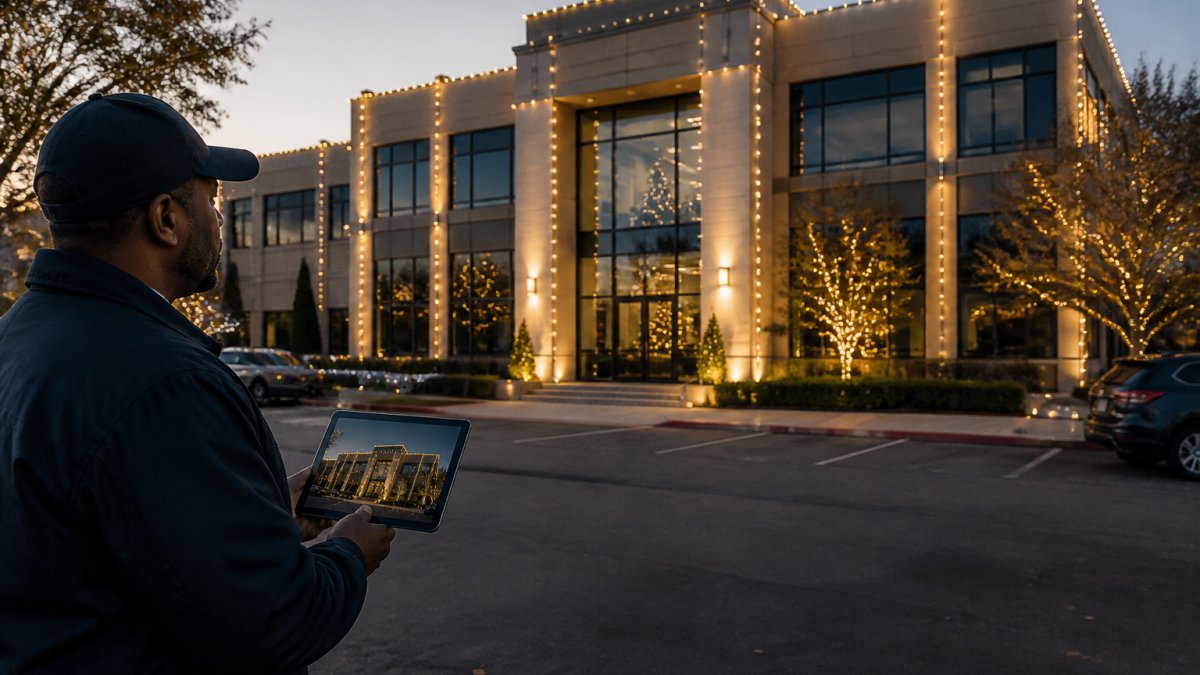
The strongest commercial holiday lighting ideas do less than you’d expect. Restraint reads as elegance on a large building. A roofline traced in warm white, a lit entryway, and a few well-placed ground displays often outperform a facade covered in competing colors.
Roofline and facade treatments
Roofline lighting is the workhorse of commercial displays. A clean line of warm white LEDs along the top edge of a building frames the architecture and reads clearly from a distance. Facade treatments work best when they follow the building’s existing lines rather than fighting them. Columns, cornices, and window frames are natural anchor points.
Color selection matters more than most people think. Warm white suits professional offices, banks, and medical buildings. Multi-color or animated displays fit retail and entertainment venues where the goal is drawing foot traffic.
Ground-level and entryway displays
Entryways carry the most weight per square foot. A lit walkway, wrapped planters, and a decorated entrance signal that a business is open and welcoming. Ground-level displays also pose less installation risk than high rooflines, which makes them a smart starting point for properties testing a new look.
For larger properties, custom wreaths and garland on entrances and columns add polish without overwhelming the space.
Choosing Commercial Outdoor Christmas Lights for Durability
Durability is the single most important specification for commercial outdoor Christmas lights. A commercial strand should carry a weather rating, use sealed connectors, and be rated for the voltage and run length the building requires. Anything less will fail under commercial conditions.
Here is how the main options compare:
| Lighting Type | Durability | Power Draw | Best For | Maintenance |
|---|---|---|---|---|
| Commercial-grade LED | High, multi-season | Low | Rooflines, facades, large properties | Minimal |
| Retail LED | Moderate, often one season | Low | Small accents, temporary use | Frequent |
| Incandescent | Low, bulb-by-bulb failure | High | Rarely recommended today | Constant |
| Solar accent | Low in shaded areas | None | Ground markers only | Weather-dependent |
The table makes the trade-off obvious. Commercial-grade LED costs more upfront and saves money over multiple seasons through fewer service calls. Incandescent strands have largely fallen out of professional use because the bulb failure rate on a large building is unmanageable.
Ask any installer what happens if a strand fails in week three. A lifetime warranty on installed lighting means the fix is their problem, not yours. Get that in writing before work starts.
Holiday Lighting for Office Buildings: Professional and Welcoming
Holiday lighting for office buildings has to do two jobs at once: look festive and still read as professional. The properties that get this right lean on warm white tones, clean lines, and restrained color. Lobbies, entrances, and exterior signage areas get the most attention because that’s where employees and clients actually look.
A few practical guidelines we follow:
- Keep exterior color palettes to one or two tones for a cohesive look
- Light the entrance and lobby windows first, then work outward
- Avoid flashing or animated displays on professional office exteriors
- Use garland and wreaths to soften hard architectural edges
The business case is straightforward. A well-lit office building signals that a company is active, cared for, and open. That matters for client visits and for employee morale during a dark, busy season.
For properties with shared common areas, HOA holiday lighting follows similar principles at a larger scale, coordinating displays across multiple buildings and open spaces.
Commercial Holiday Lighting Installation: What to Expect
A professional commercial holiday lighting installation follows a defined sequence, and knowing it helps you plan around it. Most projects move through four phases: site consultation and design, materials and scheduling, installation, and in-season maintenance.
Site consultation. A good provider walks the property, measures rooflines and facades, checks power access, and identifies safety concerns. This should happen on-site, not over the phone.
Design and materials. You get a plan showing where lights go, what colors are used, and what the display will look like from the street.
Installation. Crews work from ladders, lifts, and roofs depending on building height. Insured labor matters here, because installation is the highest-risk part of the process.
Maintenance and removal. A display is only as good as its upkeep. Ask what happens if something fails mid-season, and confirm who removes and stores the materials.
The best time to book commercial holiday lighting is late summer or early fall. Scheduling fills up as the season approaches, and properties that wait often get rushed timelines or limited crew availability.
Common Mistakes to Avoid with Commercial Holiday Lighting
Most commercial holiday lighting problems trace back to a handful of avoidable mistakes. Here are the ones we see most often.
Skipping the site survey. Providers who quote without seeing the property miss power constraints, access issues, and safety hazards. Those problems surface during installation, when they’re expensive to fix.
Buying on price alone. The cheapest quote usually means retail-grade materials and uninsured labor. When something fails or someone gets hurt, the property owner carries the risk.
Ignoring storage and reuse. Commercial-grade materials last multiple seasons if stored properly. Throwing them in a damp closet over the summer shortens their life.
No maintenance plan. A display installed in November with no service agreement means every failure becomes an out-of-pocket call.
Overlooking the exit strategy. You should never be locked into a contract you can’t leave. Ask upfront whether you own the materials and whether you can reuse them with another provider or install them yourself next year.
Conclusion: Making Your Commercial Property Shine
Getting the best holiday lighting for commercial buildings is less about finding the cheapest option and more about choosing materials and a team that hold up through the whole season. The properties that look sharpest in December are the ones that planned in September and picked durability over short-term savings.
That’s where Houston Light comes in. We offer free on-site commercial consultations, use commercial-grade LED technology, and back every installation with a lifetime warranty on the lighting we install. Our insured crews handle design, installation, maintenance, and removal, so your property looks its best without adding work to your plate.
Get your FREE estimate from Houston Light and give your building a display that earns attention all season.
Frequently Asked Questions
What are the best holiday lights for commercial buildings?
LED lights are the top choice for commercial holiday lighting. They use up to 75% less energy than incandescent bulbs and last far longer, which matters when lights stay on for six to eight hours nightly. Look for commercial-grade strings with thicker wiring and weather-resistant connectors. Warm white LEDs suit professional settings, while color-changing options work for retail. Many providers offer custom designs and lifetime warranties on installed lights.
How do you decorate a commercial building for the holidays?
Start by outlining architectural features like rooflines, columns, and windows with LED strings. Add wreaths, garlands, and oversized ornaments at entryways. For larger properties, consider ground-level displays or tree wraps. Professional installation ensures safety and even coverage. Many companies provide free on-site consultations to design a display that fits your building’s size and brand image.
How long should commercial holiday lights stay up?
Most businesses light up from mid-November through early January, about six to eight weeks. Some start right after Thanksgiving and take down by the second week of January. Check with your installer about removal timelines. Leaving lights up too long can risk weather damage and look outdated. A professional service can schedule both installation and takedown for you.
What should you consider before installing commercial holiday lights?
Check power access, building height, and local safety codes. Verify your installer is insured and offers a warranty. Plan for weather resistance, especially in humid or storm-prone areas. Also think about maintenance: who fixes flickering lights? A full-service provider handles design, installation, maintenance, and removal, so you avoid climbing ladders or chasing outages.