Table of Contents
- What You’ll Need Before Starting
- How to Troubleshoot Holiday Light Strands: A Step-by-Step Approach
- How to Find a Bad Bulb in Christmas Lights
- Understanding Shunts and Why Some Lights Stay On
- Holiday Light Strand Fuse Replacement
- How to Fix a Section of Christmas Lights
- Holiday Lights Not Working: When to Repair vs. Replace
- Common Mistakes to Avoid
- Frequently Asked Questions
Last Updated: October 10, 2026
What You’ll Need Before Starting
Gather a voltage tester or multimeter, a replacement bulb matching your strand type, and a flashlight. Always unplug the strand before starting work to prevent electrical shock.
Never troubleshoot a plugged-in strand. Electrical hazards are real, and one wrong move can cause injury. Always disconnect power at the outlet first.
How to Troubleshoot Holiday Light Strands: A Step-by-Step Approach
To troubleshoot holiday light strands systematically, start at the power source and work toward the lights to isolate the problem efficiently and safely.
Step 1: Plug in the strand and observe what happens
Plug in the strand and observe: a fully dark strand indicates a plug, fuse, or power issue; partial outages suggest a bad bulb or loose connection; flickering means loose connections. This pattern guides your next steps.
Step 2: Check the outlet and power source
Test the outlet with a lamp or phone charger. If the strand works in a different outlet, check your circuit breaker panel and reset any breaker in the middle position. If it trips again immediately, the strand has an internal fault and should not be used. If the strand stays dark in every outlet, proceed to Step 3.
Step 3: Inspect the plug and check for a blown fuse
Inspect the plug for scorch marks, cracks, or bent prongs; a damaged plug means the strand should be replaced. If intact, locate the fuse compartment (usually a small panel on the side or bottom). Remove the fuse and check for a broken wire or darkened appearance. Replace with a fuse of the exact same amperage, never use a higher rating. If the new fuse blows immediately, the strand has an internal short circuit and should be discarded.
Never use a fuse with higher amperage than the original. This removes electrical protection and risks fire. If fuses blow repeatedly, the strand is faulty and should be discarded, not repaired.
Step 4: Inspect the entire wire for damage
With the strand unplugged, run your hands along the entire length feeling for cuts, splits, or cracked insulation. Pay special attention to connection points and areas exposed to weather. Damaged insulation or exposed wire cannot be safely repaired, the strand should be replaced.
Inspect your strands before you store them each year. Catching damage early prevents mid-season failures. Store lights loosely coiled in a dry place to prevent wire stress and crushing.
Step 5: Test bulbs and connections
If the plug, fuse, and wire are sound, the problem is a bad bulb or loose connection. See the section below for testing methods. If multiple bulbs are bad, consider replacement rather than continued repair.
How to Find a Bad Bulb in Christmas Lights
A single bad bulb can darken an entire incandescent section, but LED strands behave differently, so check your bulb type first.
Visual inspection method
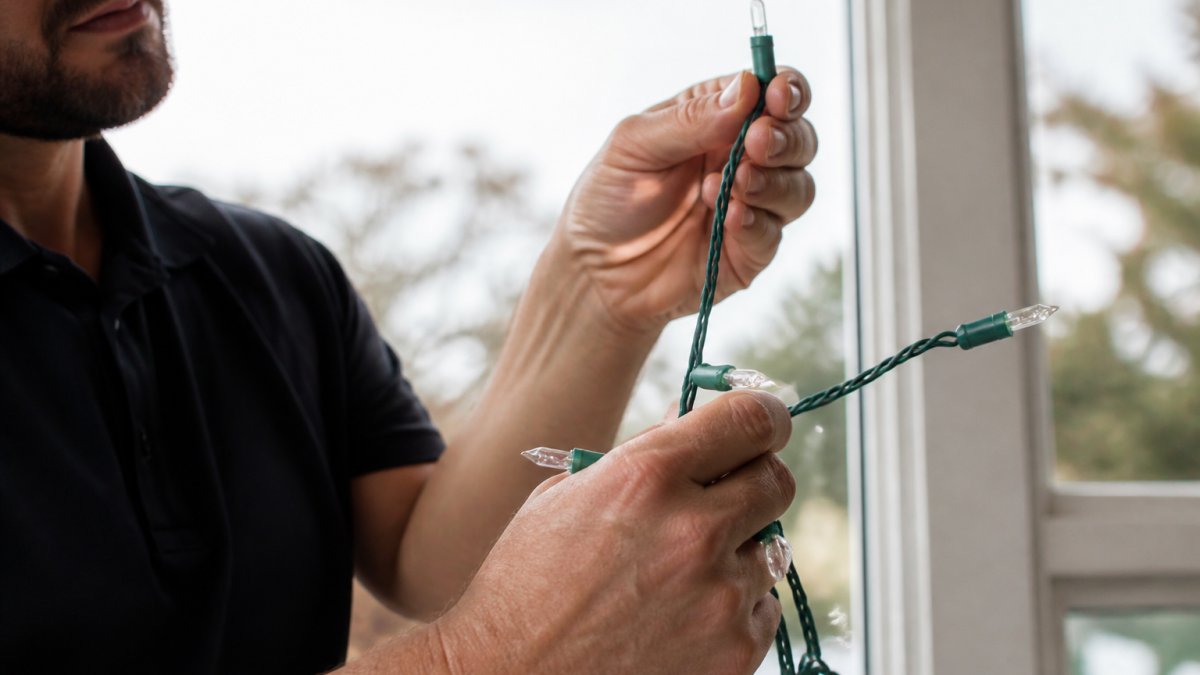
Look for dark spots inside the glass or blackened filaments. Gently push each bulb to ensure it’s seated firmly. If you find a dark or loose bulb, remove it by twisting counterclockwise and replace with a bulb of the same type and wattage.
Using a light tester
A light tester clips onto bulb sockets and lights up when power flows through, ideal for incandescent strands. Clip it to each socket; when it doesn’t light, replace that bulb. For LED strands, use a voltage tester instead to check for current at each point.
Understanding Shunts and Why Some Lights Stay On
Incandescent strands use shunts inside bulb sockets that bypass dead bulbs, allowing the rest to stay lit. LED strands lack shunts, so one failed LED darkens the entire section beyond it. This difference helps you diagnose the problem: if an entire incandescent strand is dark, the issue is upstream; if one LED section is dark, the failure is in that section.
Holiday Light Strand Fuse Replacement
Many light strands have a small fuse inside the plug to protect against electrical overload. If that fuse blows, the entire strand goes dark.
Locating the fuse in your plug
Look at the plug closely. You’ll see a small rectangular compartment, usually on the side or bottom. This compartment holds one or two fuses.
Some plugs have a visible fuse you can see through a small window. Others require you to gently pry open the compartment with a flathead screwdriver.
Check the fuse itself. A blown fuse shows a broken wire inside or a darkened glass tube.
Replacing a blown fuse
Carefully remove the old fuse. Note its amperage rating, which is printed on the end. You’ll find ratings like 2A, 3A, or 5A.
Buy a replacement fuse with the exact same amperage. Using a higher-rated fuse defeats the safety feature and creates a fire hazard.
Insert the new fuse into the compartment and close it securely. Plug in your strand and test it.
If the new fuse blows immediately, the strand has an internal electrical fault. Do not keep replacing fuses. Discard the strand and get a replacement.
How to Fix a Section of Christmas Lights
Partial outages: when half a strand or a section stops working
A dark section usually indicates a bad bulb, loose connection, or broken wire. Check every bulb in that section and replace any bad ones. Inspect the wire for cuts or pinches, and wiggle connections at the section’s start and end. If the section still doesn’t light, the wire is broken inside the insulation and cannot be safely repaired.
LED vs. incandescent behavior differences
Incandescent strands use shunts that bypass dead bulbs, so failures are localized, you see one or a few dark bulbs in an otherwise working strand. LED strands lack shunts; one failed LED darkens the entire section beyond it because they’re wired in series. LED strands also require correct polarity, connections must be oriented the same way or the section won’t light. Incandescent filaments work regardless of polarity direction.
When to repair versus replace
Before you spend time troubleshooting, ask yourself whether repair makes sense.
If the plug is damaged, the wire is cut, or multiple bulbs have burned out, replacement is usually cheaper and safer than repair. New strands, especially LED options, can be a cost-effective replacement.
However, if the problem is a single bad bulb, a loose connection, or a blown fuse, repair takes minutes and costs almost nothing. A relatively new strand with one bad bulb is worth fixing.
Consider also whether the strand is sealed or serviceable. Many modern LED strands are sealed units with no user-replaceable bulbs. If a bulb fails in a sealed strand, the entire strand must be replaced. Check your product documentation or the packaging to find out.
If a strand has recurring faults, the same section goes dark repeatedly, or fuses blow more than once, do not keep repairing it. Recurring electrical faults indicate an internal defect that will worsen over time and pose a safety risk. Discard the strand and purchase a replacement.
Never continue repairing a strand with recurring electrical faults. Repeated failures indicate an internal defect that can overheat, damage the insulation, or create a fire hazard. Safe troubleshooting ends when you identify a pattern of failure.
Holiday Lights Not Working: When to Repair vs. Replace
Before you spend time troubleshooting, ask yourself if repair makes sense. A strand that’s more than ten years old might not be worth fixing.
If the plug is damaged, the wire is cut, or multiple bulbs have burned out, replacement is usually cheaper and safer than repair. New strands can be a cost-effective replacement, especially LED options.
However, if the problem is a single bad bulb, a loose connection, or a blown fuse, repair takes minutes and costs almost nothing.
Consider the strand’s age and condition. A relatively new strand with one bad bulb is worth fixing. An old strand with multiple problems should be replaced.
If you’d rather leave the installation and troubleshooting to professionals, Holiday Decorating services can handle setup and maintenance for your displays, ensuring everything works perfectly when you need it. For larger installations, Commercial Holiday Lighting provides comprehensive design and installation for businesses and properties of all sizes.
Common Mistakes to Avoid
Don’t assume the outlet is bad without testing it first. Most “dead” strands have a problem with the strand itself, not the outlet.
Never force a bulb into a socket. If it doesn’t slide in smoothly, the socket might be damaged. Forcing it can break the socket permanently.
Don’t ignore flickering lights. Flickering means loose connections, which can create heat and become a fire hazard. Tighten connections or replace the strand.
Avoid storing lights while they’re still damp. Moisture trapped inside the wire insulation causes corrosion and electrical failures. Let strands dry completely before storage.
Don’t leave lights plugged in unattended for long periods. Even quality strands can develop faults. Unplug when you’re not watching them.
Holiday light strands fail for simple reasons: bad bulbs, loose connections, blown fuses, or damaged wire. Most problems take minutes to fix with basic tools and attention to detail. If your strand has extensive damage or multiple failures, replacement is safer and more cost-effective than repair.
Frequently Asked Questions
Why is my entire holiday light strand not working?
When a full strand goes dark, start by checking the plug fuse, a blown fuse is the most common cause. Next, inspect the entire wire for breaks, cuts, or water damage, especially on outdoor strands. If the fuse is good and the wire looks intact, test the outlet with another device to confirm power is reaching it. If the outlet works but the lights don’t, the issue is likely a failed bulb, a loose connection at the plug, or internal wire damage that requires replacement.
How do you find a bad bulb in Christmas lights?
Start with a visual inspection: look for bulbs that appear darker, cracked, or loose in their sockets. For a faster method, use a light tester designed for holiday light strands. Slide the tester along the wire; it will indicate when you pass a dead bulb. Once you locate the bad bulb, remove it, inspect the socket for corrosion or debris, and replace it with a new one of the same type. Many strands have built-in shunts that allow other bulbs to stay lit even when one fails, so a single dead bulb may only create a small dark spot in the strand.
Where is the fuse on a holiday light strand?
The fuse is located inside the plug at the base of the light strand. Open the fuse compartment by sliding or unclipping the cover on the plug body, most plugs have a small rectangular door. Inside, you’ll see one or two fuses that look like small cylinders. Check if the fuse is blown (the metal wire inside will be broken or darkened). If it is, replace it with a fuse of the same amperage rating. Always unplug the strand before opening the fuse compartment, and never use a higher-amperage fuse than the original.
What’s the difference between LED and incandescent light strands when troubleshooting?
Incandescent strands typically fail with a single dead bulb causing a section to go out due to voltage distribution. LED strands often have built-in protective circuits and may shut off entirely if there’s a short or connection issue, rather than losing just one section. When troubleshooting, test LED strands first for polarity (correct plug orientation) and check for water intrusion in connectors.