Table of Contents
- How Long Does Holiday Light Installation Take? The Short Answer
- Factors Affecting Christmas Light Installation Time
- The Professional Holiday Lighting Installation Process, Step by Step
- DIY vs Professional Installation: Time, Safety, and Trade-offs
- Holiday Lighting Maintenance and Removal Timeline
- Weather Delays and Time-Saving Installation Hacks
- Frequently Asked Questions
Last Updated: September 13, 2026
How Long Does Holiday Light Installation Take? The Short Answer
Most single-family homes take a professional crew between two and six hours to complete a holiday light installation, depending on roofline length, roof pitch, and design complexity (angi.com). Larger residential properties and commercial projects can run one to three days, and multi-building commercial displays often stretch across a full week.
This guide from Houston Light breaks down the real variables that move that number: linear footage, architectural features, ladder safety requirements, and weather. We will also cover the part most guides skip entirely, which is how long removal takes and why it matters for your planning.
Below, you will find a step-by-step look at the professional process, a DIY comparison, and the time-saving shortcuts that actually work.
Factors Affecting Christmas Light Installation Time
Several variables decide whether a job wraps in two hours or stretches into a second day. The biggest are total linear footage, roofline complexity, roof pitch, and how much prep work the property needs before a single strand goes up.
Home Size, Roofline Length, and Architectural Features
A straightforward single-story ranch with 60 to 80 linear feet of roofline is a fast job. Add a second story, multiple gables, dormers, or a wraparound porch, and the same crew can double or triple its time.
Architectural features that slow things down include:
- Steep gables that require repositioning the ladder every few feet
- Dormers and bay windows that break up a clean run of roofline
- Two-story entries and columns that need extra anchoring points
- Trees and shrubs that require wrapping rather than simple clipping
Professional-grade LED strands on mounting clips go up faster than tangled incandescent cords, mainly because clips eliminate the guesswork of tying off each section.
Roof Pitch, Height, and Ladder Safety
Roof pitch is the single most underestimated factor in installation time. A low-slope roof lets a crew walk sections safely. A steep pitch forces them onto ladders and extension poles for the entire run, which slows everything down and raises the safety stakes.
Ladder safety rules matter here, not just for insurance reasons. Crews working at height need stable footing, a spotter on uneven ground, and proper fall protection on anything above a single story (osha.gov). That takes time to set up correctly, and skipping it is how injuries happen.
The most common mistake homeowners make is underestimating roof pitch. A steep second-story roofline can add hours to a job that looked simple from the ground, and it is the number one reason DIY projects stall halfway through.
The Professional Holiday Lighting Installation Process, Step by Step
A professional install follows a repeatable sequence. Skipping steps is what causes mid-season failures, so a good crew builds in time for each one.
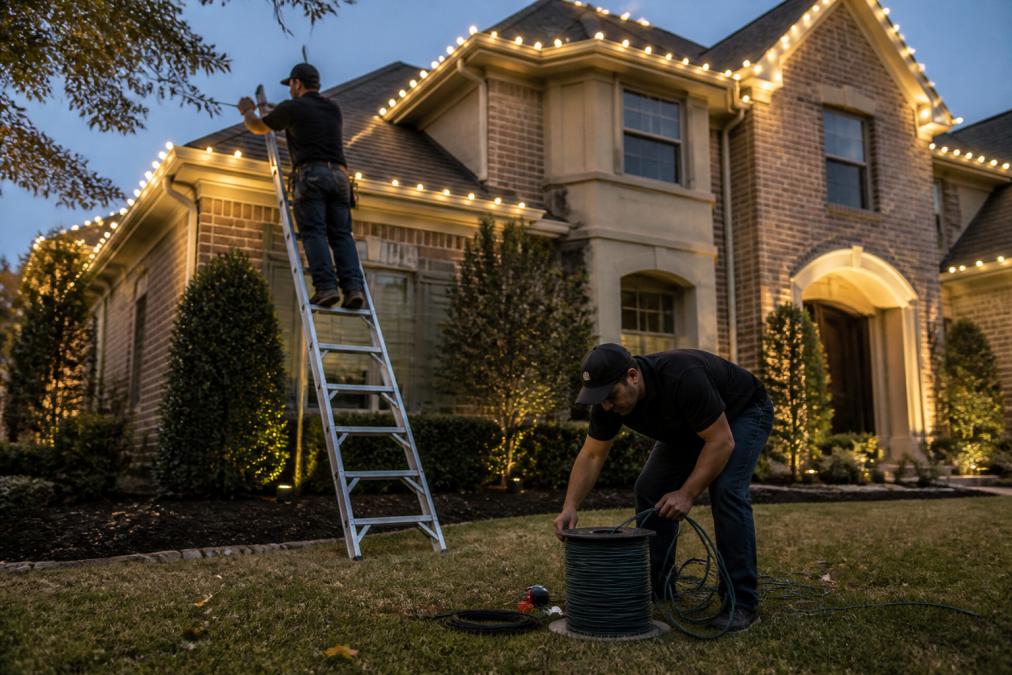
- On-site consultation and measurement. The crew walks the property, measures linear footage, and checks circuit capacity before quoting.
- Design and layout planning. A lighting plan maps every run, clip point, and power source so nothing is improvised on the roof.
- Prep work and power check. Outlets, timers, and electrical load get tested. Overloaded circuits are the most common cause of mid-season blackouts (esfi.org).
- Installation. Strands go up roofline first, then trim, trees, and ground features. This is the longest phase.
- Testing and timer setup. Every run gets checked, and smart lighting control or timer settings are configured before the crew leaves.
A typical residential job compresses these steps into a single visit. Commercial and HOA projects split them across multiple days because of scale, which is why Commercial Holiday Lighting and HOA Holiday Lighting are typically scheduled well ahead of the season.
DIY vs Professional Installation: Time, Safety, and Trade-offs
DIY saves on labor but spends your weekends. The real question is not which is cheaper on paper, it is how many hours you are actually signing up for, and whether you have the gear and comfort level to finish the job safely.
How the Hours Actually Break Down
For a single-story home with 60 to 80 linear feet of simple roofline, a confident DIYer with the right clips and a stable ladder can finish in roughly 4 to 6 hours spread across a weekend. Add a second story, a steep pitch, or multiple gables, and the same job typically stretches to 10 to 16 hours across two or three weekends, plus a return trip every time a strand fails mid-season.
A professional crew compresses that same two-story job into a single 2-to-6-hour visit because they arrive with pre-measured runs, commercial-grade clips, and a two-person system: one person on the ladder, one managing cord and power on the ground. The labor is not faster because they rush, it is faster because nothing is improvised.
What DIY Actually Requires
Before you commit to the ladder, honestly check whether you have:
- A stable extension ladder rated for your working height, plus a spotter on uneven ground
- Fall protection if any part of the run is above a single story
- Mounting clips sized to your strand type (staples and nails damage cords and void warranties)
- A circuit map so you do not overload one outlet with every run
- A plan for the removal day, which is its own multi-hour project
If any of those are missing, the DIY timeline quietly doubles, not because the work is hard, but because you are solving problems on the roof instead of on paper.
The Honest Trade-off
| Factor | DIY Installation | Professional Installation |
|---|---|---|
| Typical time, two-story home | 10-16 hours across multiple weekends | 2-6 hours, single visit |
| Safety exposure | High on ladders and steep pitch | Managed with insured labor and fall protection |
| Materials | Consumer-grade strands, shorter lifespan | Professional-grade LED, weather-resistant |
| Mid-season failures | Homeowner handles every outage | Covered under service terms |
| Removal and storage | Another full day of work | Scheduled as part of the package |
| Warranty | None on labor | Lifetime warranty on installation |
DIY makes sense for a single-story home with a simple roofline and a homeowner who is genuinely comfortable at height. Anything taller, steeper, or more detailed tips toward hiring a crew, not because DIY cannot be done, but because the hours and the risk stop being worth the savings.
If you go the DIY route, buy commercial-grade strands even for a small job. They cost more upfront but fail far less often, which saves you the mid-December ladder trip that nobody wants.
A Quick Self-Check Before You Decide
Count your linear footage. Add one hour for every gable, dormer, or second-story section. If the total lands above 10 hours and any part of the run is above a single story, the professional route usually wins on both time and safety, and it removes the removal-day problem entirely.
Holiday Lighting Maintenance and Removal Timeline
Most guides stop at installation. That is a planning mistake, because removal is a real block of time on your calendar, and it is the phase where weather, storage, and scheduling decisions either save you hours or cost you a weekend.
How Long Removal Actually Takes
Removal is usually faster than installation, but not by as much as people assume. A single-story home with 60 to 80 linear feet of roofline typically comes down in 1 to 2 hours for a professional crew. A two-story home with gables, dormers, and wrapped trees runs 3 to 5 hours. Commercial displays with oversized ornaments, garland, and multi-building runs can take a full day or more to strike, sometimes longer than the original install, because everything has to be sorted, coiled, and staged for storage rather than simply clipped up.
For DIYers, plan on roughly 60 to 80 percent of your install time for removal, plus a separate session for coiling and labeling. That is the hidden cost of the DIY route that rarely shows up in the initial estimate.
The Seasonal Calendar
A predictable display runs on three phases:
- Season-long maintenance: A visual check after any major storm, plus one mid-season pass to swap failed sections. Most well-installed displays need nothing beyond this.
- Removal window: Most crews schedule decor removal within two to three weeks after the season ends. Waiting longer means brittle clips, frozen fingers, and cords that crack instead of coil.
- Storage: Strands should be coiled, labeled by run, and stored indoors in a dry space. Poor storage is the single biggest reason next year’s install takes longer than it should, tangled, mislabeled bins turn a 2-hour job into a 4-hour one.
Why Weather Changes the Removal Math
Removal is more weather-sensitive than installation in one specific way: cold. Below roughly 40°F, most consumer-grade clips and cord jackets become brittle and snap instead of flexing, which means a fast takedown turns into a slow, careful one. Ice on the roof is an automatic no-go for crews, and wind above safe ladder thresholds pushes the job to the next available day.
That is why booking removal at the same time you book installation matters. Crews build buffer days into their late-season calendar for exactly this reason, and homeowners who wait until January to schedule often find the first available slot is weeks out.
Commercial Removal Logistics
For commercial properties, removal is a logistics problem as much as a labor one. A large plaza display with oversized ornaments and garland takes a crew longer to strike than it did to install, especially if storage is on-site and everything has to be inventoried as it comes down. Planning the removal date at the same time as the install date, and confirming where everything will be stored, is what keeps a commercial display from bleeding into February.
Removal is not an afterthought, it is 60 to 80 percent of your install time, and cold weather makes it slower. Book it when you book the install, and store your strands labeled and dry so next season starts fast.
Weather Delays and Time-Saving Installation Hacks
Weather is the variable no one can control, and it is the top reason a scheduled install slips. Cold snaps make clips brittle, wind makes ladder work unsafe, and rain turns a roof into a hazard. Crews build buffer days into commercial schedules for exactly this reason.
What actually saves time:
- Pre-measure everything. A property measured in advance installs faster because the crew arrives with pre-cut runs.
- Use mounting clips instead of staples or ties. Clips go on in seconds and come off cleanly.
- Map your circuit capacity first. Knowing your electrical load upfront prevents mid-install rewiring.
- Book early. The closer you get to the season, the tighter every crew’s calendar becomes.
A useful rule of thumb for estimating your own project: count your linear footage, then add time for every gable, dormer, and second-story section. Simple rooflines move fast. Complex ones do not.
The two biggest time killers are roof pitch and weather, not the number of strands. Plan around those two, and your installation timeline becomes predictable.
Getting your display up on time comes down to planning around the variables you can control: roofline complexity, prep work, and scheduling. Houston Light handles that planning for you, with 15 years of experience, professional-grade LED materials, insured labor, and a lifetime warranty on every installation. Our team also manages Holiday Decorating like custom wreaths and garland, and we offer free on-site commercial consultations for larger properties. Get started with Houston Light and lock in your installation date before the season fills up.
Frequently Asked Questions
How long does it typically take to install holiday lights on a residential property?
A single-story home with simple rooflines usually takes a professional crew two to four hours. Two-story homes with gables, dormers, and exterior trim typically run four to eight hours, sometimes split across two visits. Larger properties with multiple architectural features, wreaths, garland, and oversized ornaments can take a full day or more. The biggest variables are linear feet of roofline, roof pitch, and how much prep work the property needs before strands go up.
Does the size of the home affect the holiday light installation timeline?
Yes, but linear footage matters more than square footage. A compact two-story home with a steep roof pitch and multiple gables can take longer than a sprawling single-story ranch with one long, straight roofline. Professional installers measure the actual runs of exterior trim, eaves, and architectural features to estimate time, then factor in circuit capacity and outlet access. That is why two homes of similar square footage can have very different installation timelines.
Is the removal process faster than the initial holiday light installation?
Removal is usually faster, often 30 to 50 percent quicker than installation, because crews already know the layout and mounting points. A display that took six hours to install might come down in three to four hours. The catch is timing: removal scheduled in cold, wet weather takes longer because clips stiffen and strands get brittle. Booking removal in advance, before the post-holiday rush, keeps the process efficient and protects the strands for reuse next season.
How far in advance should I book professional holiday lighting services?
Book by late September or early October for the best selection of installation dates. Once November arrives, most professional crews are scheduling weeks out, and prime slots before Thanksgiving fill first. Commercial properties and HOA common areas often book even earlier because the project scope is larger and the installation window is tighter. Early booking also gives you time for a design consultation, custom wreath and garland orders, and any electrical work needed before install day.