Table of Contents
- Why Professional Holiday Decorating for HOA Communities Is Worth It
- HOA Holiday Decoration Guidelines and Policies That Work
- Planning Commercial Holiday Lighting Installation for Communities
- Safety, Liability, and Insurance: Protecting Your Community
- Holiday Lighting Maintenance for HOA Entrances
- Vendor Vetting Checklist for Holiday Decorating
- Sustainability and Post-Season Storage
- Conclusion: A Brighter Community Starts With a Plan
- Frequently Asked Questions
Last Updated: September 8, 2026
Why Professional Holiday Decorating for HOA Communities Is Worth It
Professional holiday decorating for HOA communities does more than string lights along a roofline. It transforms shared spaces into the kind of neighborhood that makes residents proud to hand out their address, and it directly strengthens the curb appeal that protects property values across the entire association.
A coordinated display reduces the chaos of individual homeowners hanging mismatched inflatables, which often become the source of complaints. Centralized professional holiday decorating for HOA common areas also centralizes the electrical load, the installation risk, and the removal timeline into one accountable vendor.
The associations that treat holiday decor as an afterthought in November end up with rushed installations, safety compromises, and resident frustration. The ones that succeed treat it as a project with a policy, a budget, and a vendor contract. Below, we’ll walk through the exact framework boards use to deliver a stunning, safe, and stress-free holiday season.
HOA Holiday Decoration Guidelines and Policies That Work
An effective HOA holiday decoration policy is a written document that defines what is allowed, where it is allowed, and for how long. Without this foundation, every decoration decision becomes a subjective argument between neighbors and the board.
Your policy should align with the association’s governing documents, specifically the CC&Rs and any architectural review committee rules. Boards should review and vote on the policy at a regular meeting, document the approval in the minutes, and distribute the final version to all residents before the season begins.
What to Cover in Your Policy
The most durable policies address five areas: placement standards defining which areas are resident-controlled versus board-controlled; a color palette restricted to warm white or a specific theme; safety standards requiring weatherproofed connections and clear walkways; an installation and removal timeline that applies to everyone equally; and a compliance process outlining warnings, fines, and corrective action.
Managing Resident Expectations and Participation
Send the guidelines in the October newsletter, post them on the community portal, and include a summary in the move-in packet. When residents know the rules in advance, they rarely fight them later.
Many boards designate a “resident lighting contest” for private homes that adhere to the color palette, which builds community engagement while keeping the aesthetic consistent. The goal is to make the policy feel like a shared standard, not a restriction imposed from above.
Planning Commercial Holiday Lighting Installation for Communities
Commercial holiday lighting installation for communities requires a different skill set than residential work. A professional installation begins with a site survey to identify power sources, measure rooflines, and assess the structural attachment points for commercial-grade clips and fasteners.
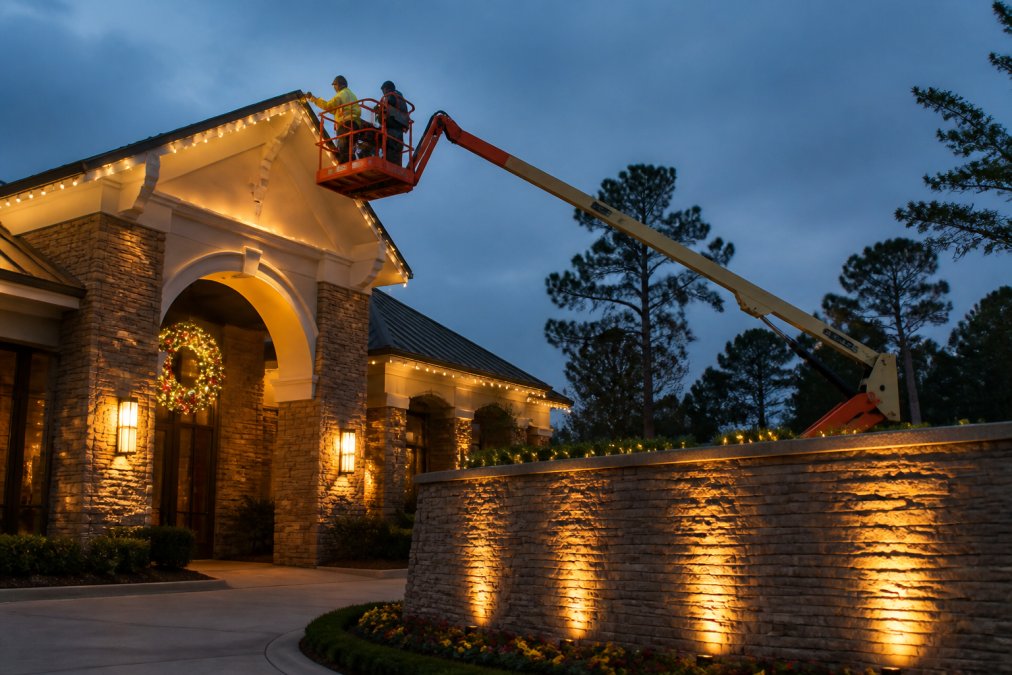
The survey determines the scope, and the scope determines the quote. Boards should request a detailed proposal that itemizes materials, labor, and the specific areas to be decorated. Require a written scope of work that names every tree, roofline, and monument included.
Setting Timelines for Installation and Removal
Professional crews typically begin commercial installations in early to mid-November, after the weather has stabilized but before the holiday rush. This window allows for careful work without the pressure of a looming deadline.
Schedule removal for the first full week of January to avoid the appearance of abandoned decor lingering into February. A contract that states the removal date in writing prevents the “we’ll get to it” delay that frustrates residents.
Design Ideas for Entrances and Monuments
The entrance monument is the visual anchor of the community. A common approach is to wrap the monument base with commercial-grade LED net lighting or a custom-wrapped garland, then add oversized, weather-resistant ornaments that scale correctly with the structure.
For the surrounding landscape, consider cool white or warm white LED path lighting that guides the eye toward the entrance. Uplighting a signature tree or adding lit wreaths to the clubhouse columns creates depth without overwhelming the space.
Safety, Liability, and Insurance: Protecting Your Community
Safety is the primary reason boards should hire professionals rather than relying on volunteer labor. Commercial-grade installations involve working at height, managing significant electrical loads, and securing fixtures against wind and weather. However, the most overlooked legal exposure for community-wide displays isn’t electrical, it’s accessibility.
The ADA and Public Right-of-Way
Under the Americans with Disabilities Act (ADA), common areas like sidewalks, pathways, and entry monuments are considered public accommodations (ada.gov). Any holiday installation must maintain a clear, unobstructed path of travel. A common violation occurs when extension cords, low-hanging garlands, or light strings encroach on a walkway.
The path of travel must maintain a minimum clear width of 36 inches, and any vertical obstructions must have a clearance of at least 80 inches above the walking surface (ada.gov). Boards should explicitly require in the vendor contract that all installations comply with these clearances and that no cabling is laid across pedestrian paths without a protective cable ramp.
Verifying Vendor Credentials
Before any vendor begins work, the board must verify three documents: a certificate of insurance naming the HOA as an additional insured, proof of workers’ compensation coverage, and a valid contractor’s license where required. The certificate should be current and should specifically list the HOA, not just the property management company, as an insured party.
Electrical Load and Fire Safety
The installation should distribute the electrical load across multiple dedicated circuits rather than overloading a single outlet, and all connections must be weatherproofed against rain and frost. A professional vendor will also ensure that no cabling creates a trip hazard on walkways or blocks emergency access. exterior restoration projects.
Fire Marshal Coordination
Many municipalities require a permit for large-scale temporary lighting installations. Boards should ask the vendor whether they handle permit applications with the local fire marshal or building department. Skipping this step can result in a stop-work order during the busiest week of the season.
Never allow a vendor to begin work without a current certificate of insurance naming the HOA as an additional insured. If an uninsured worker is injured on association property, the liability can fall on the community.
Documenting the Installation
Boards should require a post-installation walkthrough with the vendor to document the final layout. Take photographs of every connection point, anchor, and pathway clearance. This documentation provides a record for next year’s planning and protects the HOA if a resident files a claim alleging an obstruction or hazard.
Holiday Lighting Maintenance for HOA Entrances
Holiday lighting maintenance for HOA entrances is not a one-time installation; it is a season-long commitment. Wind, rain, and temperature shifts can loosen connections or damage fixtures. A maintenance plan should include a scheduled mid-season inspection to identify and address issues before they become visible failures.
The maintenance contract should specify response times. If a section of lights goes dark on a monument entrance, a professional vendor with a local crew should offer a 24 to 48 hour response window. Boards should also confirm that the warranty covers both parts and labor.
Proper removal prevents damage to the roofline or landscape and ensures that fixtures are stored correctly for reuse next year. A vendor that handles removal carefully is protecting the community’s investment.
Vendor Vetting Checklist for Holiday Decorating
Choosing the right vendor is the single most consequential decision a board makes for its holiday program. Use this checklist during the interview process to separate qualified professionals from generalists.
- Verify a current certificate of insurance naming the HOA as additional insured
- Confirm workers’ compensation coverage for all crew members
- Request references from other HOAs or commercial properties of similar scale
- Ask for a detailed written proposal with a specific scope of work
- Confirm the use of commercial-grade, weather-resistant LED materials
- Clarify the warranty terms on both parts and labor
- Establish the maintenance response time for mid-season failures
- Confirm the removal date and process in the written contract
- Ask whether the design team provides a custom plan or a standard template
A vendor that hesitates on any of these items is signaling risk. The right partner will welcome the scrutiny because they understand that a well-managed HOA is a long-term client.
Sustainability and Post-Season Storage
Modern HOA holiday programs should address sustainability, and the first step is the switch to LED technology. LED lights consume up to 80% less energy than traditional incandescent bulbs (energy.gov). When upgrading, boards should also verify that the new fixtures are recyclable at the end of their lifespan.
The Storage Dilemma: Own vs. Lease
One of the most common operational failures for HOAs is the assumption that buying decor is always the better investment. Owning requires a dedicated, climate-controlled storage space, an inventory management system, and a plan for annual inspection and repair. Many associations underestimate the cost of warehouse space and the labor required to sort, test, and organize hundreds of feet of lights each November.
A growing alternative is the leasing model, where a professional vendor provides, installs, maintains, and removes the decor each season. The vendor handles storage year-round, replacing damaged items and updating the design as trends evolve. For associations without a maintenance shed or with limited board bandwidth, leasing often delivers a lower total cost of ownership.
Inventory Management for Owners
If your board chooses to own the decor, treat it as an asset with a lifecycle. Create a simple inventory spreadsheet that logs each item, its purchase date, and its condition after removal. Label every storage bin with the zone it serves so that installation crews can pull the right materials without opening every box.
Climate Control and Material Lifespan
Commercial-grade lights and decor should be stored in climate-controlled conditions to prevent damage from humidity and temperature extremes. A garage or uninsulated shed is not adequate. If the association does not have a suitable space, factor the cost of a small climate-controlled storage unit into the annual budget.
End-of-Life Recycling
When old lights do reach the end of their usable life, boards should research local electronics recycling programs rather than discarding them with standard waste. Many municipalities and national retailers accept holiday lights for recycling, and some even offer collection drives in January. Check with your local solid waste district for specific drop-off locations and dates.
Conclusion: A Brighter Community Starts With a Plan
The difference between a chaotic holiday season and a spectacular one comes down to planning. A clear HOA holiday decoration policy sets the ground rules, a professional installation protects the community’s safety and liability, and a maintenance plan keeps the display looking pristine.
Boards that follow this framework deliver a neighborhood that residents are proud to call home, without the stress of last-minute scrambling. Houston Light transforms residential, commercial, and government properties across greater Houston into elegant, festive showcases with professional holiday lighting and decorating services. Leveraging 15 years of experience and the latest LED technology, our creative designers craft magnificent, weather-resistant displays, including custom wreaths and garland, tailored to any building size. We deliver peace of mind through comprehensive packages that feature high-quality materials, insured labor, a lifetime warranty on all installations, and free on-site commercial consultations, ensuring complete customer satisfaction.
Get started with Houston Light and bring a brighter, more connected holiday season to your community.
Frequently Asked Questions
Can an HOA require homeowners to decorate for Christmas?
No, an HOA cannot force individual homeowners to decorate. Mandates typically violate CC&Rs and create resentment. Instead, boards should focus on professionally decorating common areas like entrances and clubhouses. This creates a unified community atmosphere without intruding on personal property. Your policy should encourage voluntary participation from residents while setting clear standards for any DIY displays, ensuring aesthetic consistency and safety across the neighborhood.
What should an HOA board look for in a professional holiday decorating contract?
Look for a contract that specifies liability insurance coverage, a detailed installation and removal timeline, and a clear maintenance plan that includes regular checks and prompt bulb replacement. The agreement should also define the design scope, the quality of materials like commercial grade LED lights, and the electrical load calculations. Ask about weatherproofing standards and whether the warranty covers both parts and labor for the entire season.
How much do professional Christmas decorators charge for an HOA?
Pricing for HOA holiday decorating varies widely. It depends on the number of common areas, the height and complexity of buildings, the type of lighting and decor selected, and your required installation and removal dates. Energy consumption and any custom elements, such as wreaths or garlands for monument signage, also factor in. Contact a few professional services for a detailed quote based on your community’s specific layout and design goals.
How do professional holiday lighting services handle HOA liability and insurance?
A reputable professional service should carry general liability insurance that covers property damage and bodily injury during installation, maintenance, and removal. They should also ensure their crew is properly insured and trained for working at height. Ask for a certificate of insurance naming the HOA as an additional insured. This protects the board and the community if an accident occurs on common property.
How can professional holiday decor improve property values in an HOA?
A well-executed, professional holiday lighting display enhances curb appeal and creates a strong sense of community atmosphere. This visual impact can make the neighborhood more desirable to prospective buyers, potentially supporting property values. A consistent, high-quality display also signals an active and well-managed board, which is a positive factor for residents and real estate agents alike.
What is the typical timeline for scheduling professional holiday installation for communities?
Most professional companies begin booking HOA installations early in the year, with schedules often filling by late summer or early fall. Installation typically begins after Thanksgiving, but the specific removal timeline is set in your contract, usually in early January. To secure your preferred dates, especially for large communities, start the planning and vendor selection process in late summer.