Table of Contents
- Why Energy Efficient Holiday Lighting Matters in 2026
- How to Evaluate Eco-Friendly Holiday Lighting Options
- 1. Solar-Powered LED String Lights
- 2. Smart Holiday Lighting Controls with Timers and Automation
- 3. Energy-Efficient RGB and Color-Changing LED Systems
- 4. Professional Holiday Lighting Installation for Maximum Efficiency
- 5. Recyclable and Repairable LED Lighting Kits
- End-of-Life Disposal and Recycling for Holiday Lights
- Frequently Asked Questions
Last Updated: September 16, 2026
Why Energy Efficient Holiday Lighting Matters in 2026
Energy efficient holiday lighting is outdoor and indoor decorative lighting designed to produce strong illumination while drawing minimal power, typically through LED diodes that use a fraction of the electricity of traditional incandescent bulbs. This guide from Houston Light covers the five best eco-friendly holiday lighting options for 2026, from solar string lights to fully recyclable kits. The shift matters because holiday displays run for weeks at a time, and the difference between a wasteful setup and a smart one shows up on your utility bill and in your home’s carbon footprint.
How to Evaluate Eco-Friendly Holiday Lighting Options
Start with four specs: lumens per watt, IP rating, lifespan in hours, and whether the fixture is repairable. A light that burns out after one season is not eco-friendly no matter how little power it draws.
Use this checklist before buying anything:
- Lumens per watt: higher output per watt means less energy for the same brightness
- IP rating: outdoor-rated fixtures should carry an IP65 or higher rating for rain and dust
- Lifespan: quality LEDs are rated for tens of thousands of hours, not one season
- Repairability: can you replace a single bulb or fuse, or is the whole strand disposable?
- Recyclability: does the manufacturer take the product back at end of life?
1. Solar-Powered LED String Lights
Solar-powered LED string lights generate their own electricity from a small panel, so they draw nothing from the energy grid. Setup takes minutes: stake the panel in direct sun, run the strand, and let the built-in battery charge through the day. They work best on fences, shrubs, and rooflines that get six or more hours of daylight. Where they fall short is deep shade and heavy overcast stretches, when runtime drops noticeably.
Pros and Cons of Solar-Powered LED String Lights
Pros:
- Zero grid power consumption during operation
- No outdoor outlet or extension cord required
- Simple installation with no wiring
Cons:
- Runtime depends on daily sunlight
- Battery capacity fades over several seasons
- Brightness is lower than corded LED strands
Buy solar strands with a separate, replaceable battery pack. When the battery weakens after a few seasons, you swap one small component instead of discarding the entire strand.
2. Smart Holiday Lighting Controls with Timers and Automation
Smart holiday lighting controls are plugs, hubs, and apps that schedule when your display turns on and off, which is the single easiest way to cut wasted runtime. Automation and timer settings mean lights run only during the hours people actually see them, not from dusk until dawn. Most systems also support scenes, dimming, and smart home integration with platforms like Alexa, Google Home, or Apple Home.
What to Look For in a Smart Control
- Load rating: match the controller to the total wattage of the strands on that zone. A 15-amp plug handles far more than a 10-amp plug, and exceeding the rating is a fire risk, not just a tripped breaker.
- Protocol: Wi-Fi plugs are simplest for a single outlet; Zigbee, Z-Wave, and Matter hubs handle larger multi-zone displays with more reliability and less router congestion.
- Dimming compatibility: many older LED strands use drivers that buzz or flicker on standard dimmers. Look for controls rated for LED loads, or choose strands explicitly listed as dimmable.
- Weather rating: outdoor controllers should carry an IP65 or higher rating and a gasketed housing. Indoor-only smart plugs fail within a season when exposed to rain and freeze-thaw cycles.
- Local control fallback: a schedule stored on the device keeps running if the Wi-Fi drops, which matters during holiday travel and storms.
How to Automate an Existing Display
You do not need to replace working strands to gain the efficiency. A single outdoor smart plug on the main run, paired with a dusk-to-dawn schedule and a dimming scene, captures most of the benefit. For larger displays, split the run into zones, roofline, shrubs, trees, so each can be scheduled and dimmed independently. This also makes troubleshooting faster when one zone fails.
Pros and Cons of Smart Holiday Lighting Controls
Pros:
- Eliminates lights left on by accident
- Scene scheduling and dimming reduce power draw
- Works with existing LED strands
- Zone control lets you run only the parts of the display people actually see
Cons:
- Adds an upfront cost per zone
- Requires reliable Wi-Fi for app control
- Older strands may not be dimmer-compatible
- Hubs and apps add setup time and a learning curve
Set your schedule to match the hours your display is actually viewed, typically 5 p.m. to 11 p.m. on weeknights and slightly later on weekends. Most practitioners find this alone cuts runtime by 40 to 50 percent compared with a dusk-to-dawn timer.
Never daisy-chain more strands into a smart plug than the plug’s load rating allows, and keep outdoor controllers in a gasketed housing. A controller that fails mid-season takes the whole zone dark with it.
3. Energy-Efficient RGB and Color-Changing LED Systems
RGB LED systems use red, green, and blue diodes in one fixture to produce any color temperature or hue, so one strand replaces several single-color sets. Color-changing capability means you can shift from warm white to festive red and green without buying new lights each year. The practical benefit is fewer products purchased, stored, and eventually thrown away.
Pros and Cons of RGB LED Systems
Pros:
- One strand covers multiple color schemes
- Animated effects and projection mapping options
- Reduces the number of separate light sets you buy
Cons:
- Higher upfront cost than single-color strands
- Controllers add a failure point
- Cheaper units show weaker color accuracy
4. Professional Holiday Lighting Installation for Maximum Efficiency
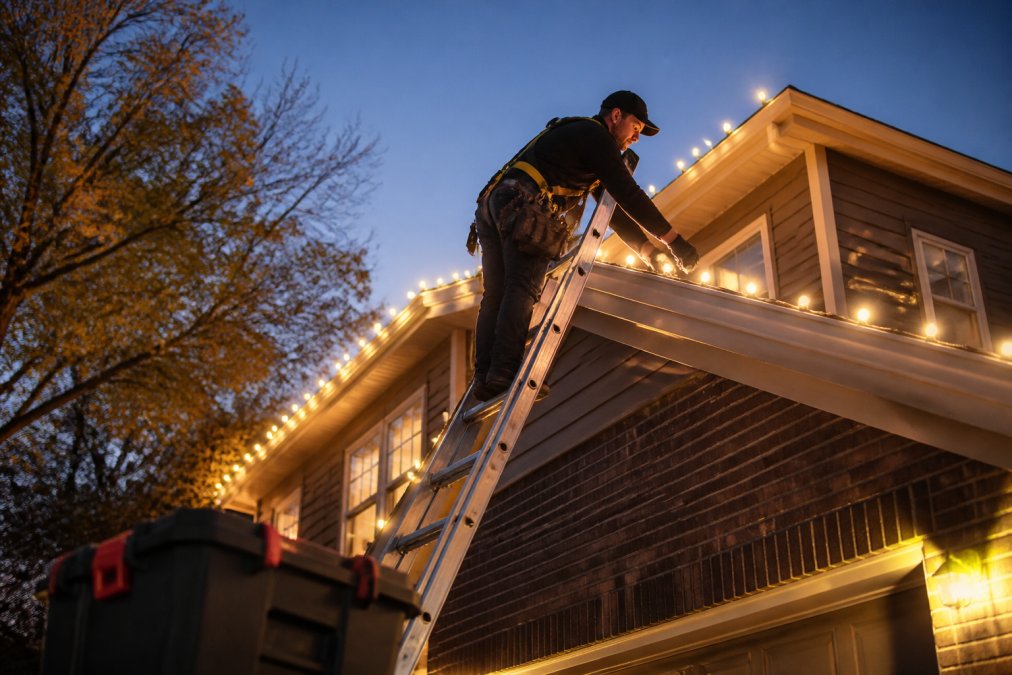
Professional holiday lighting installation pairs efficient fixtures with correct placement, load balancing, and weatherproof connections, which is where most DIY setups lose efficiency. A trained crew also handles voltage and wattage limits safely, adds fuse protection, and uses interconnectable strands so the display runs on fewer circuits. Houston Light designs and installs custom displays using current LED technology, backed by insured labor and a lifetime warranty on all installations, with free on-site commercial consultations for larger properties.
Pros and Cons of Professional Installation
Pros:
- Correct load and circuit planning from the start
- Weather-resistant, commercial-grade connections
- Insured labor and a lifetime warranty on installations
Cons:
- Higher upfront investment than DIY
- Requires scheduling ahead of the season
- Not the right fit if you enjoy installing your own display
Overloading a single circuit with too many strands is the most common cause of tripped breakers and melted connectors. Add up the wattage on each run before you plug in, and never chain more strands than the manufacturer’s limit.
5. Recyclable and Repairable LED Lighting Kits
Recyclable and repairable LED kits are built so individual bulbs, fuses, and connectors can be replaced instead of discarding the whole strand. Repairability is the quiet hero of sustainable holiday decor: a strand you fix is a strand you don’t rebuy. Look for kits with replaceable bulbs, accessible fuse protection, and a manufacturer take-back or recycling program.
Repairable vs. Sealed: How to Tell the Difference
Most strands sold today are sealed units. The LEDs are soldered to a bus wire and potted in plastic, so a single failed diode kills the whole run and there is no path to repair. Repairable kits are built differently:
- Replaceable bulbs: each socket accepts a standard replacement bulb, so one burnout does not retire the strand.
- Accessible fuses: a small slide-out fuse holder in the plug lets you swap a blown fuse in seconds instead of replacing the set.
- Serviceable connectors: screw-together or push-fit connectors can be re-terminated if a wire is nicked or a plug corrodes.
- Modular sections: some kits split into shorter runs that can be recombined, so a damaged section is replaced without scrapping the rest.
End-of-Life Disposal and Recycling
Holiday lights should never go in curbside recycling bins. The thin wiring tangles sorting equipment and the bulbs contain materials most municipal programs cannot process. Instead:
- Retailer take-back bins: several national retailers accept strands for recycling during the holiday season, typically near the entrance or customer service desk.
- Dedicated e-waste collection events: many municipalities and counties run electronics drop-off days that accept string lights.
- Mail-in recycling programs: a handful of specialty recyclers accept strands by mail and recover the copper, PVC, and LED components.
- Manufacturer take-back: some repairable-kit brands run their own return programs, which is the cleanest end-of-life path when available.
Pros and Cons of Recyclable and Repairable Kits
Pros:
- Replaceable bulbs extend usable life for years
- Fewer strands sent to landfill
- Often built with recyclable housings and packaging
- Take-back programs close the loop on materials
Cons:
- Costs more than disposable strands
- Requires a few minutes of maintenance
- Take-back programs are not available everywhere
- Replacement bulbs and fuses must be sourced from the same brand
The most sustainable strand is the one you keep. A repairable kit with replaceable bulbs and an accessible fuse costs more up front but typically outlasts two or three disposable sets, and it keeps copper and plastic out of the waste stream at the end of its life.
End-of-Life Disposal and Recycling for Holiday Lights
Holiday lights should never go in curbside recycling bins. The thin wiring tangles sorting equipment and the bulbs contain materials most municipal programs cannot process. Instead, drop strands at retailer take-back bins, dedicated e-waste collection events, or a mail-in recycling program that recovers copper and plastic. Before you recycle anything, test it: if a single bulb or fuse is the problem, repair it and keep it in service another season.
| Option | Best For | Maintenance Level | End-of-Life Path |
|---|---|---|---|
| Solar LED string lights | Fences, shrubs, sunny rooflines | Low | Battery swap, then e-waste |
| Smart controls | Any existing LED display | Low | Reuse across seasons |
| RGB LED systems | Multi-scheme displays | Low | Controller and strand recycling |
| Professional installation | Large homes, commercial sites | Minimal | Handled by installer |
| Repairable LED kits | Long-term, low-waste setups | Moderate | Bulb and fuse replacement |
The most sustainable holiday lighting choice is the one you keep using. Repairable strands and smart controls beat any single-season purchase, no matter how efficient the bulbs are.
Frequently Asked Questions
What is the most environmentally friendly lighting option for holiday displays?
LED lights are the most environmentally friendly option. They use up to 75% less energy than incandescent bulbs and last up to 25 times longer. Solar-powered LED string lights take this further by using renewable energy, and smart holiday lighting controls reduce waste by ensuring lights only run when needed. Look for recyclable or repairable kits to minimize landfill waste at the end of the season.
How do LED holiday lights compare to traditional incandescent bulbs in energy usage?
LED holiday lights consume about 75% less electricity than incandescent bulbs for the same brightness. A typical string of 100 incandescent mini lights draws roughly 40 watts, while an equivalent LED string uses only 4 to 10 watts. Over a full holiday season, that difference can cut your lighting-related energy costs significantly while reducing your carbon footprint.
Are solar-powered holiday lights effective for residential displays?
Solar-powered holiday lights work well for residential displays when placed in direct sunlight during the day. They store energy in a rechargeable battery and run for 6 to 8 hours after dark. Performance drops in cloudy conditions or shaded areas, so they are best for rooflines, fence posts, and yard fixtures that get full sun. For larger displays, pair them with energy efficient holiday lighting fixtures that draw from the grid.
How can professional holiday lighting services improve energy efficiency?
Professional holiday lighting installation ensures lights are correctly sized, properly connected, and weather-sealed to prevent energy waste. Installers use LED technology with optimized voltage and wattage, set up smart holiday lighting controls with timer settings, and design layouts that avoid overloading circuits. This reduces power consumption and extends the lifespan of your display, saving money and materials over time.