Table of Contents
- What’s Changing for HOA Holiday Lighting in 2026
- HOA Holiday Lighting Guidelines: What Most CC&Rs Actually Say
- The HOA Holiday Decor Approval Process, Step by Step
- Permanent Holiday Lighting for Communities: Year-Round Accent Lighting Done Right
- Professional Holiday Lighting Installation for HOAs: Liability, Insurance, and Safety
- Conflict Resolution and Policy Templates for HOA Boards
- Frequently Asked Questions
Last Updated: September 15, 2026
What’s Changing for HOA Holiday Lighting in 2026
Holiday lighting for HOAs 2026 is shifting toward permanent LED systems, tighter energy standards, and clearer written policies that protect both boards and residents. This guide from Houston Light breaks down the rules, timelines, and approval steps that matter most.
Boards across the country are rewriting outdated decor policies this year. The reason is practical: LED technology has changed what a community display can look like, and most CC&Rs were written before that technology existed. A policy drafted in 2010 often bans things residents now request by name, and it permits things boards no longer want.
Most guides on this topic skip the hard part. They tell residents to “check your CC&Rs” and tell boards to “be flexible,” which helps nobody. Below, we walk through the actual language, the actual review steps, and the actual timelines that keep a community display on schedule.
The single biggest change in holiday lighting for HOAs 2026 is permanence. Residents increasingly want year-round accent lighting rather than a six-week display, and most existing HOA documents have no category for it. Boards that add a permanent-lighting clause now avoid the disputes later.
HOA Holiday Lighting Guidelines: What Most CC&Rs Actually Say
Most CC&Rs address holiday lighting in three places: a seasonal display window, a restriction on permanent fixtures, and a catch-all clause about “nuisances” that covers light pollution and light trespass.
That third clause causes the most conflict. It is vague by design, which means whoever interprets it decides the outcome. A clear policy replaces interpretation with a stated rule.
Community standards typically cover:
- Approved display periods, usually tied to specific holidays
- Fixture types, often limited to low-voltage or energy-efficient LEDs
- Attachment methods, with clips and stakes generally preferred over nails and screws
- Nighttime visibility limits, addressing brightness and light spill onto neighboring lots
- Removal obligations, including who pays if a resident does not remove a display
What most guides miss is that these clauses rarely mention permanent LED lighting, because the product did not exist when the documents were drafted. That gap is where 2026 disputes are happening.
Installation Windows and Removal Deadlines
A typical installation window opens in mid-November and closes shortly after Thanksgiving, with removal required by mid-January (New HOA Holiday Guide). Exact dates vary by community, so residents should confirm the specific dates in their own documents rather than assume a standard window applies.
Two deadlines matter, and they are not the same date. The installation window governs when lights may go up. The removal deadline governs when they must come down. Missing the removal deadline is the more common violation, and it is also the easier one to enforce, because it is objective and easy to document.
The most common mistake boards make is enforcing the removal deadline inconsistently. If one resident’s lights stay up through February without consequence, every later enforcement action becomes harder to defend. Document every notice, every year, for every property.
The HOA Holiday Decor Approval Process, Step by Step
The approval process for HOA holiday decor follows a predictable path, and understanding it in advance is what separates a fast approval from a rejected request. The mechanics matter more than the steps, because most rejections are procedural, not aesthetic.
Step 1: Pull the current policy. Request the most recent version of the holiday decor policy and the CC&Rs from the board or management company. Policies are amended more often than residents expect, and a policy amended in the spring may already govern the winter season. Ask specifically for the amendment date, not just the document.
Step 2: Complete the architectural request form. Most communities require a written submission to the Architectural Review Committee (ARC), even for temporary displays. Include dates, fixture type, and a photo or sketch of the proposed design. If your community uses a management company, the form usually lives in the resident portal rather than with the board.
Step 3: Submit before the deadline. ARC review takes time. Submitting the week the installation window opens usually means missing it. A common pattern is that committees meet monthly or biweekly, so a submission that lands the day after a meeting sits for weeks.
Step 4: Respond to conditions. Committees often approve with conditions, such as a specific removal date or a limit on brightness. Accept the conditions in writing. A conditional approval that goes unacknowledged is treated as an incomplete application in many communities.
Step 5: Keep your approval letter. If a neighbor complains in January, that letter is your proof of compliance. Store it with your vendor contract so both documents travel together.
Three mechanics decide most outcomes:
- What triggers review. Temporary displays under a stated size threshold are sometimes exempt. Permanent fixtures almost never are. Confirm which category your plan falls into before you submit.
- Who actually votes. The ARC recommends; the board usually ratifies. A favorable ARC recommendation can still stall if the board does not meet before your installation window.
- What counts as a complete application. Missing photos, missing dates, or a sketch without dimensions are the most common reasons an application is returned rather than denied.
An application returned as incomplete does not stop the clock on your installation window. If the committee asks for more information two weeks before the window opens, respond the same day.
How to File a Variance Request That Gets Approved
A variance request succeeds when it answers the committee’s real concern before they raise it. Committees are not usually opposed to the display itself. They are opposed to precedent, liability, and neighbor complaints.
Write the request in four short parts:
- What you want, stated in one sentence
- Why the standard policy does not fit, with specifics about your property
- How you will limit impact, covering brightness, light spill, and duration
- What you will do if a neighbor objects, showing you will handle it yourself
That fourth point is the one most requests omit, and it is the one that moves a committee from “no” to “yes with conditions.”
Two additional details separate approved variances from denied ones. First, cite the specific clause you are asking to vary, by section number. Committees respond to precision. Second, propose a sunset date. A variance framed as “this season only” is easier to approve than one framed as permanent, and it gives the committee a face-saving exit if neighbors object later.
If your request is denied, ask for the denial in writing with the specific clause cited. A written denial is the starting point for an appeal, and many boards allow one appeal per season. Verbal denials are difficult to appeal and easy to forget.
Permanent Holiday Lighting for Communities: Year-Round Accent Lighting Done Right
Permanent holiday lighting for communities is a professionally installed, low-voltage LED system mounted along rooflines and architectural features that stays in place year-round and changes color or pattern by season. It replaces the annual install-and-remove cycle with a single installation.
The appeal for boards is straightforward. No ladders in December. No removal deadline to enforce. No storage.
When evaluating a permanent system, ask what happens at the connection points, not just the lights. Most failures trace to water intrusion at a splice or a poorly sealed channel, not to the LED itself. A lifetime warranty on the installation is only meaningful if it covers labor, not just parts.
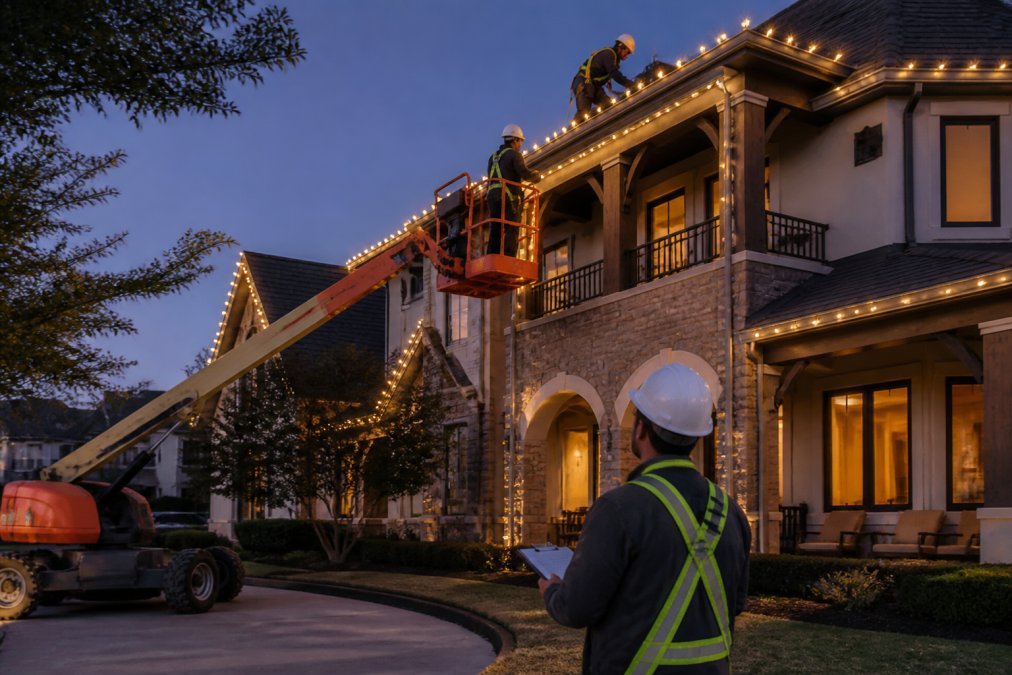
Professional Holiday Lighting Installation for HOAs: Liability, Insurance, and Safety
Ask any contractor for three things before work begins:
Conflict Resolution and Policy Templates for HOA Boards
A Board-Ready Policy Template
Boards that publish a clear policy and enforce it evenly spend far less time on complaints than boards that handle each request case by case. Consistency is the enforcement tool, not severity.
Handling a Dispute Without Escalating It
Frequently Asked Questions
Do HOAs allow Christmas lights?
Most HOAs do allow holiday lights, but nearly all attach conditions. Typical CC&Rs limit displays to a set installation window, cap the display period at 60 to 90 days, and restrict light color and brightness to reduce light trespass on neighboring homes. Some boards also require warm white only, prohibit animated or flashing elements after a certain hour, and mandate that all fixtures be weather-resistant and UL-listed. Before you hang anything, request your community’s current holiday decor policy in writing so you know the exact rules that apply to your lot.
Are permanent LED lighting systems allowed in most HOAs?
Approval rates have risen sharply as more boards recognize the benefits: permanent LED tracks can be set to warm white for everyday accent lighting and switched to RGB color-changing modes only during approved holiday windows. That dual use satisfies curb appeal goals without creating year-round light pollution. Still, permanent holiday lighting for communities usually requires an architectural review committee submission showing the track color, mounting method, and timer settings. Boards that approve these systems often add a condition that colored modes stay off outside the holiday season.
What is the recommended timeline for installing and removing HOA holiday lights?
A practical schedule starts with ARC approval in late August or early September, professional installation in the first two weeks of November, and removal by mid-January. Many CC&Rs set a hard removal deadline of January 15 or 30 days after the holiday, and fines can begin the day after. Booking installation early matters because reputable crews fill their November calendars by October. Confirm your community’s exact installation window and removal deadline in writing, then schedule both the install and the takedown at the same time.
How do HOAs handle liability for professional holiday lighting installation?
The board should require a certificate of insurance from any contractor working on common areas, showing general liability coverage and workers’ compensation. This protects the association if a worker is injured or a fixture damages property. For homeowner-installed displays, CC&Rs typically place liability on the owner. Outdoor electrical safety matters too: all exterior circuits should be GFCI-protected, connections kept off the ground, and low-voltage systems used where possible. Document the insurance requirement in your holiday decor policy so enforcement stays consistent across every property.
Community lighting works best when the rules are clear before the season starts, not after a complaint lands. Houston Light handles HOA holiday lighting from design through removal, with insured crews, weather-resistant installations, and a lifetime warranty on every installation. Free on-site consultations are available for commercial and community properties, so boards can see a plan before committing. Get a free estimate from Houston Light and start your community’s 2026 display on schedule.