Table of Contents
- Why Houston Homes Need Energy Efficient Holiday Lights
- The Benefits of LED Holiday Lights for Houston Displays
- Top Energy Efficient Holiday Lights for Houston Homes
- How to Safely Hang Roof Lights in Houston’s Climate
- Holiday Lighting Maintenance Tips for a Worry-Free Season
- Calculating Energy Savings and Smart Home Integration
- Frequently Asked Questions
Last Updated: September 16, 2026
Why Houston Homes Need Energy Efficient Holiday Lights
Houston’s holiday season brings warm, humid evenings that punish ordinary light strings. Choosing the best energy efficient holiday lights for Houston homes means picking fixtures built for heat, moisture, and long December nights, not whatever box is left at the hardware store. At Houston Light, we have 15 years of experience installing displays across the area, and the difference between a strand that survives the season and one that fails by mid-December almost always comes down to bulb type, wiring quality, and weather sealing.
The Benefits of LED Holiday Lights for Houston Displays
LED technology solves the two problems that define holiday lighting here: power draw and heat. A traditional incandescent strand converts most of its energy into heat rather than light, which is exactly the wrong trade in a warm, damp climate. LED bulbs run cool, which means less stress on the fixture and less risk near rooflines and dry landscaping.
Lower Power Consumption and Electricity Savings
Power consumption is where LED pulls ahead by a wide margin. Because each diode sips current rather than burning through it, you can run a longer, brighter display without watching your meter climb the way it would with older strings. Wattage reduction of this scale also means you can put more lights on a single circuit, which simplifies your layout and reduces the number of extension runs you need.
LED Longevity and Durability in Humidity
Humidity is the quiet killer of cheap holiday lighting. Corrosion creeps into sockets and connections, and a strand that worked fine in the store can flicker or die once it has spent a few weeks in Gulf Coast air. Professional-grade LED strings use sealed housings and corrosion-resistant contacts that hold up far better than bargain-bin alternatives.
Check the connection points first when a section goes dark. In Houston’s humidity, a loose or corroded plug causes more outages than a burned-out bulb ever will.
Top Energy Efficient Holiday Lights for Houston Homes
The best energy efficient holiday lights for Houston homes balance brightness, weather sealing, and control flexibility. Three categories cover almost every residential display: C7 and C9 string lights for rooflines and trees, and smart controllers for anyone who wants variety without rehanging anything.
C7 and C9 String Lights: Warm White vs Cool White
C7 string lights use smaller, closer-set bulbs that suit window frames, wreaths, and detailed trim work. C9 bulbs are larger and spaced further apart, which makes them the standard choice for rooflines and large trees where you want bold, visible points of light from the street. Both come in LED, and both reward you with low power draw and long life.
| Bulb Type | Best Placement | Look | Notes |
|---|---|---|---|
| C7 | Windows, wreaths, trim | Defined, detailed | Closer bulb spacing |
| C9 | Rooflines, large trees | Bold, visible from street | Wider spacing, higher impact |
| Warm white | Brick and stone facades | Traditional, welcoming | Consistent color temperature |
| Cool white | Contemporary architecture | Crisp, modern | Avoid mixing with warm white |
Smart Controllers and Twinkling Effects
Smart controllers let you change twinkling effects, brightness, and timing from an app instead of climbing a ladder. For a homeowner who wants a static warm-white display one week and a livelier pattern the next, a controller delivers that variety without touching a single strand. Smart home integration also means you can schedule your display to match your evening routine and shut off automatically when you head to bed.
Match bulb type to placement first, then add a controller. The controller changes how your display behaves, but it cannot fix a bulb that is the wrong size or color temperature for the job.
How to Safely Hang Roof Lights in Houston’s Climate
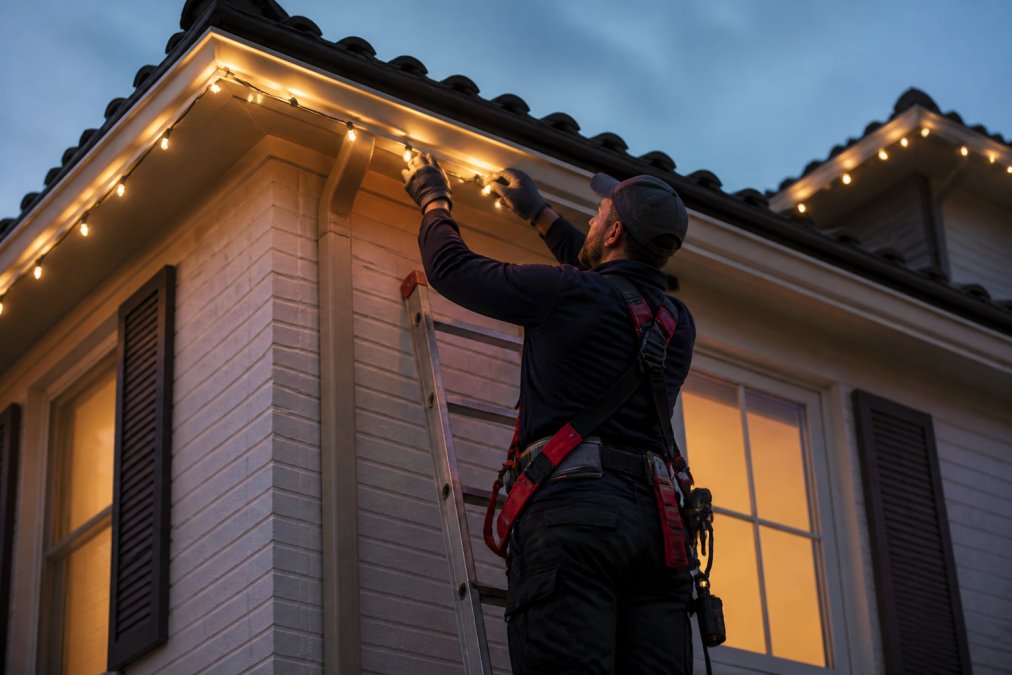
Safety here comes down to three things: the right hardware, certified wiring, and a plan for heat and humidity. Learning how to safely hang roof lights starts with treating your roofline as an electrical installation, not a decoration project.
Weather-Resistant Hardware and IP Ratings
An IP rating (Ingress Protection) is a two-digit code. The first digit covers solids like dust; the second covers water. IP65 means the housing is dust-tight and protected against water projected from a nozzle, the sensible minimum for outdoor holiday lighting in a humid climate. IP67 adds protection against temporary immersion, which matters for fixtures sitting in low spots where water pools after a storm. IP44 is splash-resistant only and is a poor fit for a roofline that will see weeks of Gulf Coast moisture.
Hardware choices matter just as much:
- Clips: Cheap plastic clips crack under UV exposure and drop your strands onto the lawn. Look for UV-stabilized plastic or coated metal clips rated for outdoor use.
- Fasteners: Stainless steel or coated fasteners resist the oxidation that turns ordinary steel hardware into a rust stain on your fascia.
- Connections: Keep every plug and connector off the ground and out of standing water. Elevate them on a clip or a stake, and point connections downward so water drains away rather than pooling in the socket.
UL-Certified Wiring and Load Planning
UL-certified wiring has been tested to recognized safety standards, which matters when you are running current along a roof edge for weeks at a time. Look for the certification mark on every strand, and never daisy-chain more strings than the manufacturer allows. Voltage drop over long runs causes dim sections and extra heat, so plan your circuits rather than extending one line across the whole house.
A few load-planning habits prevent most mid-season problems:
- Add up the wattage on each circuit before you plug in, and stay well under the breaker’s rating.
- Split long runs across multiple circuits instead of chaining everything end to end.
- Use outdoor-rated extension cords sized for the load, and keep the connection points elevated.
- Inspect before you hang. Test every strand on the ground, and replace any with cracked sockets or exposed wire rather than hoping they hold.
Overloading a single outlet with too many strands is the most common cause of mid-season outages. Split the load across circuits and keep connections off the ground where water collects.
End-of-Season Storage for Humidity
Storage is where a lot of Houston displays quietly fail. Moisture trapped in a bin over the summer corrodes contacts long before the next season starts. Take the lights down carefully, let them dry completely in a covered area, and store them in labeled bins by strand length and bulb type. Coiling them loosely around a spool prevents the tangles and cracked sockets that shorten a strand’s life.
Holiday Lighting Maintenance Tips for a Worry-Free Season
A short maintenance routine keeps your display running from Thanksgiving through New Year. Walk your roofline once a week and check for sagging strands, loose clips, and dark sections. Clear debris and standing water away from ground-level connections, since pooled moisture is what pushes corrosion into a socket.
Calculating Energy Savings and Smart Home Integration
Most guides tell you LEDs save energy and stop there. The useful version of that claim is a number you can check against your own bill, so here is the math worked out for a typical residential display.
The Wattage Math, Step by Step
Start with the wattage printed on the strand’s tag or listed on the manufacturer’s spec sheet. Incandescent C9 strings commonly draw around 5 to 7 watts per bulb, while LED C9 replacements typically draw well under 1 watt per bulb, often in the 0.5 to 0.8 watt range. That per-bulb gap is where the savings live, and it compounds fast across a roofline.
- Incandescent at 6 watts per bulb: 200 × 6 = 1,200 watts, or 1.2 kW. Over 6 hours that is 7.2 kWh per night, and 324 kWh across the season.
- LED at 0.7 watts per bulb: 200 × 0.7 = 140 watts, or 0.14 kW. Over 6 hours that is 0.84 kWh per night, and about 38 kWh across the season.
Smart Controllers, Scheduling, and Automation
A few practical points worth knowing before you buy:
- Channel count matters. A single-channel controller runs one effect across the whole display. Multi-channel controllers let you run different effects on different zones, roofline one way, trees another, from the same app.
- Check the amperage rating. The controller’s rated load has to cover every strand plugged into it, with headroom to spare.
- Weather sealing still applies. A controller mounted outdoors needs the same moisture protection as the strands themselves; a controller tucked into a garage or covered outlet lasts longer.
- Timer backups help. If your controller loses power, a schedule that resets automatically saves you a ladder trip.
Run the wattage math once with your own bulb count and your own effective rate, then let a scheduled controller handle the rest. The calculation tells you what the upgrade is worth; the schedule makes sure you actually capture it.
If you would rather hand the whole project to a team that does this every year, Houston Light installs weather-resistant LED displays with insured labor and a lifetime warranty on the installation. Our HOA holiday lighting and commercial holiday lighting services cover properties of every size, from a single roofline to a full plaza.
Frequently Asked Questions
What are the most energy-efficient Christmas lights for Houston homes?
LED lights are the most energy-efficient option, using up to 75% less electricity than incandescent bulbs. For Houston’s humid climate, look for UL-certified, weather-resistant LEDs with an IP65 rating. C7 and C9 string lights in warm white or cool white are popular choices. Smart controllers can further reduce power consumption by scheduling on/off times. Professional-grade LEDs from Houston Light are designed to withstand local weather while keeping energy costs low.
How can I reduce my electricity bill while decorating for the holidays?
Switch to energy-efficient LED holiday lights, which consume significantly less power than traditional bulbs. Use smart controllers or timers to limit display hours to 6-8 per night. Choose the right color temperature and avoid overloading circuits. For Houston homes, weather-resistant LEDs with durable wiring prevent energy waste from faulty connections. A professional installation can optimize your setup for maximum efficiency and minimal cost.
Are LED holiday lights safer for outdoor use in Houston?
Yes, LED holiday lights are safer for outdoor use because they operate at lower temperatures and are less likely to overheat. Look for UL-certified lights with an IP65 rating for protection against Houston’s humidity and rain. Proper installation with corrosion-resistant hardware and GFCI outlets further reduces risks. Houston Light’s insured labor and lifetime warranty ensure your display is both safe and reliable throughout the season.
What maintenance do energy-efficient holiday lights need after installation?
Energy-efficient LED lights require minimal maintenance. Check for loose connections, replace any faulty bulbs promptly, and clean fixtures with a dry cloth to prevent corrosion. In Houston’s humid climate, inspect wiring for moisture damage after storms. Store lights in a cool, dry place during the off-season. Professional services like Houston Light include seasonal maintenance and a lifetime warranty, so you can enjoy your display without frequent upkeep.
Houston’s humidity and warm winters make holiday lighting a tougher job than most homeowners expect, and the wrong strands will show it by mid-December. Houston Light brings years of local installation experience, the latest LED technology, and weather-resistant hardware built for this climate, all backed by a lifetime warranty and insured labor. Get a free estimate from Houston Light and start your season with a display built to last.