Table of Contents
- What Separates the Best Outdoor Holiday Decorators for Large Estates
- How We Evaluated These Estate Decorating Providers
- 1. Houston Light: Full-Service Holiday Decorating for Large Properties
- 2. Professional Holiday Lighting Installation Providers
- 3. Custom Holiday Lighting Design for Estates
- 4. Holiday Lighting Maintenance and Removal Services
- 5. Commercial-Grade Decor for Large Properties
- 6. Smart-Home and Automation Integration
- 7. Sustainability and Eco-Friendly Decor Practices
- Frequently Asked Questions
Last Updated: October 2, 2026
What Separates the Best Outdoor Holiday Decorators for Large Estates
Choosing outdoor holiday decorators for large estates comes down to one question: can the crew handle scale without cutting corners?
Most homeowners start by comparing price quotes. That’s the wrong first move. The providers who fail on large estates rarely fail on price. They fail on insurance documentation, storage logistics, and whether their crew can finish a full install before the season starts.
U.S. Consumer Product Safety Commission holiday decoration safety guidance
How We Evaluated These Estate Decorating Providers
We scored providers on four criteria: insurance and liability coverage, installation capacity for large properties, material durability, and post-season storage and takedown. A provider that nails three of four but drops the ball on storage will leave you hunting for a place to put 40 strands of commercial-grade garland in January.
Full-Service vs. Install-Only Providers
Full-service providers handle design, installation, maintenance, takedown, and storage. Install-only providers show up, hang lights, and leave. For a large estate, full-service almost always wins. The coordination alone, matching roofline runs to tree wraps to entry columns, takes planning that install-only crews don’t build into their schedule.
Insurance, Warranty, and Safety Documentation
Ask for a certificate of insurance before anyone climbs a ladder. A provider working at height on a two-story home or a commercial plaza carries real liability exposure. Insured labor protects you if a worker is injured on your property. A written warranty tells you what happens when a strand fails in week three. Get both in writing before signing anything.
The most common mistake estate owners make is hiring on price alone and skipping the insurance check. If an uninsured worker falls on your property, your homeowner’s policy may be the one that responds. Always request a certificate of insurance and a written warranty before work begins.
1. Houston Light: Full-Service Holiday Decorating for Large Properties
Houston Light is a full-service holiday decorating company built specifically for residential, commercial, and government properties.
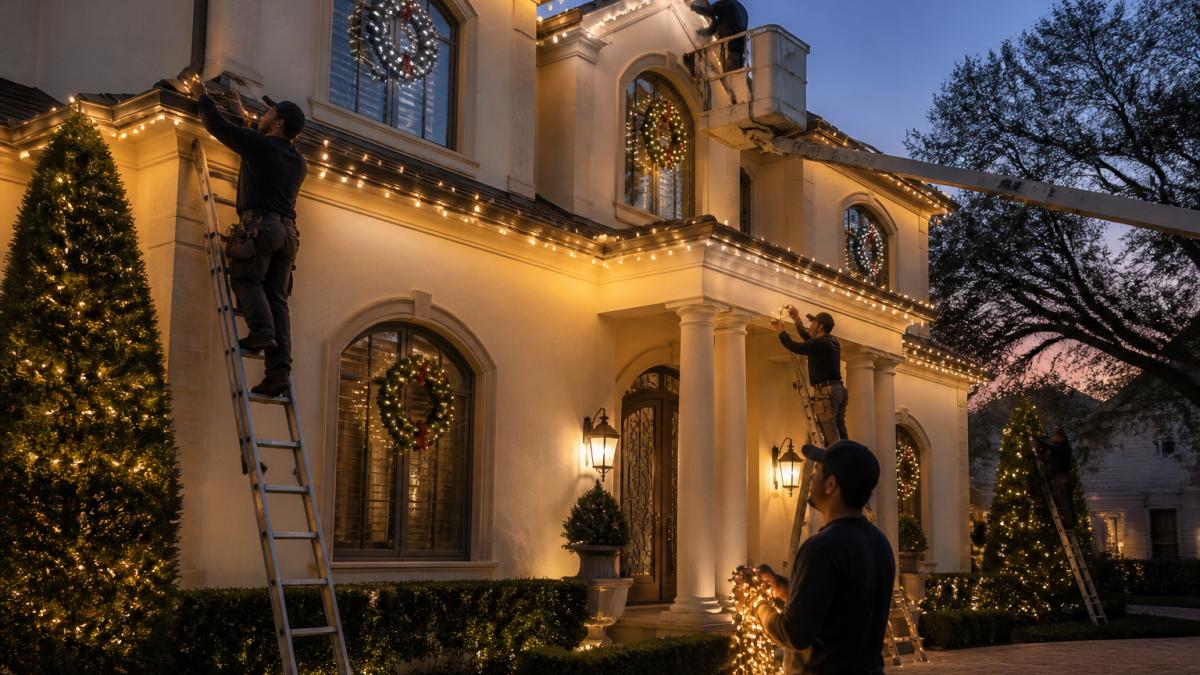
Best for: Estate owners and commercial property managers who want one provider handling everything from design through storage.
The honest limitation: Full-service packages cost more than hiring a crew that only installs. You’re paying for coordination, insurance, and warranty coverage that install-only providers don’t carry.
Occupational Safety and Health Administration ladder safety guidance
2. Professional Holiday Lighting Installation Providers
Professional holiday lighting installation is the category most people picture: a crew arrives, hangs lights, and leaves. These providers work well when you already have a design and just need labor. The catch is that “professional” means different things to different companies. Some carry full insurance and use commercial-grade materials. Others are seasonal operations with minimal coverage.
Ask three questions before hiring: What’s your insurance coverage? What happens if a strand fails mid-season? Do you offer takedown? A provider that can’t answer all three clearly isn’t built for a large property.
3. Custom Holiday Lighting Design for Estates
Custom holiday lighting design for estates starts with the architecture, not a catalog. A designer walks the property, notes rooflines, columns, tree placement, and sightlines from the street, then builds a plan around them. This is where a curated aesthetic separates a standout display from a generic one.
Design-led providers typically charge for the design phase separately or fold it into a full-service package. If you want a festive exterior that looks intentional rather than assembled, this is the category to prioritize.
4. Holiday Lighting Maintenance and Removal Services
Holiday lighting maintenance and removal services cover the middle and end of the season. Mid-season maintenance matters more than most owners expect. A single failed strand on a roofline run can darken an entire section of your display.
Takedown timing matters too. Leaving lights up past January exposes them to weather and can void a warranty. Confirm the takedown window in writing.
Book takedown at the same time you book installation. Crews fill their January calendars fast, and a provider who installs in November may not have room to remove your display in January if you call late.
5. Commercial-Grade Decor for Large Properties
Commercial-grade decor uses thicker wire, sealed connections, and weather-resistant housings built to survive a full season outdoors. On a large estate, this isn’t a luxury. It’s the difference between a display that holds up through rain and wind and one that needs constant repair.
What “Commercial-Grade” Actually Means
The term gets thrown around loosely, so it helps to know what to look for. Commercial-grade strands typically use 18-gauge or heavier wire, molded sealed sockets rather than push-in bulbs, and connectors rated for wet locations.
Look for products carrying a UL listing for wet locations. That listing tells you the strand has been tested for outdoor exposure, not just indoor use.
Why Volume Changes the Math
On a small home, a failed strand is an inconvenience. On a large estate with dozens of runs, a failed strand is a service call, a ladder, and a scheduling headache. Commercial-grade materials cost more upfront, but they typically last multiple seasons, which changes the math when you’re buying volume. A display that survives three seasons costs less per season than one that gets replaced every year.
The Storage Question Competitors Skip
Here’s the part most guides leave out: commercial-grade decor only pays off if it’s stored correctly between seasons. Thick wire and sealed sockets survive weather, but they don’t survive a damp garage or a cardboard box in an attic.
A common pattern among estate owners is to spend on premium materials in November and then store them in conditions that shorten their life by half.
Commercial-grade decor is only commercial-grade if it’s stored like it. Ask about climate-controlled storage before you sign, not after the season ends.
6. Smart-Home and Automation Integration
Smart-home integration lets you control your holiday display from a phone, set schedules, and change colors without touching a single strand. Providers offering this connect lighting to existing smart-home systems, so your display runs on the same app as your interior lights.
This is one of the areas most estate owners overlook, and it’s also where the biggest gap in the current market sits. Most holiday decorators can hang lights.
How Integration Actually Works
There are two common approaches. The first uses smart plugs and controllers that connect to your existing Wi-Fi network, letting you schedule zones through an app.
The second approach is more reliable at scale. Wi-Fi plugs work fine for a few strands, but when you’re running dozens of zones across a large property, signal drops and scheduling conflicts become a real problem.
Why This Matters for Large Estates
Automation reduces energy use by running lights only during set hours, and it eliminates the nightly ritual of plugging in and unplugging multiple zones. On a property with a long driveway, multiple outbuildings, and tree wraps spread across acres, manual control isn’t realistic.
There’s also a security angle. A display that runs on a predictable schedule looks intentional. A display that flickers on and off because a smart plug lost its connection looks like a problem.
The Question to Ask Before Hiring
Ask any provider how their system integrates with what you already have. If they can’t explain the difference between a Wi-Fi plug and a dedicated controller, or if they can’t tell you what happens when your home network goes down, they’re not set up for estate-scale automation. The providers worth hiring will walk your property, identify your existing control infrastructure, and design the display around it rather than bolting on a separate app you’ll have to manage.
If your estate already runs on a central automation system, ask whether the holiday display can be added as a scene rather than a separate app. One control interface is easier to manage than three.
7. Sustainability and Eco-Friendly Decor Practices
Eco-friendly decor practices center on LED technology, reusable materials, and responsible disposal at season’s end. LED strands use a fraction of the power of incandescent bulbs, and commercial-grade pieces built to last multiple seasons keep materials out of landfills.
Ask providers whether they reuse structural elements like frames and garland bases year over year. A provider that stores and reuses your display is also practicing sustainability, since nothing gets thrown away and re-bought each season.
Frequently Asked Questions
What should I look for when hiring a professional holiday decorator for a large estate?
Look for full-service capability: custom design, commercial-grade materials, insured installation crews, and takedown with storage. Confirm the provider carries liability insurance and offers a written warranty. Ask whether they use LED technology and weather-resistant fixtures, since these hold up through winter storms. For large estates, verify they have experience with multi-story facades, long rooflines, and large trees. Houston Light, for example, provides insured labor and a lifetime warranty on all installed lighting.
How do professional holiday lighting services handle large estates?
Providers typically start with an on-site consultation to map the property’s architecture, measure rooflines and trees, and plan power access. They use bucket trucks or lifts for multi-story work, commercial-grade clips and cable for long spans, and LED fixtures that draw less power across large areas. Installation is usually scheduled in phases so the display is complete before peak season. Houston Light offers free on-site commercial consultations and has handled large plaza installations.
Are holiday lighting services insured for large residential properties?
Reputable providers carry general liability insurance and workers’ compensation coverage. For large estates, ask for a certificate of insurance before work begins and confirm the policy covers installation at height. This protects you if a crew member is injured or property is damaged during installation. Houston Light emphasizes insured labor as part of its service, giving property owners documented protection throughout the project.
How early should I book professional holiday decorators for my estate?
Book by late summer or early fall for large estates. Multi-story properties and commercial installations require design time, material ordering, and scheduling of lifts and crews. Waiting until November often means limited availability and rushed installations. Houston Light recommends reaching out in advance to secure your preferred installation window and allow time for custom design work, including wreaths and garland tailored to your property.
Sourcing outdoor holiday decorators for a large estate gets complicated fast when you’re juggling design, installation, insurance, and storage across multiple vendors. Houston Light handles all of it under one roof, with 15 years of experience, a lifetime warranty on every installation, insured labor, and free on-site consultations for commercial properties. Get your FREE estimate and let one team manage the entire season, from the first design walkthrough to January takedown.