Table of Contents
- Why LED Holiday Lights Are the Right Choice for Rooflines
- C9 vs C7 LED Holiday Lights: Which Bulb Size Works Best
- How to Safely Hang Roof Lights: Installation Fundamentals
- Holiday Lighting Safety Standards and Electrical Considerations
- Calculating Total Footage and Planning Your Roofline Display
- Permanent vs Seasonal Installation: What Works for Rooflines
- Professional Holiday Lighting Installation: When to Call the Experts
- Maintenance, Storage, and Longevity of Your LED Display
- Frequently Asked Questions
Last Updated: September 20, 2026
Why LED Holiday Lights Are the Right Choice for Rooflines
LED holiday lights have fundamentally changed how homeowners approach roofline decorating. Unlike incandescent bulbs that waste energy as heat, LEDs convert nearly all electrical input into visible light, making them the practical choice for permanent or seasonal roofline installations. The shift matters because rooflines demand durability, they’re exposed to weather, temperature swings, and the physical stress of installation hardware.
The best LED holiday lights for rooflines combine three essential qualities: bright output that reads well from street level, weatherproof construction rated for outdoor conditions, and compatibility with the mounting hardware your roof type requires. Whether you’re decorating a modest residential home or a large commercial property, the fundamentals remain constant.
At Houston Light, we’ve learned that the right bulb choice, paired with proper installation technique, determines whether your display looks elegant for years or fails mid-season.
LED strings consume 80% less energy than incandescent equivalents while producing comparable brightness. On a roofline that runs 200 feet, this difference translates to measurable utility savings across a season.
C9 vs C7 LED Holiday Lights: Which Bulb Size Works Best
The choice between C9 and C7 bulbs shapes your entire roofline display. These aren’t interchangeable, they differ in brightness, spacing, visual impact, and the load they place on your electrical circuit.
C9 Bulbs: Brightness and Visual Impact
C9 bulbs are the larger option, roughly the size of a thumb. They deliver higher lumen output, meaning they read clearly from greater distances and create a bolder visual statement. C9s work best on rooflines where you want architectural scale, homes with high pitch, large commercial buildings, or displays meant to draw attention from across a parking lot.
The tradeoff is spacing. C9 strings typically space bulbs 12 inches apart, so you’ll need fewer total feet to cover the same roofline length. A 100-foot roofline might require 100 feet of C9 string versus 150 feet of C7. This matters for load calculations and installation labor.
C9 LED bulbs with E17 bases fit standard C9 sockets. Verify your existing hardware accepts E17 before ordering, especially if you’re reusing strings from prior years.
C7 Bulbs: Efficiency and Density
C7 bulbs are smaller, roughly the size of a marble, and space 4 inches apart on most strings. This density lets you create uniform, continuous coverage with fewer gaps. C7 is the choice for rooflines where you want elegant, refined appearance rather than bold impact.
C7 LED strings consume less power per foot than C9 equivalents, which matters if you’re daisy-chaining multiple strings on a single circuit. The smaller bulb also means less wind resistance, which reduces stress on mounting hardware during storms.
The downside: C7 bulbs produce less lumen output individually. From a distance, a C7 display reads as a continuous line of light rather than distinct points of brightness. For residential homes under 40 feet wide, this is actually preferable. For large commercial rooflines, C9 usually wins.
Choose C9 if your roofline is large or highly visible from a distance. Choose C7 if you want dense, uniform coverage on a smaller footprint or prefer refined appearance over bold impact.
How to Safely Hang Roof Lights: Installation Fundamentals
Installing LED lights on a roofline requires three components: the light string itself, mounting hardware that secures it without damaging the roof, and weatherproof connectors that protect electrical connections from water intrusion.
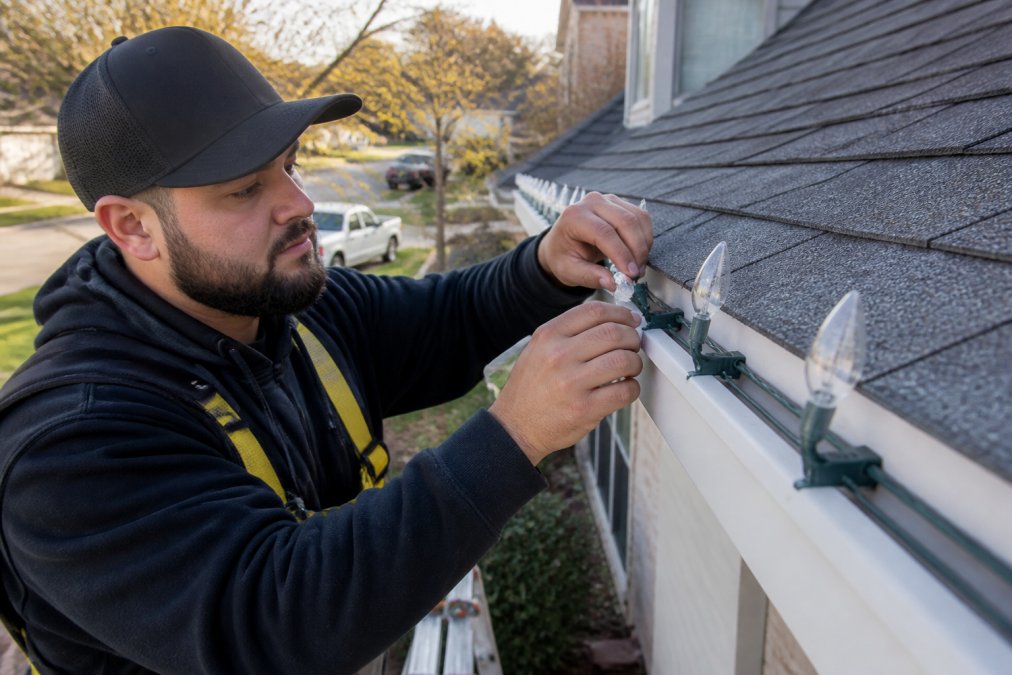
Mounting Hardware: Clips, Hooks, and Fasteners
Spring clips are the industry standard for residential rooflines. They grip the gutter edge or drip edge without requiring nails, screws, or adhesive. Quality clips distribute pressure across a wider surface, reducing the risk of gutter damage or deformation.
For shingle roofs, gutter hooks designed for metal gutters work well. These hooks loop over the gutter lip and hold the light string in place. Avoid adhesive-based mounting on asphalt shingles, temperature swings cause adhesive to fail, and removal often damages the shingle surface.
Permanent installations sometimes use discrete fasteners anchored into the fascia board. This approach requires drilling, which means water intrusion risk if not sealed properly. If you go this route, use stainless steel fasteners and weatherproof sealant rated for outdoor use.
The rule: choose hardware that distributes load across multiple contact points rather than concentrating pressure in one spot. A single clip per 3 feet of string is typical. Adjust for wind exposure, coastal areas or open rooflines might need clips every 2 feet.
Weatherproofing and Connector Protection
Water is the enemy of outdoor electrical connections. Weatherproof connectors rated IP67 or higher seal out moisture while allowing safe current flow. Standard indoor connectors will corrode within weeks when exposed to rain and humidity.
Daisy-chaining multiple light strings means exposed connectors where one string plugs into the next. Waterproof connector covers, small plastic shells that slide over the connection point, are inexpensive insurance. They cost a few dollars per connector and prevent the majority of mid-season failures.
For permanent installations, consider buried or conduit-protected wiring. This approach requires more upfront labor but eliminates exposed connectors entirely. The wiring runs through PVC conduit from the power source to each light string, protecting it from weather and physical damage.
Holiday Lighting Safety Standards and Electrical Considerations
Roofline lighting sits at the intersection of electrical safety and fall prevention. Understanding both is non-negotiable.
IP Ratings and Waterproof Requirements
IP ratings describe how well a device resists dust and water. The first digit rates dust protection (0-6), the second rates water protection (0-9). For outdoor roofline lights, you need at least IP44 (splash-proof). IP67 (temporary submersion) is better for areas with heavy rain or snow melt.
Check both the bulbs and the string connectors. A weatherproof bulb won’t help if the connector between strings allows water inside. Reputable LED manufacturers publish IP ratings for both components.
Voltage Drop and Load Calculations
This is where many installations fail. Voltage drop occurs when current travels long distances through wire, losing power along the way. A 200-foot string of lights on a single circuit experiences more voltage drop than a 50-foot string.
The practical consequence: lights at the far end of a long string dim noticeably or flicker. Voltage drop becomes critical if you’re daisy-chaining multiple strings. Each additional string compounds the problem.
The fix is to split long runs across multiple circuits. A 200-foot roofline works better as two 100-foot circuits than one continuous 200-foot string. This requires running separate power lines from your breaker box or using multiple outlet locations.
Load calculations matter too. Each LED bulb draws minimal current, typically 0.1 amps per bulb. A 100-bulb string draws around 10 amps. Most household circuits are 15 amps, so a single string is safe. But add a second string and you’re approaching capacity. Add a third and you risk tripping the breaker mid-display.
Never exceed the rated amperage of a circuit. Overloaded circuits create fire risk and will trip breakers during peak usage. If your roofline requires more than two daisy-chained strings, use separate circuits.
Calculating Total Footage and Planning Your Roofline Display
Before buying lights, measure your roofline carefully. Underestimating footage means an incomplete display. Overestimating wastes money and creates storage challenges.
Start with the horizontal roofline perimeter. This is the distance from one corner of the roof to the other, measured along the edge where the roof meets the wall. Don’t estimate, use a tape measure or laser distance tool. A 40-foot house typically has a roofline perimeter of 80-100 feet when you account for all four sides and any dormers or peaks.
Next, decide whether you want single-strand or double-strand coverage. Single strand creates a clean outline. Double strand (two parallel strings) creates denser, more dramatic visual impact. Double strand roughly doubles your footage requirement.
C7 spacing (4 inches) means roughly 30 bulbs per 10 feet. C9 spacing (12 inches) means roughly 10 bulbs per 10 feet. If you want continuous light with no gaps, use C7.
Permanent vs Seasonal Installation: What Works for Rooflines
This choice affects everything: mounting hardware, weatherproofing strategy, storage space, and annual labor.
Professional Holiday Lighting Installation: When to Call the Experts
Not every homeowner should install roofline lights themselves. Ladder safety, electrical work, and load calculations involve real risks.
Professional installation makes sense for rooflines over 25 feet high, homes with steep roof pitch, or any installation where you’re uncertain about electrical safety.
Maintenance, Storage, and Longevity of Your LED Display
LED lights last significantly longer than incandescent equivalents, but they still require care.
Frequently Asked Questions
How do I choose between C9 and C7 LED holiday lights for my roofline?
C9 bulbs deliver higher lumen output and create dramatic architectural scale, making them ideal for large rooflines and commercial properties. C7 bulbs are smaller, energy-efficient, and work better for detailed perimeter lighting or homes with modest rooflines. Consider your roof’s silhouette, desired visual impact, and total footage needed. C9s typically space 12 inches apart, while C7s work at 6-8 inch intervals for comparable brightness.
What safety precautions should I take when installing roofline lights?
Use a sturdy ladder and secure it on level ground; never overreach. Wear non-slip footwear and work during daylight. Verify your electrical setup can handle the load before connecting strands. Use weatherproof connectors and ensure all outdoor-rated components have IP67 or higher waterproof ratings. If your roof is steep or your home is large, professional installation eliminates safety risks and ensures compliance with local building codes.
How many LED light strands do I need for my roofline?
Measure your roofline’s perimeter in feet, then divide by the bulb spacing (typically 12 inches for C9 or 6-8 inches for C7). For example, a 100-foot roofline with C9 spacing needs approximately 100 feet of strand. Account for daisy-chaining multiple sets and voltage drop over long runs. Many installers recommend 20-30% extra footage for overlaps and design flexibility. Consulting a professional ensures accurate calculations and prevents undersized or oversized displays.
Are permanent LED roofline lights worth the investment?
Permanent installations offer convenience, eliminate annual setup labor, and provide consistent curb appeal year-round. They require weatherproof connectors, UV-resistant wiring, and proper electrical integration. Long-term durability depends on quality components and professional installation. The investment is worthwhile for homeowners seeking hassle-free displays, but seasonal installations remain a practical option for those who prefer flexibility or have budget constraints.