Table of Contents
- How Smart Outdoor Lighting Control Systems Work
- Key Benefits of Smart Outdoor Lighting Control
- Components and Architecture of Smart Lighting Systems
- Smart Home Integration for Exterior Lighting
- Outdoor Lighting Control System Installation and Setup
- Best Smart Plugs for Outdoor Holiday Lights
- Security, Weatherproofing, and Maintenance
- Frequently Asked Questions
Last Updated: September 21, 2026
How Smart Outdoor Lighting Control Systems Work
Smart outdoor lighting control systems automate exterior lights through connected devices and scheduling software, letting you turn lights on and off, adjust brightness, and change color temperature from a smartphone app or voice assistant.
The system uses a mesh network where each fixture relays signals to extend range across your property. A smart hub bridges your outdoor lights to your home network and internet connection, enabling remote access and ensuring reliable communication even if one device loses connection temporarily.
Control happens through a mobile app for manual adjustments, automation schedules for dusk-to-dawn operation, or voice commands through compatible assistants. Motion sensors and geofencing trigger lights when movement is detected or when you approach home.
Key Benefits of Smart Outdoor Lighting Control
The most immediate benefit is convenience, adjust lights from anywhere without manually flipping switches or climbing ladders. Activate lights before arriving home or dim them remotely during travel.
Automated scheduling ensures lights operate only when needed, reducing energy consumption. Dimming capabilities lower brightness during low-activity periods without turning lights completely off.
Lights activate automatically when motion is detected, deterring intruders. Scheduling creates the appearance of occupancy when you’re away. Integration with security cameras and door sensors enables coordinated responses, lights brighten when someone approaches your entryway.
Adjust color temperature throughout the day: warmer tones create inviting evening ambiance, cooler white light enhances security visibility. Holiday lighting becomes simpler when you program custom color sequences and schedules across all fixtures simultaneously, whether you’re managing a residential display or coordinating Commercial Holiday Lighting across multiple properties.
Components and Architecture of Smart Lighting Systems
A smart hub serves as the central command center, translating app commands into wireless signals that control individual fixtures. It connects to your home network and typically sits indoors for optimal coverage.
Outdoor fixtures (sconces, path lights, string lights, spotlights) contain smart modules that receive wireless signals and control power, brightness, and color using Zigbee, Z-Wave, or Wi-Fi protocols.
Low-voltage transformers convert household current to safer electricity, reducing shock hazards and allowing thinner wiring. Hardwired connections provide permanent installation; smart plugs offer easier setup in standard outdoor outlets.
Motion sensors trigger lights automatically. Dusk-to-dawn sensors activate fixtures at sunset. Smart switches and plugs control existing non-smart lights. Advanced systems include weather sensors that adjust lighting based on conditions.
Each fixture extends wireless range through mesh architecture, intermediate lights relay signals so losing one device doesn’t disconnect others downstream.
Smart Home Integration for Exterior Lighting
Connecting outdoor lighting to your smart home ecosystem enables powerful automation. Most systems integrate with Google Home, Amazon Alexa, and Apple HomeKit for voice control and cross-device automation.
Integration with smart thermostats coordinates outdoor lights with climate control, lights dim during evening cooling to reduce heat absorption. Smart locks trigger lights to brighten when the door unlocks.
Geofencing links your smartphone’s location to lighting behavior, lights dim to security levels when you leave and brighten as you approach, eliminating manual scheduling for regular commutes.
Automation routines combine multiple actions into single commands. A “Movie Night” routine might dim all outdoor lights except pathway lights; a “Leaving Home” routine activates security lighting and locks doors simultaneously.
Not all outdoor lighting systems work with all smart home platforms. Before purchasing, verify your chosen system supports the platforms you already use.
Outdoor Lighting Control System Installation and Setup
Plug-in systems require minimal skill: connect the smart plug to an outdoor outlet, screw in compatible bulbs, and add the device to your app. This works well for string lights and standalone fixtures.
Hardwired installations require planning layout, determining wire gauge, and potentially digging trenches. Many homeowners hire professionals, particularly when installing 10 or more fixtures or when integrating smart controls with existing Holiday Decorating installations.
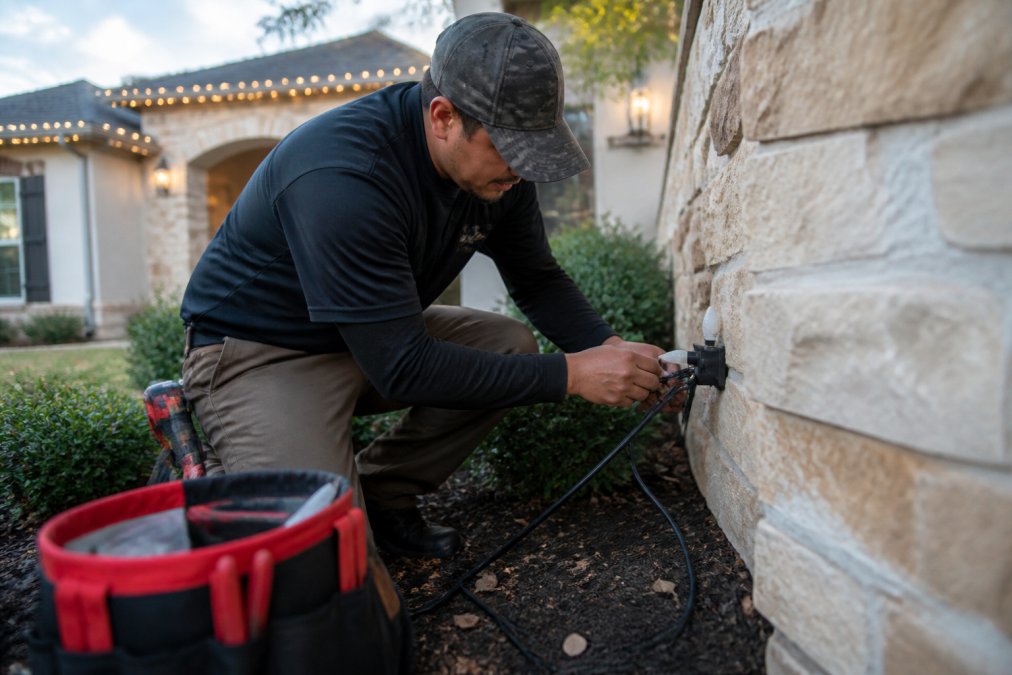
Properly securing these low-voltage connections ensures the stability required when scaling residential setups into complex professional DMX rigs.
Download the app, create an account, and add your hub to your home network. Pair individual fixtures by holding a button until the app detects them. Name each fixture logically (“front porch,” “patio,” “pathway”) to simplify control.
Define on and off times based on sunset and sunrise to eliminate seasonal adjustments. Create scenes for different moods: “Evening” for warm dimmed lighting, “Security” for bright white light.
Addressing Outdoor Connectivity Challenges
Wi-Fi systems maintain reliable control within 100-150 feet of your router, but obstacles reduce range significantly. Zigbee and Z-Wave mesh networks extend range through intermediate devices but require careful placement to avoid dead zones.
Test connectivity before finalizing placement by walking your property with the app open. Note areas where signal weakens, especially corners, areas behind trees, and spots far from exterior walls. For dead zones, relocate the hub, add an intermediate fixture to relay the signal, or install a Wi-Fi or mesh network extender.
Mesh network extenders amplify signals between your hub and distant fixtures without requiring a new hub. Some systems support dedicated extender hardware; others allow any fixture to relay. Confirm capabilities before purchase if you anticipate coverage challenges.
Interference from neighboring networks, cordless phones, and microwave ovens can degrade signal quality. Reposition your hub away from these sources or switch to 5 GHz Wi-Fi if supported. Zigbee and Z-Wave are less susceptible to Wi-Fi interference, making them better for properties with heavy wireless congestion.
Ensure all exposed connectors have protective caps rated for outdoor use. Apply silicone sealant around wire entry points to prevent water intrusion. Install the hub in a location protected from direct rain and extreme temperature swings.
Best Smart Plugs for Outdoor Holiday Lights
Smart plugs offer the simplest path to controlling existing outdoor lights and holiday decorations. They plug into standard outdoor outlets and accept regular bulbs or light strings, making them ideal for retrofitting non-smart fixtures.
When selecting outdoor smart plugs, prioritize weatherproofing. Look for devices rated IP64 or higher, meaning they resist water jets and dust. Check that the plug design accommodates your outlet type and doesn’t block adjacent outlets. Some plugs are bulky and prevent using both outlets on a dual-outlet box.
Compatibility matters significantly. Verify the plug supports your preferred control method, app, voice assistant, or both. Some plugs work only with specific platforms, limiting flexibility if you later add devices from different manufacturers. Universal options supporting multiple platforms offer better long-term flexibility.
Remote access capability distinguishes quality plugs from basic models. Ensure the plug connects to your home network rather than requiring Bluetooth-only control, which limits range to 30-50 feet. Network connectivity lets you control lights from anywhere and enables automation scheduling.
Dimming capability adds versatility. Not all smart plugs support dimming, some only turn power fully on or off. If you want to adjust brightness for holiday lights or sconces, confirm the plug includes dimming and that your bulbs support it.
Security, Weatherproofing, and Maintenance
Outdoor smart lighting systems face continuous exposure to rain, UV radiation, temperature extremes, and humidity. IP ratings define weatherproofing standards and are critical to long-term reliability. IP65 means the device resists water jets from any direction and is dust-tight; IP67 allows brief submersion in up to 1 meter of water for 30 minutes; IP68 permits continuous submersion. Most outdoor smart lights use IP65 or higher, but understanding the difference matters for placement decisions.
IP65-rated fixtures are suitable for exposed locations where they’ll receive occasional water spray from rain or irrigation systems. IP67-rated fixtures can tolerate brief submersion and are ideal for areas prone to standing water or heavy spray. If you’re installing lights near a pool, fountain, or in a low-lying area that collects water, prioritize IP67 or IP68 ratings. Check the rating of every component, the light fixture itself, the smart module inside it, and any exposed connectors. A fixture rated IP67 won’t provide that protection if its connector is only IP54.
Material composition affects longevity in outdoor environments. Aluminum and stainless steel housings resist corrosion better than painted steel. Silicone gaskets and seals degrade over time when exposed to UV radiation; inspect them annually and replace if they become brittle or cracked. Polycarbonate lenses yellow under UV exposure, gradually reducing light output; UV-stabilized polycarbonate lasts longer but still requires periodic replacement in high-sun climates.
Cybersecurity for Outdoor IoT Devices
Outdoor smart lighting systems create network entry points that deserve serious attention. Unlike indoor smart home devices, outdoor lights are physically accessible to anyone on your property, and they communicate wirelessly across your home network.
Connection Reliability and Signal Strength
Maintenance Requirements
Light Pollution and Local Compliance
Frequently Asked Questions
What are the main benefits of using a smart outdoor lighting control system?
Smart outdoor lighting control systems offer automation, remote access, and energy efficiency. You can schedule lights to turn on at dusk and off at dawn, control them from your smartphone from anywhere, and reduce energy consumption by dimming or adjusting color temperature. For holiday displays, automation eliminates manual switching, while remote access lets you manage lights without stepping outside in bad weather. Many systems also provide scheduling flexibility for different seasonal needs.
How do I choose the best smart plugs for outdoor holiday lights?
Look for smart plugs with IP ratings of at least IP44 to handle outdoor weather conditions. Check compatibility with your existing smart home ecosystem (Wi-Fi, Zigbee, Z-Wave, or Bluetooth). Verify that the plug supports the wattage your holiday lights require. Consider features like scheduling, remote on/off control, and energy monitoring. Weatherproof construction and UV-resistant materials ensure durability through multiple seasons. For professional installations, consult with specialists who can recommend plugs suited to your specific lighting setup.
What should I know about outdoor lighting control system installation?
Professional installation involves assessing your property layout, determining optimal fixture placement, running low-voltage or hardwired connections, and configuring your smart hub or bridge. Installers verify mesh network coverage to ensure signals reach all fixtures, especially on larger properties. They also set up scheduling, dimming, and remote access through your app. Proper installation prevents connectivity issues and ensures weather-resistant connections. Most professionals handle configuration so your system is ready to use immediately after installation.
How does smart home integration work with exterior lighting?
Smart home integration connects your outdoor lights to a central hub that communicates with other smart devices in your home. You can create automation rules, for example, outdoor lights turn on when motion sensors detect activity or when your phone leaves the property via geofencing. Voice control lets you command lights through smart speakers. Integration also enables scenes, so one command activates multiple outdoor and indoor lights together. This creates a cohesive smart ecosystem where exterior lighting responds to your routines and preferences alongside interior automation.