Table of Contents
- Why Energy-Efficient Holiday Decor Matters for Office Spaces
- Switching to LED Lighting for Holiday Displays
- Smart Timer Systems for Holiday Displays
- Office Holiday Decor Safety Standards and Compliance
- Commercial Holiday Lighting Installation Best Practices
- Sustainable Materials and Eco-Friendly Alternatives
- Planning Your Office Holiday Decor Budget
- Conclusion
- Frequently Asked Questions
Last Updated: September 22, 2026
Why Energy-Efficient Holiday Decor Matters for Office Spaces
Holiday decorations transform office environments into festive, welcoming spaces, but traditional decor comes with hidden energy costs. LED lighting, smart controls, and sustainable materials cut your office’s holiday energy use significantly while maintaining an elegant, festive atmosphere. Office displays differ from residential ones: longer operating hours, extended installation periods, and higher occupancy multiply energy costs fast, making energy efficient holiday decor essential for both your budget and environmental impact.
A single string of traditional incandescent bulbs running 12 hours daily for two months adds measurable expense to your utility bill. LED alternatives deliver the same visual impact with a fraction of the power draw. Houston Light helps commercial clients navigate these choices with custom installations designed for maximum efficiency and visual impact.
Switching to LED Lighting for Holiday Displays
LED bulbs are the foundation of any energy efficient holiday decor strategy. They consume 75-80% less energy than incandescent bulbs while lasting thousands of hours, making them practical for annual office installations.
Here’s what makes LEDs the clear choice for offices:
- Lower wattage: LED holiday lights draw minimal power, reducing strain on your building’s electrical system
- Cooler operation: LEDs produce almost no heat, eliminating fire hazards around office materials and furnishings
- Longer lifespan: Fewer replacements mean less maintenance and lower labor costs over time
- Instant brightness: LEDs reach full brightness immediately, unlike some traditional bulbs that warm up gradually
- Color consistency: LEDs maintain consistent color throughout their lifespan without dimming or yellowing
When selecting LED strings for office spaces, check the lumen output and color temperature. Warm white LEDs (2700K) create the cozy holiday feel most offices want; cool white (4000K) works better in modern, minimalist designs. Professional installers like Houston Light understand these nuances and can recommend the right LED products for your specific building aesthetic.
Smart Timer Systems for Holiday Displays
Smart timer systems automate when your holiday lights turn on and off, reducing energy waste and ensuring lights don’t stay on during unoccupied hours.
Smart timers work in several ways:
- Basic plug-in timers – Set specific on/off times daily. These cost little and work reliably for straightforward schedules.
- Smart plugs with app control – Control lights remotely via smartphone. Adjust schedules without visiting the display.
- Motion sensors – Lights activate only when movement is detected in the space. Ideal for lobbies and entryways.
- Occupancy-based systems – Integrate with your building’s existing smart systems to sync lighting with actual office usage.
For offices, motion sensors and occupancy-based systems deliver the biggest energy savings. If your lobby lights up at 6 AM but employees don’t arrive until 8 AM, you’re wasting energy. Installation varies by system type: basic timers plug directly into outlets, smart plugs require Wi-Fi connectivity, and professional integrations connect to your building’s energy management system. Houston Light can assess your office layout and recommend the system that fits your building’s infrastructure and security requirements.
Office Holiday Decor Safety Standards and Compliance
Office holiday decorations must meet specific safety standards that residential displays do not require. Your building has fire codes, electrical load limits, and insurance requirements that govern what you can install. Understanding these regulations prevents costly violations and protects your liability coverage.
Fire Safety and Building Codes
Commercial buildings fall under the International Building Code (IBC) and the National Fire Protection Association (NFPA) standards, which classify holiday decorations as temporary installations. Key requirements include:
- Fire-retardant materials: Artificial garlands and wreaths must be labeled fire-retardant per NFPA 701 standards. Live greenery requires placement at least 3 feet away from heat sources, sprinkler heads, and exit signs.
- Flame spread rating: Materials must have a flame spread rating of 25 or less for all fabric, paper, and plastic decorations.
- Exit accessibility: Decorations cannot obstruct emergency exits, fire extinguishers, first aid kits, or evacuation routes per OSHA guidelines and building codes.
- Electrical safety: All outdoor wiring must be rated for wet locations (Type W or equivalent). Extension cords cannot be used as permanent installations.
Electrical Load Management
Your building has a maximum electrical capacity per circuit, typically 15 or 20 amps for standard office circuits. Professional installers calculate total wattage and distribute loads across multiple circuits to stay within safe limits, ensuring no single circuit exceeds 80% of its rated capacity when holiday lighting is added.
Structural and Wind Load Considerations
Roof-mounted and exterior decorations must account for wind loads, weight distribution, and structural integrity. High-wind areas require engineering calculations to ensure decorations won’t fail or damage the building facade. Improper installation can void your building’s warranty or create liability if decorations fail and cause injury or property damage.
Insurance and Documentation Requirements
Most commercial property insurance policies require documentation of holiday decoration installations, including installation methods, materials certifications, electrical load calculations, photos, and maintenance logs. Insurance providers may require proof that installations were performed by licensed electricians or certified installers. Working with professionals who maintain liability insurance and understand commercial standards protects your building and ensures your insurance remains valid.
Local Jurisdiction Variations
Fire codes and building regulations vary by municipality. Some jurisdictions require permits for commercial holiday lighting installations. Contact your local fire marshal’s office or building department before finalizing your decoration plan to prevent compliance issues.
Commercial Holiday Lighting Installation Best Practices
Professional installation makes the difference between a safe, efficient display and a liability risk. Commercial properties benefit from strategic planning before lights go up.
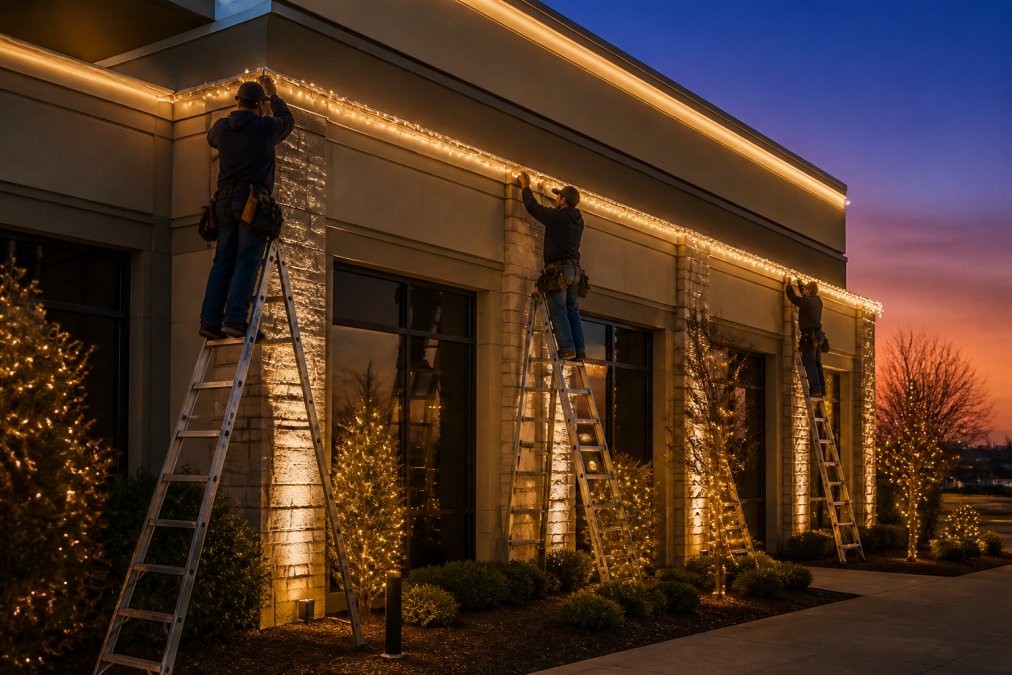
Follow these steps for successful commercial holiday lighting:
- Schedule early – Plan installations in November to avoid last-minute rushes.
- Conduct a site assessment – Evaluate roof access, electrical outlets, structural attachment points, and visibility.
- Calculate electrical requirements – Determine total wattage and confirm your building can handle the load.
- Map the design – Decide which areas get lighting for maximum visual impact.
- Use outdoor-rated materials – All wiring, connectors, and fixtures must be rated for outdoor use and your climate.
- Test before final installation – Run all lights and verify function before permanent mounting.
- Document everything – Keep records for insurance and future reference.
Professional installers bring proper equipment, safety protocols, insurance, and knowledge of local codes and electrical standards.
Sustainable Materials and Eco-Friendly Alternatives
Beyond LED lighting, your material choices impact the overall environmental footprint of office holiday decor. Sustainable options exist for nearly every decorative element.
Material Choices and Circular Economy Impact
Choose items you can reuse year after year, or materials that can be recycled when no longer needed, to reduce annual waste and environmental impact.
- Artificial greenery made from recyclable materials: Modern artificial garlands and wreaths use recyclable plastics (#2 or #5) and last for decades, reducing annual waste.
- Live potted trees: Potted evergreens can be replanted after the season, eliminating waste while adding natural beauty.
- Wooden ornaments and decorations: Sustainably sourced wood ornaments are durable, reusable, and can be composted at end of life.
- Solar-powered accent lights: Small solar lights don’t draw from your building’s electrical system and work well for pathway lighting.
- Fabric and paper decorations: Banners, paper snowflakes, and fabric garlands are recyclable and can be reused for multiple seasons.
Responsible Disposal and Recycling
At the end of the holiday season, proper disposal prevents waste from entering landfills and recovers valuable materials:
- Incandescent and old LED strings: Contact your local waste management facility or Earth911.com to find e-waste recycling programs.
- Artificial garlands and wreaths: If made from recyclable plastics (#2 or #5), contact your local recycling program to confirm acceptance. Otherwise, donate to thrift stores or community theaters.
- Live greenery: Fresh garlands and tree branches can be composted through municipal programs. Potted trees can be planted or donated to local parks.
- Ornaments and decorative items: Donate items in good condition to thrift stores, schools, or community centers.
- Wiring and hardware: Recycle copper wiring and metal hardware through scrap metal recycling programs.
Live Greenery vs. Artificial: Environmental Trade-offs
Live greenery presents an interesting choice for offices.
Planning Your Office Holiday Decor Budget
Budget planning for commercial holiday decor involves multiple cost factors: materials, installation, maintenance, and energy consumption. Energy efficient options often cost more upfront but deliver long-term savings.
Here’s how to approach budget planning:
Initial investment considerations:
- LED lighting costs more per unit than incandescent bulbs, but runs for multiple seasons
- Professional installation adds labor costs but ensures safety and proper execution
- Smart timer systems and sensors require upfront purchase but reduce ongoing energy expense
- Sustainable materials may cost more initially but last longer and reduce replacement frequency
Operating cost factors:
- Monthly energy consumption during the decorating season
- Maintenance and replacement costs
- Labor for adjustments or repairs
- Insurance or liability coverage
Conclusion
Choosing energy efficient holiday decor for offices requires balancing visual impact, safety compliance, and operational costs. LED lighting forms the foundation. Smart timer systems reduce waste. Sustainable materials align with corporate values. Professional installation ensures everything meets safety standards.
Frequently Asked Questions
How much energy do LED holiday lights actually save compared to incandescent bulbs?
LED holiday lights consume approximately 75% less energy than traditional incandescent bulbs. A string of 100 LED lights uses roughly 5 watts, while the same incandescent string uses about 40 watts. Over a holiday season running 8 hours daily for 60 days, that difference translates to significant energy savings and lower electricity bills for office spaces.
What smart timer systems work best for managing office holiday lighting?
Smart timer systems allow you to automate when decorative lights turn on and off, eliminating manual control and preventing lights from running unnecessarily. Options range from simple plug-in timers to smart plugs that integrate with building management systems. For offices, programmable timers that align with business hours reduce energy waste while maintaining festive ambiance during peak occupancy periods.
What safety standards should office holiday decorations meet?
Office holiday decor must comply with NFPA 101 (Life Safety Code) and local fire codes. Decorations should be fire-retardant or non-flammable, electrical connections must meet NEC standards, and displays cannot obstruct emergency exits. Commercial spaces also need proper electrical load calculations to prevent overloading circuits. Professional installation ensures compliance and reduces liability risks.
Are solar-powered outdoor decorations practical for office holiday displays?
Solar-powered decorations work well for outdoor office displays, especially in areas with adequate daylight exposure. They eliminate wiring concerns, reduce energy consumption to zero during operation, and simplify installation. However, their brightness depends on sunlight availability and battery capacity, making them better suited for accent lighting rather than primary illumination on larger commercial properties.