Table of Contents
- Why Cohesive Holiday Themes Matter for Corporate Campuses
- Establishing Your Brand Identity Through Holiday Decor
- Commercial Holiday Lighting Installation: Strategy and Execution
- Corporate Holiday Decor Trends Shaping 2026
- Holiday Lighting Safety Standards for Commercial Properties
- Multi-Building Campus Rollouts: Planning and Logistics
- Sustainability and Post-Holiday De-installation
- Frequently Asked Questions
Last Updated: September 19, 2026
Why Cohesive Holiday Themes Matter for Corporate Campuses
Disjointed holiday displays undermine your brand identity. When one building features warm white lights while another glows with cool blue, when wreaths vary in style across entrances, employees and visitors notice the inconsistency.
Cohesive holiday themes corporate campuses create a unified aesthetic that reinforces your company’s values and strengthens workplace morale. When your entire campus speaks the same visual language during the holidays, it demonstrates intentionality, professionalism, and care. This consistency builds employee pride, enhances your corporate image, and creates an immersive experience that makes people want to spend time on your property.
The challenge is executing a theme across multiple buildings, different architectural styles, and varying site conditions without looking forced or generic. That’s where strategy matters.
Establishing Your Brand Identity Through Holiday Decor
Your holiday theme should reflect who you are as an organization. Before selecting colors, lighting styles, or decorative elements, define what your brand communicates year-round.
If your company values innovation, your holiday aesthetic should feel contemporary with clean lines and modern materials. If you emphasize tradition and stability, warm lighting, classic greenery, and timeless designs make sense. If sustainability is central to your mission, eco-friendly materials and energy-efficient LED technology should be non-negotiable.
The most effective cohesive holiday themes for corporate campuses align with your existing brand guidelines. Your color palette during the holidays should complement your corporate identity. Your decorative style should feel like a natural extension of your office aesthetic, not a departure from it.
Houston Light works with corporate clients to translate brand values into seasonal design. When you’re designing across multiple buildings, this consistency becomes your competitive advantage.
Commercial Holiday Lighting Installation: Strategy and Execution
Professional installation separates a polished display from amateur results. The difference lies in planning, quality materials, and execution that accounts for weather, building architecture, and electrical safety.
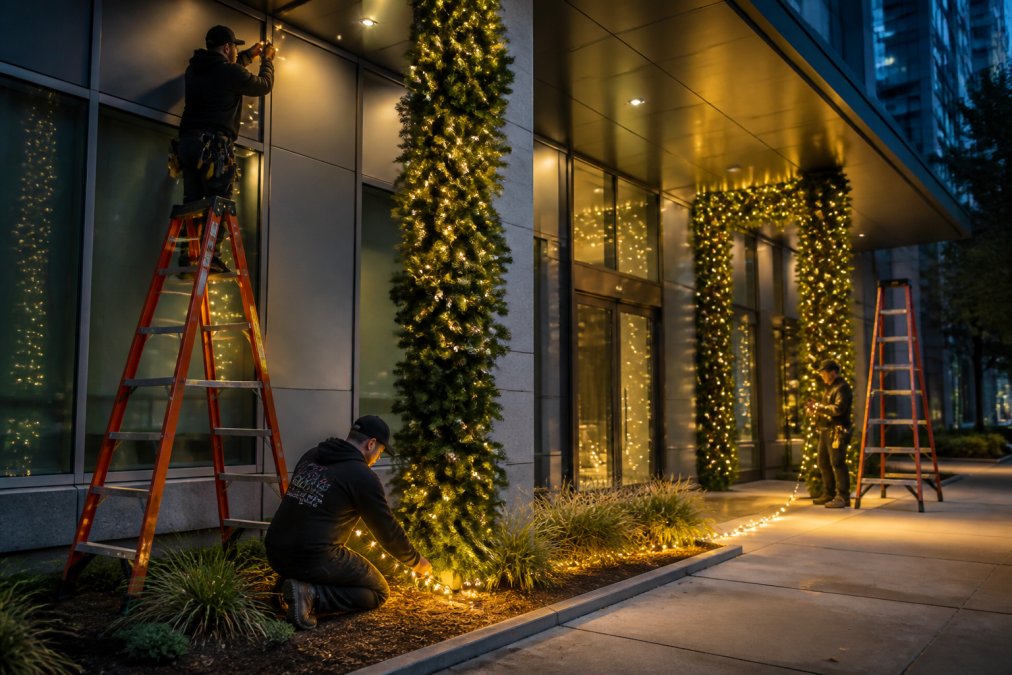
Start with a site assessment. Walk your entire campus and document building heights, architectural features, existing electrical infrastructure, and sight lines from parking areas and street-level views. Identify focal points and main entrances where lighting will have the most visual impact.
Plan your lighting layout before installation begins. Sketch where lights, garland, and custom wreaths will go. Test your color temperature choices, warm white (2700K), cool white (5000K), or a blend, against your buildings’ exterior colors and materials. Warm light typically complements brick and stone; cool white enhances modern glass and metal facades.
Quality materials matter more than quantity. Professional-grade LED strings hold up to wind, temperature swings, and moisture exposure far better than consumer-grade alternatives. Weather-resistant fixtures ensure your display maintains its appearance throughout the season.
Execution requires attention to detail. Secure lights and garland properly so they don’t shift in wind. Hide power cords and electrical connections. Ensure all installations comply with electrical codes and safety standards. Professional installers understand load requirements, proper grounding, and the specific codes that govern commercial properties.
Corporate Holiday Decor Trends Shaping 2026
Several design directions are gaining traction among corporate properties this year. Understanding these trends helps you create a cohesive holiday themes for corporate campuses that feels current while aligning with your operational capacity and brand values.
Maximalist greenery with strategic lighting layering. Companies are investing in lush, abundant greenery that creates an immersive atmosphere. Dense garland forms the base structure, then warm-white LED strings (2700K) are woven through to create depth. The trade-off is maintenance, lush greenery requires regular misting in dry climates and inspection for browning mid-season.
Personalization within consistency. While maintaining a unified color palette and style across your campus, different buildings can feature subtle variations that reflect their specific function. Your creative department’s entrance might feature bolder accent colors; your client-facing lobby might be more refined. The cohesion comes from shared materials, lighting temperature, and overall design language. Create a visual brand guide showing the “core palette” (non-negotiable colors and lighting specs) versus “accent zones” (where variation is permitted).
Sustainable materials and energy-conscious design. LED-only lighting, recycled garland, and minimal single-use decorative elements align actions with stated values. LED technology consumes 75% less energy than incandescent alternatives and lasts 25,000+ hours versus 1,000 hours for traditional strings. Natural garland and wreaths biodegrade at season’s end; partner with local composting services to process this material responsibly.
Experiential and interactive elements. Rather than passive decoration, companies are creating spaces where employees and visitors can engage: a decorated courtyard with seating and ambient lighting, a photo opportunity area with custom branded signage. These spaces strengthen workplace morale and create natural social media moments. Plan for dedicated staff or contractor time to maintain these interactive zones throughout the season.
Accessibility-forward design. Ensure pathways remain clear for employees using mobility devices, avoid strobe or rapidly flashing lights that can trigger migraines, and provide quiet zones near decorated areas. Accessible design expands your audience and demonstrates genuine inclusion.
Holiday Lighting Safety Standards for Commercial Properties
Commercial properties must comply with electrical and fire safety codes that residential installations don’t face. Understanding these requirements prevents liability and ensures your display is genuinely safe.
All outdoor electrical connections must use GFCI (ground fault circuit interrupter) protection. GFCI outlets automatically shut off power if they detect a ground fault, preventing electrical shock in wet conditions.
Lighting fixtures and extension cords must be rated for outdoor use. Look for products marked “wet location” or “damp location” rated.
Load calculations prevent fire risk and system failure. Professional installers calculate the total wattage of your display and ensure it doesn’t exceed circuit capacity.
Secure all fixtures and cords properly so they don’t create tripping hazards. If your campus includes roofline installations or work at height above 10 feet, installers must follow OSHA fall protection standards.
Regular inspection throughout the season catches problems early. Check for damaged cords, loose connections, or fixtures that have shifted, and address issues immediately.
Multi-Building Campus Rollouts: Planning and Logistics
Coordinating cohesive holiday themes for corporate campuses across multiple buildings requires fundamentally different planning than a single-property installation. The complexity multiplies with each building: different architectural styles, varying electrical infrastructure, and the challenge of maintaining visual consistency. Establishing this level of aesthetic unity across diverse spaces often mirrors the strategic considerations involved in selecting corporate art to anchor the professional identity of a lobby.
Master timeline and sequencing strategy. Create a master timeline that accounts for building access, weather windows, and electrical load distribution. Sequence installations strategically: start with the most visible or high-traffic areas (main entrance, executive parking, primary courtyard) to ensure focal points are complete even if weather delays other sections. For campuses with 5+ buildings, plan a 2-3 week installation window. Staggered installation prevents electrical overload and allows your installation team to troubleshoot issues in one building before moving to the next.
Document weather constraints specific to your region. If your campus is prone to early December storms, front-load installations in exposed areas before weather deteriorates.
Cross-building communication and access coordination. Assign a single point of contact for coordination who manages building access, communicates timelines to facility managers, and resolves conflicts. Create a shared access schedule showing which buildings can accommodate installation crews on which days. Include contingency dates so if weather delays work at one building, the crew can shift to another.
Design specifications and quality-control documentation. Create a detailed visual guide showing the exact lighting type, color temperature, wattage, placement, and mounting method for each building section. Include high-resolution photos of completed reference areas. This becomes your quality-control standard so every building matches the overall vision.
Include electrical specifications: circuit assignments, load calculations per building, GFCI outlet locations, and any building-specific code requirements. Some older buildings may have outdated electrical infrastructure that limits total wattage.
Inventory and asset management across buildings. Create a detailed inventory of all decorative elements: linear feet of garland per building, custom wreaths, light strings and their specifications. Use a shared spreadsheet so your team knows exactly what’s installed where. If your campus has buildings with similar architectural styles, standardize certain elements (same wreath design for all entrance doors, same garland type for all rooflines).
De-installation and storage planning from day one. Determine where decorations will be stored after the season, climate-controlled warehouse space, a designated storage area on campus, or a third-party facility. Plan removal in reverse sequence so your campus maintains its festive appearance as long as possible. Create a de-installation checklist that mirrors your installation documentation.
Handling architectural inconsistencies. Multi-building campuses often feature mixed architectural styles. Rather than forcing identical designs, develop a modular design system: core elements (color palette, lighting temperature, material quality) remain consistent, but application varies by building type. A modern glass building might feature clean-lined LED installations; a traditional brick building might feature more abundant greenery.
Sustainability and Post-Holiday De-installation
The environmental impact of holiday decorating extends beyond the season itself. Thoughtful material selection and proper end-of-season management reduce waste and align your display with corporate sustainability commitments.
Frequently Asked Questions
How far in advance should we plan cohesive holiday themes for a corporate campus?
Start planning 8-10 weeks before your target installation date. This timeline allows your team to finalize design concepts, source custom decor elements, coordinate across multiple buildings, and schedule professional installation. For large campuses with complex lighting and greenery requirements, beginning in early September ensures you capture the full holiday season without last-minute stress or compromised quality.
What’s the best way to balance festive holiday decor with our corporate brand identity?
Select a cohesive color palette that reflects your brand colors, typically 2-3 primary colors plus metallics. Use custom signage and branded elements in high-visibility areas like entrances and gathering spaces. Incorporate your company’s visual language through lighting patterns and decor placement. This approach reinforces brand awareness while creating an immersive experience that employees and visitors recognize as distinctly yours, strengthening workplace morale.
What safety standards apply to commercial holiday lighting installations?
Commercial holiday lighting must comply with National Electrical Code (NEC) standards and OSHA guidelines for outdoor electrical safety. All installations require proper grounding, weatherproof connections, and UL-listed components. Professional installers should carry liability insurance and follow fall-protection protocols when working at height. Regular inspections ensure weatherproofing integrity throughout the season, reducing fire and electrical hazards on your corporate property.
How do we handle holiday decor across multiple buildings on a large campus?
Create a master design template that adapts to each building’s unique architecture while maintaining visual consistency. Assign a project coordinator to oversee timing and logistics across all locations. Prioritize high-traffic areas and main entrances first, then extend to secondary buildings. Professional installation teams can work multiple sites simultaneously, ensuring synchronized completion and a unified campus environment that reinforces your cohesive design strategy.