Table of Contents
- Why Energy Efficient Patio Lighting Matters
- Low Voltage LED Outdoor Lighting: The Foundation
- Smart Outdoor Lighting Controls and Automation
- Best Practices for Patio Lighting Layout
- Color Temperature and Kelvin Ratings Explained
- Maintenance and Lifecycle Costs
- Light Pollution Mitigation Strategies
- Frequently Asked Questions
Last Updated: September 28, 2026
Why Energy Efficient Patio Lighting Matters
Energy efficient patio lighting design transforms outdoor spaces while reducing consumption and environmental impact, creating an inviting atmosphere without draining your electricity bill.
LED technology delivers brilliant, warm lighting that rivals traditional halogen or incandescent fixtures with a fraction of the power draw. A well-designed energy efficient patio lighting system runs nightly throughout the season without excessive energy consumption.
The latest LED solutions deliver the warm color temperatures and brightness levels homeowners want in weather-resistant fixtures built to last, you get both aesthetics and efficiency.
Low Voltage LED Outdoor Lighting: The Foundation
Low-voltage LED outdoor lighting is the backbone of energy efficient patio lighting design, operating at 12 volts instead of 120 volts to reduce energy consumption and improve safety.
A transformer steps down household voltage to a safe level, allowing thin wires to run across your patio with fixtures positioned exactly where needed. LED bulbs consume 75-80% less energy than traditional outdoor lighting while delivering the same brightness (Saving American Families and Businesses Money through Lighting Efficiency).
Professional installation ensures proper voltage drop calculations and weatherproof connections. Houston Light specializes in custom low-voltage LED installations that blend seamlessly into your holiday lighting design while maximizing energy efficiency.
LED bulbs last 25,000 to 50,000 hours, years of reliable lighting with minimal maintenance.
Smart Outdoor Lighting Controls and Automation
Smart timers and automated controls adapt to your actual usage patterns, eliminating the waste of lights running when no one is outside.
Motion sensors activate lights only when movement is detected, ideal for path lights and accent lighting. Photocell sensors automatically trigger lights at dusk and turn them off at dawn. Combined, these sensors create layered efficiency: ambient lights on timers during peak hours, path lights on motion, and accent lights responding to dusk/dawn cycles.
Smart Home Integration and Voice Control
Modern outdoor lighting integrates with smart-home ecosystems and voice assistants, enabling automation rules that optimize energy use automatically.
Geofencing automatically dims or shuts off outdoor lights when your phone leaves home and brightens them upon return, eliminating the common waste of lights running all evening when no one is home. A typical household might reduce patio lighting runtime by 20-30% through geofencing alone.
Scheduling rules create complex automation: lights off until 6 p.m., 60% brightness from 6-8 p.m., 20% from 8 p.m. onward, off at midnight. This granular control uses only the energy necessary for each time period.
Dimming and Adaptive Brightness
Dimmable LED fixtures dim smoothly without color-temperature shifts or flickering. Dimming to 50% brightness uses roughly 50% of the energy, making it one of the most direct efficiency tools available.
Adaptive brightness systems detect ambient light levels and adjust accordingly, dimming on moonlit nights and brightening on overcast ones, preventing over-lighting and energy waste.
Remote dimming control lets you adjust mood without leaving guests, bright for dining, dim for conversation, off when moving indoors, encouraging lights off when not needed.
Integration with Existing Smart Home Platforms
Most modern outdoor lighting systems integrate with major smart-home platforms, allowing outdoor lighting to be triggered by other home events: security system arming dims lights, front-door motion brightens patio lights.
Integration creates household-wide efficiency rules where all lights respond to occupancy, time of day, and season through a single framework, ensuring no fixture is forgotten or left on unnecessarily.
Best Practices for Patio Lighting Layout
Strategic placement determines visual impact and energy efficiency. The goal is achieving your desired atmosphere while using the minimum number of fixtures necessary, matching the right fixture type, color temperature, and technique to each zone.
Identify functional zones: seating areas, dining spaces, pathways, and landscaping features. Ambient lighting creates general illumination, task lighting provides focused brightness for activities, and accent lighting highlights architectural details or plants.
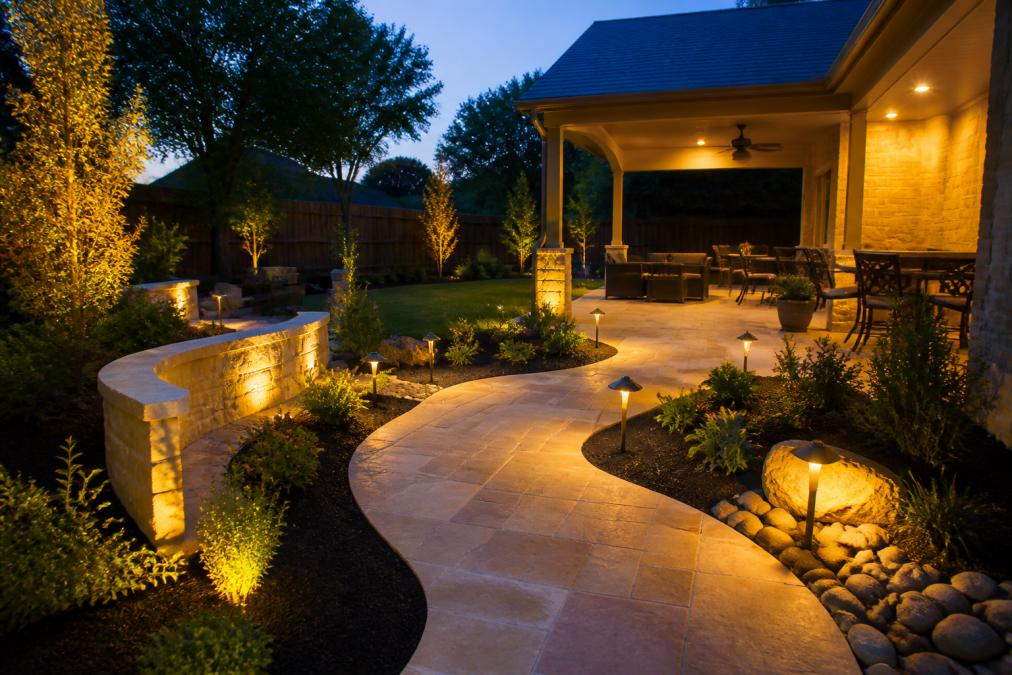
Efficient layouts avoid overlapping light coverage. Position lights to create distinct zones with minimal overlap, reducing the total number of fixtures needed and lowering installation and energy costs.
Color Temperature Strategy by Zone
Warm white light (2700K to 3000K) creates a cozy atmosphere ideal for relaxation and entertaining. Cool white light (4000K to 5000K) suits task areas requiring clarity. Daylight (5600K and above) is rarely used on patios because it feels institutional and requires more fixtures.
For energy efficient patio lighting, warm white (2700K) is ideal for ambient and accent zones, using less energy than cooler light. Task lighting zones may benefit from 3000K to 4000K for better color rendering without harshness.
Cooler light scatters more readily through the atmosphere, requiring brighter fixtures for the same perceived brightness. Warm white LEDs contain less blue light, making them better for limiting sky glow. Check both Kelvin rating and lumen output to ensure brightness and color from minimal wattage.
Lumens measure brightness output. A 10-watt LED at 2700K might produce 800 lumens, roughly equivalent to a 60-watt incandescent. Match lumen output to actual zone needs to avoid over-specifying brightness, which wastes energy and increases light pollution.
Dark-Sky Compliant Fixture Selection
Light pollution wastes energy and disrupts ecosystems. Dark-sky compliant fixtures direct light downward, not into the sky, and are increasingly available in the consumer market.
Dark-sky compliant fixtures feature full cutoff or near-full cutoff designs, directing all available light downward where it’s useful. Recessed lights, downward-facing fixtures, and baffles prevent light from scattering upward.
The International Dark-Sky Association (IDA) certifies fixtures meeting strict standards for light distribution, color temperature (typically 2700K or lower), and glare control. IDA-certified fixtures minimize environmental impact while maximizing energy efficiency.
Avoid overlighting, which wastes energy and contributes to light pollution. Dimmer controls let you adjust brightness to match actual needs: bright for entertaining, dim for quiet evenings, off when unoccupied.
Accent Lighting for Visual Interest
Accent lighting highlights specific features, a textured wall, flowering shrubs, or architectural details, without lighting the entire patio. This selective approach is inherently energy efficient because you’re directing light precisely where you want it. Reflective surfaces and textures interact differently with these focused beams, making the process of choosing patio materials a critical step in maximizing the visual impact of your lighting design.
Uplighting, where fixtures point upward toward an object, creates dramatic shadows and depth. A single uplighting fixture on a feature draws the eye while consuming minimal power. Position uplights at ground level, angled upward, to avoid light spilling into the sky where it wastes energy and contributes to light pollution. Warm-white LEDs (2700K) create an inviting glow without the harsh, energy-intensive brightness of cooler tones.
Moonlighting mimics natural moonlight by placing fixtures high on structures, casting soft shadows across your patio. This technique creates a romantic, natural ambiance while being remarkably energy efficient, you’re using gravity and placement rather than brightness to achieve the effect. A single moonlighting fixture positioned correctly can illuminate a large zone with minimal energy, often using 10-15 watts while providing comfortable visibility across 200+ square feet.
Path and Walkway Illumination
Path lights serve both safety and aesthetic purposes. Low-level fixtures along walkways guide movement while creating visual interest. These lights are typically lower wattage than ambient fixtures, making them ideal for energy efficient patio lighting design.
Space path lights 4 to 6 feet apart for consistent illumination without gaps. This spacing prevents the need for overlapping coverage and reduces the total number of fixtures required. Consider solar-powered path lights for areas far from electrical outlets, they charge during the day and run on stored energy at night, adding zero to your electrical consumption. Solar fixtures are ideal for accent pathways or secondary routes where brightness requirements are modest.
For primary walkways requiring reliable brightness, low-voltage LED path lights (typically 4-7 watts per fixture) offer superior efficiency compared to solar alternatives, especially in climates with limited sunlight. Pair them with motion sensors to activate only when someone is walking the path, further reducing runtime and energy use.
Color Temperature and Kelvin Ratings Explained
Color temperature, measured in Kelvin (K), defines whether light appears warm or cool. Understanding this metric helps you choose fixtures that deliver the ambiance you want while using energy appropriately.
Warm white light (2700K to 3000K) mimics incandescent bulbs and creates a cozy, inviting atmosphere.
Maintenance and Lifecycle Costs
Energy efficient patio lighting reduces long-term costs through multiple channels. LED bulbs last 25,000 to 50,000 hours, potentially 10 to 20 years of nightly use. This lifespan eliminates the frequent replacements required by older technologies, saving time and money on maintenance.
Light Pollution Mitigation Strategies
Light pollution, excess artificial light spilling into the night sky, wastes energy and disrupts ecosystems. Responsible energy efficient patio lighting design minimizes this impact.
Frequently Asked Questions
What is the most energy efficient type of lighting for outdoor patios?
LED lighting is the most energy efficient choice for patios, consuming 75% less electricity than incandescent bulbs while producing the same brightness in lumens. Low-voltage LED systems paired with smart controls and motion sensors reduce consumption further by activating lights only when needed. Solar-powered LED options eliminate electricity costs entirely, though they work best in sunny climates and may require battery backup for consistent nighttime performance.
How can smart outdoor lighting controls help reduce electricity usage?
Smart outdoor lighting controls use programmable timers, photocells, and motion sensors to eliminate unnecessary operation. Photocells automatically turn lights on at dusk and off at dawn, while motion sensors activate fixtures only when movement is detected. Dimming capabilities reduce wattage consumption during low-activity periods. Automated schedules align lighting with actual usage patterns, preventing lights from running all night when the patio is unoccupied, resulting in significant energy savings without sacrificing security or ambiance.
What color temperature should I choose for my patio lighting?
Color temperature, measured in Kelvin (K), affects both ambiance and energy perception. Warm white (2700-3000K) creates a cozy, inviting atmosphere ideal for dining and relaxation, while cool white (4000-5000K) provides brighter, more functional illumination for active areas. Warm white is generally preferred for patios because it feels more welcoming and typically requires fewer lumens to achieve comfortable lighting levels. Choose based on the patio’s primary use: entertaining spaces benefit from warm tones, while work or safety areas may need cooler, brighter light.
Do outdoor lights pull a lot of electricity?
Modern LED outdoor lights consume minimal electricity compared to older technologies. A typical LED patio light uses 5-10 watts, while an equivalent incandescent fixture uses 40-60 watts. A small patio with 10 LED fixtures running 5 hours nightly costs roughly $5-10 monthly in electricity. However, total consumption depends on fixture quantity, wattage, runtime, and control methods. Low-voltage systems reduce voltage drop and energy waste over longer cable runs, while smart controls and motion sensors further decrease overall electricity usage by preventing unnecessary operation.