Table of Contents
- Top Commercial Holiday Lighting Trends for 2026
- Energy Efficient LED Holiday Lighting for Businesses
- Commercial Holiday Lighting Installation Services: What to Expect
- Custom Commercial Holiday Decor Packages That Stand Out
- ROI and Budgeting for Commercial Holiday Displays
- Holiday Lighting Maintenance and Removal Services
- Frequently Asked Questions
Last Updated: September 12, 2026
Top Commercial Holiday Lighting Trends for 2026
The best commercial holiday lighting designs in 2026 lean on three things: commercial-grade LED systems, programmable color control, and displays designed for the building they sit on. At Houston Light, we’ve observed a shift among property managers away from one-size-fits-all string light packages toward lighting that can be reprogrammed, dimmed, and reused season after season.
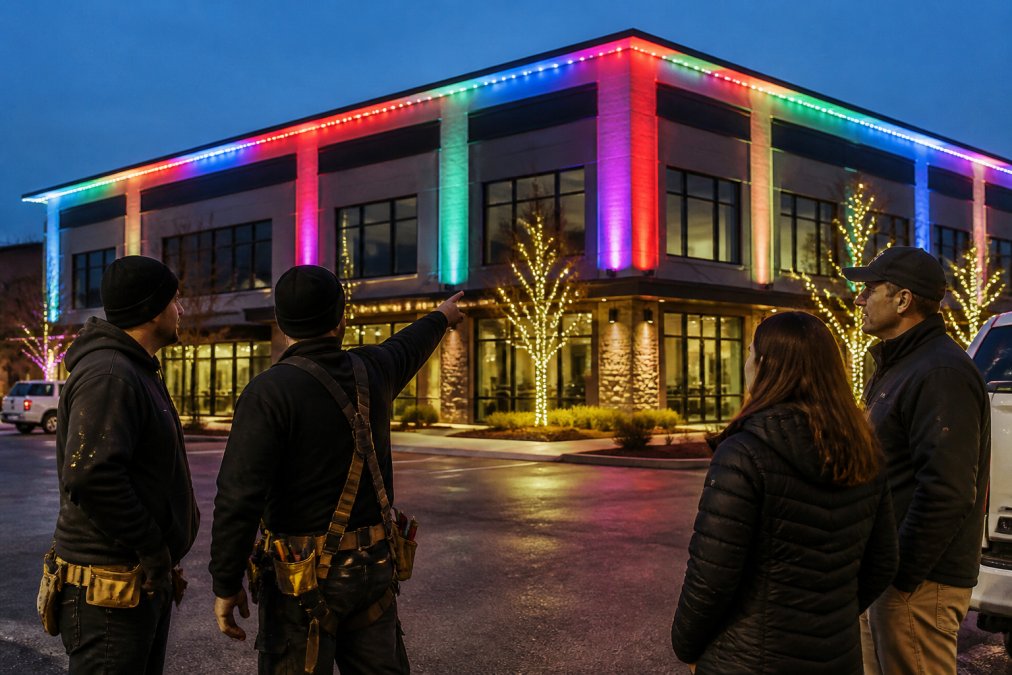
What separates a display that looks sharp in week six from one that looks tired by week two comes down to hardware quality and system control.
RGB Color-Changing Technology and Programmable Systems
RGB color-changing lighting uses LED nodes with red, green, and blue diodes that mix to produce nearly any color on demand. A programmable controller lets you schedule scenes, shift palettes for different holidays, and sync multiple buildings.
One installation can carry you from Thanksgiving through New Year’s, then shift to a spring palette. You buy the hardware once and change the programming, not the lights.
Projection Mapping and Animated Effects
Projection mapping uses high-output projectors to cast animated scenes onto a building facade, turning flat walls into moving displays without drilling a single hole. Animated effects work best layered on top of a static LED outline rather than replacing it.
The practical trade-off: projection is stunning on large, light-colored facades and nearly invisible on dark or highly textured surfaces. Walk your building at night before committing.
Energy Efficient LED Holiday Lighting for Businesses
LED holiday lighting for businesses uses a fraction of the power of incandescent bulbs and lasts far longer, which is why commercial-grade LED is now the default for any display larger than a single storefront. The gain isn’t just the electric bill: fewer bulbs burn out, fewer circuits overload, and fewer service calls happen mid-season.
Not all LED is built the same. Consumer-grade strings often fail within a season or two outdoors. Commercial-grade LED uses heavier gauge wire, sealed connections, and a higher IP rating (a standardized measure of how well a fixture resists dust and water).
What Actually Separates Commercial-Grade LED From Consumer Strings
Four numbers on the spec sheet matter most:
- Wire gauge. Commercial spools typically run 18 to 20 AWG stranded copper; consumer strings use thinner wire that voltage-drops over long runs, dimming or flickering the far end of a roofline.
- IP rating. IP65 handles rain and hose spray; IP67 tolerates temporary immersion; IP68 is built for continuous submersion (iec.ch). For exposed commercial rooflines, IP65 is the practical floor, and IP67 is the safer call on low runs near sprinklers or drainage.
- LED driver quality. A sealed, constant-current driver holds color and brightness steady as temperatures swing. Cheap drivers drift, so two strands from the same box can look mismatched by January.
- Node spacing and lensing. Tighter node spacing (often 3 to 6 inches on commercial spools) reads as a continuous line from the street; wide spacing reads as a dotted string.
Many properties replace consumer strings two or three seasons in a row before switching to commercial hardware, which usually pays for itself in avoided mid-season service calls alone.
Load Planning: Why Amperage Beats Bulb Count
Efficiency only helps if the circuit can carry the display. Commercial installers calculate amperage draw per run and stay well under the breaker’s limit, because holiday displays share circuits with parking lot lighting, signage, and outlets. Overloading a shared circuit is the most common cause of a mid-December blackout. Keep any single run under roughly 80 percent of the circuit’s rated capacity, and split long rooflines into multiple home runs rather than daisy-chaining.
Warm White vs. Cool White: Choosing the Right Color Temperature
Color temperature is measured in Kelvin and describes how warm or cool a white light appears. Warm white (roughly 2700K-3000K) reads as traditional and elegant, closer to candlelight (energy.gov). Cool white (5000K-6500K) reads as crisp and modern, closer to daylight.
For most commercial exteriors, warm white is the safer choice: it flatters brick, stone, and stucco and photographs well for storefronts. Cool white works on glass-and-steel facades and contemporary office buildings, but can look clinical on older architecture.
A quick decision guide:
| Building Type | Recommended Temperature | Why |
|---|---|---|
| Brick or stone storefront | Warm white | Complements natural materials |
| Glass office tower | Cool white | Matches modern facade |
| Mixed-use plaza | Warm white | Reads as welcoming to foot traffic |
| Historic property | Warm white | Preserves period character |
Ask your installer to run a single test strand of each temperature on the actual building at night before you commit. Photos and showroom samples lie. Your facade doesn’t.
Where the Efficiency Story Gets More Interesting
Two developments are reshaping commercial LED specs heading into 2026. First, tunable-white fixtures let a single installation shift between warm and cool without swapping hardware, which matters for properties hosting different events across the season. Second, integrated smart drivers report power draw and fault status back to a controller, so a property manager can see a failed run before a customer does.
Neither feature is universal yet, and both add cost. But for multi-building portfolios and HOA common areas, remote diagnostics often outweigh the premium.
Commercial Holiday Lighting Installation Services: What to Expect
Commercial holiday lighting installation services handle design, engineering, installation, and takedown as one package. A professional crew surveys the property, maps circuits and load, specifies the correct voltage and amperage per run, and installs with commercial hardware rather than adhesive hooks.
A proper commercial quote starts with an on-site walk to check roofline access, existing power, and whether the building can safely carry the load. Houston Light provides free on-site commercial consultations for exactly this reason: you can’t price a display accurately from a photo.
Expect these phases:
- Site survey and design – access, power, and layout assessment
- Material specification – commercial-grade fixtures, clips, and stakes rated for the exposure
- Installation – insured crews working to a scheduled timeline
- Verification – a nighttime walkthrough before the season starts
The Engineering Work Behind a Commercial Quote
A residential installer hangs lights. A commercial installer solves problems first. Three come up on nearly every property:
- Access method. Rooflines above two stories usually require a lift, boom truck, or rope-access technician. Access drives scheduling and insurance requirements, and it’s the biggest variable in install time.
- Anchoring. Commercial facades are brick, EIFS, metal panel, or glass curtain wall, and each takes a different clip or bracket. Adhesive hooks fail in cold weather and can pull finish off EIFS. The right hardware is mechanically fastened or clamped, never glued.
- Circuit capacity. The installer verifies available amperage at the panel, identifies which circuits the display can share, and documents the load so the property’s electrician can sign off if needed.
Insurance, Licensing, and Safety on Commercial Sites
Commercial work brings requirements residential work doesn’t. Crews should carry general liability and workers’ compensation coverage, and many property managers require a certificate of insurance before anyone sets foot on the roof. For work above certain heights, OSHA fall-protection rules apply (osha.gov).
Ask two questions before signing: who is on the crew, and who carries the liability if something is damaged. A subcontracted crew with unclear coverage is a risk the property absorbs, not the installer.
Regulatory and Permitting Requirements for Commercial Displays
Permitting requirements for commercial displays vary by jurisdiction and property type, so check with your local building or planning department before installation. Many municipalities require electrical permits for new or expanded outdoor circuits, and some commercial districts have separate rules covering display size, illumination levels, or duration.
Confirm two things early: whether your display needs an electrical permit, and whether your lease or property covenant restricts exterior illumination. Getting this wrong can mean a citation or forced takedown in December.
A short checklist of what to verify before the season starts:
- Electrical permit. Required in many jurisdictions for new or expanded outdoor circuits, and often inspected before energizing.
- Zoning or sign ordinances. Some commercial districts cap display height, brightness, or the number of illuminated square feet.
- Display duration rules. A few municipalities limit how many days a seasonal display can stay up.
- Lease and covenant language. Commercial leases and HOA covenants frequently restrict exterior illumination, signage-like displays, or anything attached to the facade.
- Landlord or property manager sign-off. Even when no permit is required, written approval protects you if a neighbor complains.
Skipping the permit check is the single most expensive shortcut in commercial holiday lighting. A forced removal mid-season costs you the installation twice and leaves your storefront dark during peak foot traffic.
What a Realistic Timeline Looks Like
Most commercial projects move through four windows: design and permitting in late summer, material procurement in early fall, installation in the weeks before Thanksgiving, and verification the week the display goes live. Properties that wait until November accept whatever hardware is still in stock, which is how generic displays happen. The properties that look best in December started the conversation in August.
Custom Commercial Holiday Decor Packages That Stand Out
Custom commercial holiday decor packages go beyond roofline lights to include tree wraps, oversized ornaments, garland, wreaths, and architectural accents designed for your building. The goal is a display that looks intentional rather than rented.
The difference between a generic package and a custom one shows up in the details: how the garland is proportioned to the columns, whether the wreaths match the window scale, and whether the color palette ties to your brand. A holiday display that repeats the same three elements across every entrance reads as filler. One that varies by sightline reads as design.
For larger properties, HOA common areas, and government facilities, a phased package often makes sense: signature lighting on the primary facade first, then decor layered into secondary entrances and landscaping.
Custom work pays off where customers actually look: the entrance, the main sightline from the street, and any spot where people stop and take photos. Spend the budget there first.
ROI and Budgeting for Commercial Holiday Displays
Commercial holiday lighting should be treated as a marketing line item, not a maintenance expense. The return comes from curb appeal, foot traffic, and the signal that a business is open, active, and worth walking into.
Budgeting realistically means separating one-time costs from recurring ones:
| Cost Category | One-Time or Recurring | Notes |
|---|---|---|
| Design and site survey | One-time | Often included in a consultation |
| Commercial-grade fixtures | One-time | Reusable for multiple seasons |
| Installation labor | Recurring | Annual, insured crews |
| Maintenance and takedown | Recurring | Budget for both |
| Storage | Recurring | Off-season storage of reusable materials |
The lifecycle math favors commercial-grade hardware. Cheaper consumer strings get replaced every year or two, so the “savings” evaporate by year three. Commercial fixtures that survive five or more seasons cost less per year and don’t fail mid-December.
Pricing for any commercial display depends on square footage, access difficulty, fixture count, and how much custom decor you want. There’s no honest flat rate. Houston Light provides a free estimate after an on-site walk so the number reflects your property.
Holiday Lighting Maintenance and Removal Services
Holiday lighting maintenance and removal services cover mid-season repairs, storm damage response, and post-season takedown and storage. This is the part most owners underestimate, and where a display either holds up or falls apart.
What goes wrong mid-season: a windstorm knocks out a section, a critter chews through a low run, or a connection corrodes after heavy rain. A maintenance plan means someone responds without you climbing a ladder in January.
Removal matters just as much. Leaving lights up past the season exposes fixtures to weather and can violate local display ordinances. Takedown should include inspection and storage so the same hardware is ready to redeploy next year.
A common mistake is hiring installation and removal from different providers. When the same crew handles both, they know how the display was mounted and can take it down without damaging the mounting points.
Frequently Asked Questions
What are the top commercial holiday lighting trends for 2026?
The biggest trends for 2026 include RGB color-changing technology that lets you switch themes with a smartphone, projection mapping that turns building facades into animated canvases, and a continued shift toward energy-efficient LED systems. Warm white displays remain popular for traditional settings, while programmable systems and smart building integration are gaining traction for businesses that want dynamic, low-maintenance displays.
How do I choose a professional commercial holiday lighting installation service?
Look for a provider with commercial experience, insured labor, and a clear maintenance plan. Ask about their process for handling permits, their warranty terms, and whether they offer removal and storage. A free on-site consultation is standard for reputable companies. Houston Light, for example, provides a lifetime warranty on all installations.
Are there specific safety standards for commercial holiday lighting installations?
Yes. Commercial installations must comply with local building codes and NFPA 70 (National Electrical Code) for electrical safety. Outdoor-rated fixtures need appropriate IP ratings for weather resistance. Many jurisdictions also require permits for large displays or temporary structures. A professional installer will handle permitting and ensure all hardware, clips, and stakes meet code requirements for your property type.
What are the benefits of custom commercial holiday decor packages for my business?
Custom packages let you match the display to your brand colors, building architecture, and budget. They often include wreaths, garland, and oversized ornaments in addition to string lights. A tailored design improves curb appeal, attracts foot traffic, and creates a festive atmosphere that customers remember. Many providers offer full-service packages that cover design, installation, maintenance, and removal.