Table of Contents
- Why Your Outdoor Holiday Lighting Timer Matters
- Types of Outdoor Holiday Lighting Timers
- Understanding Weatherproof Outdoor Timer Ratings
- Smart Plug vs Mechanical Timer for Lights
- Amperage Capacity and Load Requirements
- How to Set Up Outdoor Holiday Lighting Timers
- Safety Considerations for Outdoor Electrical Connections
- Choosing Your Timer: Key Takeaways
- Frequently Asked Questions
Last Updated: September 26, 2026
Why Your Outdoor Holiday Lighting Timer Matters
An outdoor holiday lighting timer automates when your festive displays turn on and off, eliminating manual switching. Beyond convenience, a reliable timer protects lights from weather exposure, extends bulb lifespan, and reduces energy waste. The right timer choice directly impacts both your holiday experience and electrical safety.
Selecting the right outdoor holiday lighting timer depends on understanding timer type, weatherproofing standards, electrical capacity, and your installation environment.
Most people overlook the amperage rating on their timer. If your lights draw more power than the timer can handle, you risk tripping circuits or damaging the device. Check your total wattage before you buy.
Types of Outdoor Holiday Lighting Timers
The outdoor holiday lighting timer market offers three primary categories, each with distinct advantages and trade-offs. Understanding what each type does helps you narrow your choice based on your specific situation.
Mechanical Timers
Mechanical timers use a rotating dial and spring-loaded pins to set on/off cycles in 15 or 30-minute intervals. They’re simple, durable, require no batteries, and perform reliably in cold weather. The main limitation is inflexibility, they cannot adjust for seasonal daylight changes, so you’ll need to manually reprogram the dial every few weeks as sunset times shift from November through January.
Digital Programmable Timers
Digital programmable timers offer multiple daily schedules with precise minute-level control and battery backup. They handle complex schedules, different on/off times for weekdays versus weekends, multiple cycles per day, and seasonal adjustments without physical reprogramming. The trade-off is slightly more complexity during setup, and some models experience cold-weather performance issues. For most applications, they strike the right balance between capability and reliability.
Digital programmable timers let you adjust your schedule seasonally without touching the device. As sunset times shift from November to January, you can reprogram remotely or via app without visiting your outdoor outlet.
Dusk-to-Dawn Timers
Dusk-to-dawn timers use a photocell sensor to detect ambient light and automatically turn lights on at darkness and off at dawn. They automatically handle seasonal daylight changes without manual adjustment. The limitation is lack of control over exact timing, if you want lights off at 11 PM but sunset occurs at 5:30 PM, the timer keeps lights on for the full duration. They also perform less reliably in overcast or heavily shaded areas.
Understanding Weatherproof Outdoor Timer Ratings
Outdoor timers face constant exposure to rain, humidity, temperature swings, and UV radiation. The right weatherproofing ensures your timer survives the season without failure. Two standards matter most: IP ratings and cold temperature tolerance.
IP Ratings Explained
IP ratings measure dust and water resistance using two digits. For outdoor holiday lighting timers, look for a minimum IP44 rating (dust-resistant and splash-resistant from all directions). IP65 offers full dust protection and water jet resistance. IP67 adds temporary submersion resistance. If your timer sits in an area prone to standing water or heavy spray, IP67 provides meaningful extra protection.
Cold Temperature Tolerance
Digital timers with LCD screens become sluggish in extreme cold, while mechanical timers perform reliably because they have no electronic components to freeze. If your area experiences consistent temperatures below 32°F, choose mechanical timers or cold-rated digital timers. Check product specifications for minimum operating temperature, many digital timers list 0°F or -10°F limits.
Smart Plug vs Mechanical Timer for Lights
The rise of smart home technology has introduced a new category: smart plugs that control outlets via smartphone app. Understanding how smart plugs compare to traditional mechanical timers helps clarify which approach fits your situation.
Smart Plug Advantages and Limitations
Smart plugs connect to Wi-Fi and allow remote on/off control via smartphone app, with scheduling and energy monitoring. The major advantage is flexibility and remote access. The trade-off is Wi-Fi dependency, if your network drops, the plug defaults to its previous mode. Most smart plugs lack battery backup, so power outages reset programming.
Mechanical Timer Reliability
Mechanical timers require no Wi-Fi, app, batteries, or internet connection. They operate independently and resume your schedule when power returns. This independence makes them ideal for reliability-focused applications and areas with poor Wi-Fi coverage. The trade-off is inflexibility, you cannot adjust schedules remotely or monitor energy use in real time. For most outdoor holiday lighting applications, mechanical timers deliver superior reliability.
Smart plugs lose their schedule if your Wi-Fi network drops during the holiday season. If your router goes down on December 15th, your lights may stay on continuously until you manually reset the plug. For critical holiday displays, mechanical or digital timers with battery backup provide more predictable behavior.
Amperage Capacity and Load Requirements
One of the most commonly overlooked factors in timer selection is electrical capacity. Your timer must handle the total electrical load your lights draw, or you risk circuit damage, fire hazard, or device failure.
Calculating Your Power Needs
Determine your total wattage by adding up every light string, spotlight, and fixture. LED strings draw 5-10 watts, incandescent strings draw 40-60 watts per strand, and outdoor spotlights range from 50-150 watts. Most outdoor holiday lighting timers are rated for 15 amps (1,800 watts). Add a 20% safety margin to your total wattage and select a timer rated above that number.
Voltage Drop on Long Runs
When your outdoor outlet sits far from your main electrical panel, voltage naturally drops as electricity travels through the wire. This voltage drop reduces the power available to your timer and lights, potentially causing dimming, flickering, or device malfunction.
For runs under 50 feet, voltage drop is negligible. For runs between 50 and 100 feet, voltage drop becomes measurable but usually acceptable. For runs over 100 feet, voltage drop can significantly impact performance.
If your outdoor outlet is more than 100 feet from your electrical panel, consult an electrician about wire gauge and voltage compensation. Using heavier-gauge wire (lower gauge number) reduces voltage drop. An electrician can calculate whether your setup needs compensation or if a closer outlet location would solve the problem.
Most homeowners don’t need to worry about voltage drop, but if your property is large or your outdoor outlet is distant, understanding this factor prevents frustrating performance issues mid-season.
How to Set Up Outdoor Holiday Lighting Timers
Proper installation and programming determine whether your timer performs reliably throughout the season. The process involves both physical setup and electrical safety considerations.
Installation and Grounding
First, locate your outdoor outlet. It should be GFCI-protected (Ground Fault Circuit Interrupter), which automatically shuts off power if it detects a ground fault. If your outlet is not GFCI-protected, have an electrician install GFCI protection before connecting your timer.
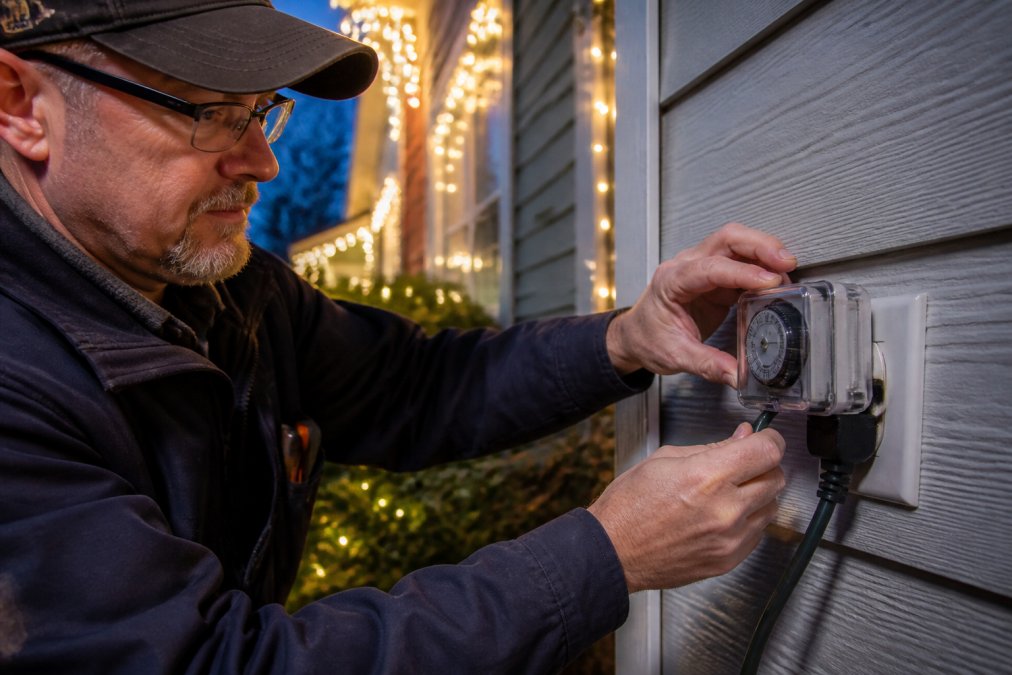
Plug the timer into the outlet. Do not use an extension cord between the outlet and timer, this creates a tripping hazard and complicates troubleshooting. The timer should connect directly to the outlet.
Ensure the outlet has proper grounding. A three-prong outlet with grounding provides the safest connection. Two-prong outlets lack grounding and create safety risks with outdoor electrical equipment. If your outdoor outlet is only two-prong, have an electrician upgrade it to three-prong with proper grounding.
Position your timer so it’s not sitting directly in standing water or exposed to heavy spray. While timers are weatherproof, they’re not designed for submersion. A slight overhang or protective positioning extends timer lifespan.
Programming and Testing
Once physically installed, program your timer according to its type. For mechanical timers, insert pins into the dial at your desired on and off times. For digital timers, follow the manufacturer’s instructions to enter your schedule through the control buttons.
Test your setup before relying on it for the season. Set the timer to turn on in 5 minutes and off in 10 minutes.
Safety Considerations for Outdoor Electrical Connections
Outdoor electrical work carries real safety risks. Understanding these hazards and how to mitigate them protects your property and your family.
Choosing Your Timer: Key Takeaways
Selecting the right outdoor holiday lighting timer requires balancing three core considerations: timer type (mechanical, digital, or dusk-to-dawn), weatherproofing standards (IP ratings and cold tolerance), and electrical capacity relative to your lighting load.
Frequently Asked Questions
What is the best timer for outdoor Christmas lights?
The best outdoor holiday lighting timer depends on your display size and convenience preference. For simple setups, a mechanical timer with dusk-to-dawn capability offers reliable, weatherproof operation without batteries or apps. For larger displays with multiple light strings, a digital programmable timer or smart plug provides flexibility to schedule different on/off times and integrates with home automation systems. Always verify the timer’s IP rating for moisture resistance and amperage capacity to match your total wattage requirements.
Are smart plugs better than traditional mechanical timers for holiday lights?
Smart plugs and mechanical timers serve different needs. Smart plugs offer remote control, scheduling through smartphone apps, and integration with existing smart home ecosystems, making them ideal for tech-forward users. Mechanical timers are simpler, require no batteries or Wi-Fi, and perform reliably in cold temperatures. For outdoor holiday lighting, mechanical timers are often preferred because they’re weatherproof by design and don’t depend on internet connectivity. Choose smart plugs if you want advanced automation; choose mechanical if you prioritize simplicity and cold-weather reliability.
What features should I look for in an outdoor holiday light timer?
Prioritize an IP rating of at least IP44 to ensure weatherproof protection against moisture and dust. Check the amperage capacity to confirm it handles your total light load without risk of short-circuit or overload. Look for cold temperature tolerance if you live in a climate with freezing winters. Dusk-to-dawn capability automatically adjusts to seasonal daylight changes. A countdown mode helps you set up quickly without manual calculation. Grounded outlet compatibility and GFCI protection add safety. If you prefer smart features, confirm app control and integration with your existing smart home ecosystem.
Can I use an indoor timer for outdoor holiday decorations?
No. Indoor timers lack the weatherproof rating needed for outdoor exposure. They don’t have the IP rating or moisture-resistant housing required to withstand rain, snow, and humidity. Using an indoor timer outdoors risks electrical failure, short-circuit, or safety hazards. Always use an outdoor-rated timer specifically designed for external conditions. Check the product packaging for an IP rating (typically IP44 or higher) and confirmation that it’s rated for outdoor use. Your installation’s safety and longevity depend on using the correct equipment.